Friday, 26 September 2008

Shenzhou-7 launches

China’s third manned space mission, Shenzhou-7, launched yesterday at 13:10 UTC with 3 taikonauts onboard. They are only staying in orbit for 68 hours, less than 3 days. The spacewalk will take place between the 29th and 30th orbits of Earth and last for around 20 minutes.

A trivia note is that this is the first Shenzhou with a toilet!

No toilet was on board of the previous two manned spaceships. The men had to wear diapers. But this time a toilet is set up. The toilet seat is tailor-made to the astronauts’ physiques and it also includes a separate urinal.

From Novosti Kosmonavtiki news №731:

26/9/2008/00:05 – Roskosmos believes China is not a competitor but a partner

China’s space program is not considered by Roskosmos as a competitor. “We do not see China as a competitor rather see it our partner in the exploration of outer space,” said Aleksander Vorobyov, the head of the Roscosmos press service on Thursday, commenting on the launch of China’s third manned spacecraft Shenzhou-7 with three cosmonauts.

He congratulated China on the successful launch, recalling that the Russian and Chinese space agencies are cooperating on a wide range of works, including the first EVA of Chinese astronauts into space. One of the spacesuits on the ship Shenzhou-7, was produced in Russia.

In the coming years, Russia and China will organize joint projects of the exploration of Mars and the Moon with automated spacecraft. The project “Phobos-Grunt”, whose main task is to deliver to Earth samples of soil Martian satellite Phobos, the Russian interplanetary station will carry a Chinese autonomous vehicle to carry out Martian research. In turn, Russian specialists are directly involved in the Chinese lunar research program (orbiting, photography, landing on the surface, sampling soil and delivering it to Earth).

26/9/2008/00:05 – Russia needs to reorient its space program to co-operate with China

Russia should think about strengthening its co-operation in space with China, said a member of the K.E. Tsiolkovskii Russian Academy of Space.

“Today we need to think about who are our key partners in space. Perhaps the time has come to switch our focus from the West to the East. Economic, technological and political centers are concentrated in the Asia-Pacific region, where a vigorously developing China, Japan and South Korea are located,” a Russian expert, Aleksandr Ionin, commented during the launch of the third manned Chinese spacecraft.

In this context, said A. Ionin, the decision to build a cosmodrome in the Far East from a strategic perspective is the right step. He called for increasing cooperation with China in space. “Our country, unlike the U.S., does not suffer the affliction of an ambitious world leader and is ready to engage in manned and unmanned space,” said A. Ionin.

According to him, launching China’s third manned spacecraft during the flight of which a taikonaut will attempt an EVA, “this is a big step for China, but a small accomplishment for the world of space. In today’s world, beginning of EVA, which the Soviet Union and the U.S. have carried out more than 40 years ago, is a normal activity,” said the expert.

A development for a protective Martian diet:

26/09/2008/00:05 – Cosmonauts going to Mars will drink “light water” during the flight

Cosmonauts on the interplanetary flights may drink “light water” – water from which has been removed the heavy hydrogen isotopes and oxygen and possessing positive biological side-effects, which in particular, provide protection from radiation, Russian scientists said.

As the professor of the Institute of Biomedical Problems Yurii Sinyak reported at the conference in Moscow, dedicated to the development of life-support system for space flights, studies showed that “light water”, where deuterium and heavy oxygen are absent or their content considerably lowered, on the contrary, possess a number of useful biological properties.

In the experiments at the IMBP it was shown that light water protects from radiation: mice that received a significant radiation dose, had the longer lifetime, if they drank light water.

Furthermore, the anti-carcinogenic properties of light water was discovered; experiments showed that it slows down an increase in some types of tumors.

In experiments on Japanese quail birds, those that drank light water had a higher weight.

Professor Yurii Sinyak noted that studies of water with the changed isotopic composition began from the study of melt water, which also possessed a number of useful properties. He expressed the opinion that these properties were connected precisely with its isotopic special features.

“We decided to completely remove deuterium and then to verify how it worked. Then they began to remove heavy oxygen. They decided to test on plants, then on animals and finally man, to explain its anti-carcinogenic and anti-radiation properties,” said the agency representative.

He explained that the anti-radiation properties of light water are especially important for space flights. “If we fly to Mars, there there is no shielding from magnetic belts (Earth is protected from the cosmic rays by its magnetic field); therefore the danger will considerably higher for cosmonauts. It is necessary to search for methods both chemical and mechanical to reduce such radiation exposure,” said the professor. At the same time he emphasized that “everything which in space is achieved, is applicable on the Earth.”

(Article also at the Russian Federal Space Agency site, in Russian: «Космонавты в полете на Марс будут пить легкую воду», 25/9/2008)

“The US Has No Option But To Use Russia’s Soyuz Craft”, RIAN/Space Daily, 23/9.

NASA administrator Michael Griffin has described extending the service life of the hopelessly outdated shuttles, costing an additional $4 billion, as a jihad. Hence, he believes, the first and most obvious likelihood is that there will be no American astronauts or cosmonauts from U.S. or international partners on the space station after December 31, 2011. Only Russians will be there, he said.

The American concern has not a leg to stand on: Russia has always been noted for the scrupulous observance of its commitments. It never broke them even during the Cold War. Still, it will not give free rides to the Americans. The problem needs to be solved before 2009: Russian ships have a two-year production cycle.

Russia does not yet believe that the Americans can quit a multi-billion dollar project and let down their European, Canadian and Japanese partners. What’s more, Griffin said the ISS’s life could be extended beyond the established deadline of 2015. He said the U.S. was committed to building and using the station for most of the next decade. He added that the ISS held the main niche in U.S. space policy over the coming years and that medical and biological research on it would contribute to future Moon and Mars expeditions.

Typical of the negative attitude of many towards such co-operation is this post at NASASpaceflight.com, from the generation who grew up during the worst of the Cold War. Perhaps when my generation and those following (born in the 1970s onwards) are in power this nonsense will fade into the past?

I am in my 38th year as an engineer, I have worked Apollo, Shuttle and part time with Constellation. I normally only comment about the orbiters on this fine website as there’s a heart warming amount of interested people. However for the first time in my career I am now considering immediate retirement.

This is related to the passing of the INKSNA waiver, because NASA, and the U.S. showed how weak we are to countries like Russia, Iran and anyone else who have little regard for us.

Led by Mike Griffin, and a number of gullible politicians, we have sacrificed not only our domestic manned launch capability, but we have roadblocked domestic options to bridge the gap, with no regard for national security.

Well, you only have yourselves (namely, clueless U.S. politicians) to blame!

The next time Russia invades an ally of the U.S. and we see lots of angry reaction from the elected few, turn off the television, because they are liars.

More accurately, “when Russia responded to the Georgian invasion of South Ossetia”, but who cares about the facts? And since when was Georgia such an important ally anyway?

We’ve just approved billions of tax payers dollars to be taken out of the pockets of hard working American engineers, and into the pockets of the regime in Moscow. I’m old enough to remember the Soviet threats to my family and myself and a leopard does not change its spots, as we have seen recently. The message is “invade as many of our allies as you wish, we’ll stamp and shout, but we’ll also happily keep writing checks. Feel free to tell us to sit down and be a good USA.”

Griffin will tell you Shuttle is at the risk of a 1/8 chance of a disaster: An insult to the hundreds of engineers who have worked tirelessly after Columbia, which was a FREAK accident, and people like myself who have worked hard after Challenger, which was a FREAK accident, to ensure over 100 safe missions. And you think Soyuz is safe? It nearly killed its crew on the last two landings.

Two “freak” accidents? Perhaps indicative of design flaws? The Soyuz isn’t 100% safe either, but the two off-nominal ballistic landings were back-up modes and they certainly did not “nearly kill” their crew (though they caused some discomfort).

I won’t bother to post a snarky reply in that thread as it will likely just get deleted.

Monday, 22 September 2008

Ballistic landings on Mars

“If I Were to Land on Mars...”, Air & Space Magazine, 1/11. Astronaut Don Pettitt’s account of the Soyuz ballistic landing he and Expedition 6 endured on 3 May 2003. He does note one positive aspect: the landings could be regarded as rehearsals for Mars landings!

So we had made a serendipitous discovery: Because of how the mission unfolded and culminated in a lost recovery, it had an uncanny resemblance to a trip to, and a landing on, Mars. We showed that barriers associated with such a trip, in the form of human physical performance deficits, can be overcome with the knowledge gained from the similar effects experienced on long-duration space station missions.

The parallels are striking. First we lived in a weightless environment for five and a half months. Depending on the choice of propulsion, six months is a good estimate for a one-way trip to Mars. So our level of deconditioning was about the same as that of a crew arriving at the Red Planet. We piloted our own spacecraft through a high-G entry maneuver, similar to what a crew may have to do at Mars. Our landing sequence involved a combination of parachutes and landing rockets, culminating in a hard landing on dry ground in one of the more remote places on Earth. For reaching the Martian surface, such a combination is an attractive option. And the landing site will be remote.

On our own, we performed a number of basic operational tasks not unlike those a crew might execute after landing on Mars, such as spacecraft safing, which involves reading procedures, flipping switches, and pushing buttons on the control panel to power down unneeded equipment to extend battery life for the radios. Since the Soyuz capsule ended up on its side, we did this strapped into a seat fixed to a slanted ceiling. We then opened the hatch by ourselves, unstrapped, and crawled out. In my spacesuit, I weighed 200 Earth pounds. On Mars, at 0.38 of Earth’s gravity, it would require over 500 Earth pounds to equal the same loading on my body. So while future Mars astronauts will wear heavier suits with life support systems, they will be lighter there than I was in Earth’s gravity. We deployed the survival gear that was scattered in numerous small bundles throughout the spacecraft. It takes a pair of strong hands to pull these bundles from their stowage in odd nooks and crannies – woolen clothes, food, water, a medical kit, a portable radio, and a flare-shooting pistol.

We performed all these operations with no outside help. We might as well have been on Mars.

“Opening The Window For Shenzhou 7”, SpaceDaily, 19/9. Shenzhou-7 is due to liftoff on 25 September. Zhai Zhigang will perform the EVA in an experimental Chinese-built suit, called “Feitian” after a mythological flying god; it weighs 120 kilograms, and each model will cost about 30 million yuan ($4.4 million) to produce. Liu Boming will wear a Russian Orlan suit to come to his rescue if necessary. Jing Haipeng will remain inside the pressurized Descent Module

“Russia And France Sign Contract To Launch 10 Rockets From Kourou”, RIAN/SpaceDaily, 22/9. The rockets will be Soyuz-ST carrier rockets used to launch geostationary satellites.

(Oh, and thanks to “FlyingSinger” for the nice post!)

Saturday, 13 September 2008

Hurricane havoc

Progress M-65 (30P) launched on 10/9 at 19:50:02 and was due to dock on 12/9, but this has been delayed until 17/9 due to Hurricane Ike forcing the evacuation of Houston Mission Control (and the rest of the city) – “Hurricane Ike disrupts traffic in space”, MSNBC.com, 12/9.

NASA has set up backup Mission Control teams for the space station near Austin, Texas, and in Huntsville, Ala. Yembrick said that the main Mission Control room in Houston is preferred to feather the space station’s U.S. solar arrays into an edge-on position to incoming spacecraft to avoid damage from thruster firings.

From orbit the hurricane looks deceptively calm and serene (ISS photos ISS017-E-015751 and ISS017-E-015752); like swirled cotton wool or whipped cream. NASA has a Hurricane Resource Page with updates, and the NASASpaceflight.com forum has a dedicated thread. The hurricane is a Category 2 and is very wide (nearly 1000 km across). The low-lying Texas coast means the storm surge will flood the region.

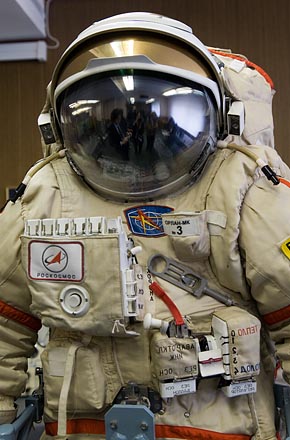
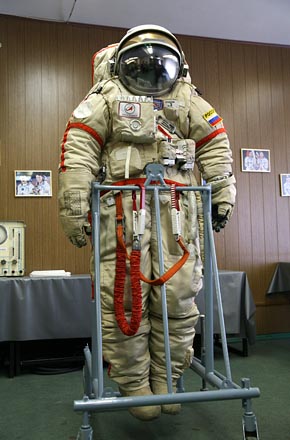
The Progress is carrying the first of the new Orlan-MK spacesuits, numbered 4; this is fitted with a digital computer in its life support backpack to process and transmit systems information, rather than the previous BRTA, БРТА radio-telemetry equipment. It will also indicate malfunctions and display the necessary recommendations to deal with these on a new special liquid crystal display (LCD) screen on the front chest part of the spacesuit. The Orlan-MK will be able to work in two modes: with the digital computer (as the MK) or without (as the previous M version).

Interesting tidbit: if a spacesuit’s serial number has a last even digit (2, 4, 6, etc.), then the spacesuit has blue stripes, if a last odd digit (1, 3, 5, etc.), then red stripes – a tradition of NPP Zvezda. (Via Anik) Thus Orlan-MK №4 has red stripes.

Some photo links of the spacesuits used for testing:

“Florida lawmaker opposes giving NASA permission to buy Russian spacecraft”, The Write Stuff, 12/9. If NASA loses its Russian/Soyuz access to space, the blame can be laid squarely upon cranky U.S. politicians! “Russia invaded Georgia” is somewhat more accurately phrased as “Russia responded to Georgia’s invasion of South Ossetia”.

Former astronaut LeRoy Chiao has a reasonably balanced blog post on the topic: “U.S.-Russian relations”, 31/8.

Prime Minister Putin signed a directive allocating 45 billion rubles ($1.8 bln) in additional funding for Russia’s space program. Funds will go firstly toward the construction of the new Russian spaceport, Vostochnii, in the Amur Region. Secondly will be ensured compliance with all the manned programs, which Russia exercises in the framework of international cooperation, taking into account all their commitments to the ISS. The third aspect is spacecraft, designed to enhance the effectiveness of Russia’s economy, such as meteorology, weather forecasting and scientific research.

Wednesday, 10 September 2008

Aleksei’s annus horribilis

Cosmonaut Aleksei Leonov is having a really bad year (annus horribilis). I am a bit confused about the sequence of events: in June he had to be resuscitated after having unspecified surgery. In August he developed pneumonia and this worsened, causing him to have a heart attack. He was given drug treatment in the clinic as the specialists were reluctant to operate because of his age (74), but his condition contined to worsen and he was operated on, in a procedure called a coronarography. One cause of his deterioration was his accidentally learning of the death of his 87-year-old sister, Raisa (his parents and 9 other siblings are deceased). Then to add insult to injury, his house near Star City was recently robbed! Details at the CollectSPACE forum here and here, and the Orbiter Forum.

“The Politics Of Shenzhou”, Space Daily, 8/9. The launch of the third Chinese manned space mission is due to take place between 25-30 September, carrying a crew of three.

Wednesday, 27 August 2008

Happy 50th Birthday, Sergei

Cosmonaut Sergei Krikalyov turns 50 today! С днём рожденья, Сергей! (Not that he ever reads this…) I wonder what he will achieve in his next half-century? Maybe be 1st on Mars!

From Novosti Kosmonavtiki news №724:

28/08/2008/00:09 – The President of Russia, D.A. Medvedev, congratulated the pilot-cosmonaut S.K. Krikalyov on his 50th birthday

On 27 August the President of Russia, Dmitrii Medvedev, congratulated pilot-astronaut and deputy chief designer of Rocket and Space Corporation Energiya, Sergei Krikalyov, on his 50th birthday.

“You are deservedly considered one of the record holders among cosmonauts for the total length of time spent in orbit,” Mr. Medvedev said in his telegram. “Your truly heroic biography is an outstanding example of courage, strength of will and firmness of character. Your competence, organisational talents and professional and personal qualities have earned the deserved respect of your colleagues and friends.”

From the Energiya website:

August 28, 2008. S.P.Korolyov RSC Energiya, Korolyov, Moscow region.

An S.P. Korolyov RSC Energiya deputy general designer, instructor-cosmonaut-tester, 1st Class, Hero of the Soviet Union and of the Russian Federation, Sergei Konstantinovich Krikalyov turned 50 on August 27, 2008.

The President of the Russian Federation D.A. Medvedev sent him a congratulatory telegram, which, among other things, says: “You are rightfully considered one of the record-breakers among active cosmonauts with regard to the total duration of your orbital missions. Your truly heroic biography became an outstanding example of courage, will-power and fortitude. Your competence, managerial ability, professional and personal qualities earned you a due respect of your colleagues and friends” (news on the web site of the Russian President www.kremlin.ru).

On this significant day, S.K. Krikalyov was congratulated by Governor of St.Petersburg V.I. Matvienko, heads of the Federal Space Agency, management and staff of the S.P. Korolyov Rocket and Space Corporation Energiya, representatives of various companies and organizations in the Russian space industry and Russian Academy of Sciences, including the Gagarin Cosmonaut Training Center, Head of the town of Korolyov A.F. Morozenko, S.P. Korolyov RSC Energiya cosmonaut team, NASA representatives, friends and colleagues.

Dear Sergei Konstantinovich!

The management and staff of the S.P. Korolyov Rocket and Space Corporation Energiya heartily congratulate you on this significant day of your 50th anniversary!

Upon graduating with honors from the Leningrad Mechanical Institute in 1981, you took a job with the world-known Korolyov’s company, where you have been working for more than a quarter of a century now, having risen through the ranks from an engineer to a deputy general designer.

You worked on developing manuals for cosmonauts, proposals on displaying operator’s data on consoles of the Mir space station, updating the on-board documentation of the Salyut-7 space station. You worked at the Mission Control Center during several long-term missions. After communication was lost with Salyut-7 in 1985, you, as a member of a “ground crew”, took part in developing various options for procedures of flying and docking with the uncontrollable space station. Afterwards, this operation was successfully performed for the first time in history! The same year you joined the team of cosmonauts of NPO Energiya. You were training yourself and were taking an active part in training cosmonauts at the Gagarin Cosmonaut Training Center and at Baikonur.

You have accomplished six space missions to the muti-modular space station Mir, the unique creation of the 20th century, and the International Space Station, an ambitious international project of the 21st century, during which hundreds of sessions of scientific and applied research experiments were carried out, providing invaluable results for Russian and world science. And your pictures taken in space are the envy of any professional photographer!

Special milestones in your career are the activities on the International Space Station. Three times you worked onboard the station, and each of these missions was unique in its own way. The first mission was the first manned mission under the International Space Station assembly program, in the course of which US Node 1 module was docked to the Functional Cargo Module Zarya. Together with Space Shuttle Commander R. Cabana, you were the first to open the hatch leading to ISS. The second mission was under the program of the first expedition to ISS (ISS-1). It started the continuous operation of the ISS. You were the first to make habitable the Service Module Zvezda and Functional Cargo Module Zarya, and, later on, the Laboratory Module Destiny, and started scientific research under Russian and US programs. In the third mission you set up the absolute world record for the total space flight endurance of 803 days, which remains unbroken by any other nation in the world!

For the courage and heroism displayed during your missions into space, you were given titles of the Hero of the Soviet Union and the Hero of the Russian Federation, and awarded both Russian and foreign orders and medals. You are an honorary citizen of St. Petersburg. Your energy, commitment and perseverance in achieving your goal, high professionalism and erudition, communication skills and kindness towards people earned you due respect among your Russian colleagues and foreign partners. Everybody also knows about your achievements in sports: you have learned to fly several types of airplanes, including a foreign airplane, and you won prizes several times at the USSR, Europe and world championships.

On this great day, dear Sergei Konstantinovich, please accept our heartfelt wishes of good health, happiness and prosperity to you and your relatives, of new creative successes and luck in the course of flight design tests and operation of the rocket and space hardware for the sake of strengthening the power and prosperity of Russia.

– President, General Designer V.A. Lopota

Sergei Krikalyov

(Photo via Energiya)

Sunday, 24 August 2008

Star City article

I’ve had a head cold since last week, so I haven’t felt much like doing anything. *Snuffle*

“Going to Space? First Stop: Eight Months of Grueling Training in Russia’s Star City”, Wired Magazine, September 2008. An overview of Star City, Звёздный Городок. A somewhat quirky overview of the place from the point-of-view of the space tourists training there.

Marina Driga, a military captain and press liaison, confides what some around Star City think of its high-profile trainees: “People say it is better to send monkey.”

“Mission Possible”, Anatoly Zak, Air & Space Magazine, 1/9. An overview of the Phobos-Grunt probe to be launched in 2009 (hopefully).

Tuesday, 12 August 2008

He started it!

Georgia’s pea-brained hothead of a president decided to provoke Russia by invading South Ossetia, this while the Olympics are on too. Naturally the Western media are siding with Saakashvilli, who has them well and truly conned (“Saakashvili as a propaganda phenomenon”, RIA Novosti). This thread at NASASpaceflight.com speculates whether the hostilites will affect the ISS partnership, seeing as the USA has sided with Georgia (whose military has been trained by U.S. forces). Though as one notes, the U.S. invasion of Iraq didn’t affect the partnership.

Some blog commentaries: Da Russophile (beginning from this entry); Saakashvilli’s War at Sean’s Russia Blog. The Western media is generally useless for anything approaching impartial reporting when regards to Russia (some exceptions: “Russo-Georgian conflict is not all Russia’s fault”, Christian Science Monitor; “Plucky little Georgia? No, the cold war reading won’t wash”, Guardian).

Saakashvilli - epic FAIL

Sunday, 3 August 2008

ISS medical training

Some information on the medical training cosmonauts receive for an ISS stay, from Novosti Kosmonavtiki news №719:

31/7/2008/12:30 – ISS commander and military pilot Sergei Volkov was trained for a new profession as the head physician

Sergei Volkov – ISS-17 commander and Lieutenant Colonel of the Russian Federation VVS (Air Force) – has for some time been trained for a new profession as the head physician of the Station. The more so because today in orbit is medical day. The official representative of TsUP (Moscow Mission Control Center), Valerii Lyndin, said, “Today the physicians are evaluating the physical fitness level of the of Russian cosmonauts on the treadmill, and Volkov is still developing critical skills for the medical operations.”

“Exercises are conducted with the cosmonaut on working with the onboard American medical equipment of which there is a lot onboard the Station,” explained Irina Alferova, the head of the TsUP Medical Group. According to her, NASA assigns a specialist in each expedition to be responsible for medicine and train them to use onboard equipment and to render aid to associates aboard. If there is a doctor in the composition of the crew – as there was, for example, in ISS-15, where Oleg Kotov had medical qualifications – that question is solved. But if the ISS crew only comprises pilots and engineers, then one of them is selected, who will, during the entire flight, fulfill the function of head physician and will periodically refresh his skills by training with the medical equipment.

Several times during the flight, training is conducted aboard to deal with a non-standard medical situation, which includes the additional training of crew for the use of equipment for the rendering of first aid. The NASA specialists assign to the cosmonauts a specific situation – for example, to remove a mote from the eye of an associate or to dress a wound – and they perform the function of physicians, using the multifunctional medical equipment existing onboard the ISS. “Through the Russian program we do not carry out such training, since we consider that our cosmonauts without this are wonderfully prepared and can render each other practical assistance,” emphasized Alferova.

“Before the flight, all Russian cosmonauts during the year pass a special course on medicine and obtain knowledge and habits, which correspond to a unfinished higher medical education.” Onboard the ISS there is all that is necessary for the rendering of first aid. Cosmonauts can give each other an electrocardiogram, take a blood analysis, or perform intravenous infusion. On the sudden stopping of heart of one of the crew members, their partner can use a defibrilator, which is located on the Station in a special medical case. There is on the ISS dentistry equipment, which includes the necessary tool for the treatment and the removal of teeth. “Truthfully, in the entire time of the operation of the Station, the dental tools have so far been not required, since before the flight the cosmonauts treat their teeth with a special composition of fluorine.”

“Can people live on Mars?”, RIA Novosti, 25/7. NASA’s Mars Science Laboratory (MSL) will carry some Russian equipment, the Russian Dynamic Albedo of Neutrons, or DAN. On a side note, when the New Horizons space probe reaches Pluto, NASA will have visited every planet in the solar system! Russia, in contrast, hasn’t done anything in unmanned spaceflight since the failed Mars-96 launch in 1996.

Russian President Dmitrii Medvedev declared 2011 the “Year of Russian Cosmonautics”. He could back that up with some funding for a manned Russian Mars mission! (Wishful thinking…)

Wednesday, 16 July 2008

EVA-20 completed

Sergei Volkov (EVA-1, Orlan #27, red stripes) and Oleg Kononenko (EV-2, Orlan #26, blue stripes) completed their second spacewalk. This was the originally-scheduled spacewalk for various tasks. The duration was 5h 54m (17:08-23:02 on 15 July). Reports:

Friday, 11 July 2008

ISS EVA-20a completed

“Phew! Spacewalkers remove explosive bolt”, MSNBC.com, 10/7. Sergei Volkov (EVA-1, Orlan #27, red stripes) and Oleg Kononenko (EV-2, Orlan #26, blue stripes) completed their first spacewalk to retrieve a suspected faulty pyro bolt from Soyuz TMA-12. The spacewalk lasted 6h 18m. More reports at NASA and this NASASpaceflight.com thread. Their next EVA is to take place on 15 July.

This blog entry regarded them as somewhat amateurish:

They fumbled and they stumbled, and wrestled with their space tools, but in the end, cosmonauts Oleg Kononenko and Sergei Volkov managed to cut through insulation and pull an explosive bolt from a Soyuz spacecraft parked at the International Space Station.

[…]

Nowhere near as polished as U.S.-trained spacewalkers, the Russians had problems finding their tools which were tethered to a special case and often tangled. At times the pair looked like a couple of amateur car mechanics with fishbowls on their heads, working with oven mitts, trying to change spark plugs with a spoon.

This was the first EVA for both; they also did not have extensive rehearsal training on Earth like the NASA Shuttle astronauts do. Russian EVA training tends to be more general, rather than focus on learning specific tasks like U.S. EVAs do (for Shuttle missions). The EVA was also somewhat unexpected (not initially scheduled). This item from Novosti Kosmonavtiki news №714 elaborates:

8/7/2008/09:28 – The ISS crew for the first time in the history of the Station conducted a second “general rehearsal” before going out in open space

A “general rehearsal” for the upcoming EVA will be held again today on the ISS. Sergei Volkov and Oleg Kononenko will hold a second so-called “dry run” in the Russian space suit Orlan-M for the EVA, scheduled for July 10, said Valerii Lyndin, the official representative of Moscow Mission Control Center. The first rehearsal was similar to that of June 26, he recalled.

The Russians dismantled ducts in the Pirs docking module from where they will step into space, then donned 130 kg Orlans and “take a walk” in them in the module. There is provision also for entrance to the docking compartment of the Soyuz attached to Pirs, in which the crew could return to Earth in case of emergency. In addition, the crew must test the system transition and living quarters.

On the ISS this is the first precedent of this prolonged and thorough preparation for an EVA; usually crew conducts one training session in their flight suits and one in the spacesuits. However, this time Volkov and Kononenko decided to twice practice abandoning the Station and entering the “lifeboat” in the Orlan-M spacesuits. The reasons for this are several. First, Volkov and Kononenko are novices; for them this is their first EVA. Certainly, they worked out in detail all EVA operations in the hydrolaboratory of the Zvezdni Gorodok/Star City; however, training on Earth is still not work in open space. Furthermore, this output is unplanned; the cosmonauts before the flight did not do extensive training for it. The novices have to inspect “the lifeboat” – the Soyuz spacecraft – and extract the cartridge, which the specialists consider the reason “for the disruption” to the ballistic descent of two previous expeditions – ISS-15 in October 2007 and ISS-16 in April this year. This is not a trivial task even for an experienced crew, since the Soyuz is not fitted with handrails unlike other ISS modules. And one additional difficulty: conditions are complicated by the unusual configuration of the Station, when the Soyuz spacecraft, which usually is docket to the end of the Russian segment, is “moored” to Pirs, from where cosmonauts exit into space. In the case of a contingency situation for Volkov and Kononenko, it is necessary for them to move directly into the Soyuz Orbital Module in their bulky spacesuits so they can, after removing their spacesuits, take their seats in the Descent Module of the Soyuz spacecraft vehicle, in which the third member of the ISS-17 crew – American Gregory Shamitoff – will already be waiting.

According to Lyndin, the only precedent for such operations before Volkov and Kononenko VKD are Russian Alexander Kaleri and NASA astronaut Michael Foale (ISS crew-9), but both had experience of several long-duration flights on the orbital complex Mir, and the ISS Station crew then consisted only of two people, so the cosmonauts did not have to worry about the safety of a third crew member.

After some comments (from the NASASpaceflight.com forum!), the blog author edited:

Many readers rightly point out (see the comments section) that this was the first spacewalk for these cosmonauts and that Russians don’t traditionally undergo the same level of highly choreographed EVA training as their U.S. counterparts. They also point out the spacewalk achieved its objectives and was a success. Agreed on all counts and important points. No disrespect was intended. Nevertheless, it was a markedly different experience from recent NASA spacewalks. – RB

More on cosmonaut training from NK news №214:

9/7/2008/00:09 – Russian cosmonauts will do parachute training in Siberia

The group of GCTC cosmonauts who are undergoing parachute training will be based in a separate helicopter regiment of the Siberian air force and air defense, said Lieutenant Vladimir Drik, temporarily Acting Assistant Commander of the Air Force, on Tuesday.

“The main program for the group, which will be prolonged to the middle of August, consists of jump training, which is part of a comprehensive training for the cosmonauts crews for work in space,” said Drik.

According to him, the special exercises for the training of cosmonauts, developed by domestic specialists, which are to be undertaken in just a few seconds of flight, make it possible to train for complex combined activities. During the exercises the instructors check the rapidity of reaction, the speed of decision-making of the cosmonauts and the clarity of their actions, specified the assistant Commander.

“During the jump the cosmonaut must be able to simultaneously keep track of many sources of information, and at the same time be prepared for any abnormal situations. Parachute jumping for the cosmonauts brings out the necessary qualities for spaceflight – concentration, attentiveness, courage,” said Drik.

“Will We Ever Reach Mars?”, RIAN/Space Daily, 7/7. Andrei Kislyakov opinion piece, mainly to do with the upcoming IMBP medical experiment (26/6 entry).