Showing posts with label rockets. Show all posts

Wednesday, 21 September 2011

Heavenly bodies

The cause of the Soyuz rocket crash last month was given as being due to a clogged fuel line leading to a gas generator, thought to be human error rather than a design flaw. (NASASpaceflight.com articles: 31/8, 15/9.) Crew launches on the Soyuz rocket have been delayed a little, and the next Progress launch (Progress M-13M/45P) is set for 30 October. Crew launches are on the Soyuz-FG, which has a modifed fuel injection system on the engines of the first and second stages, but it and the Soyuz-U have the same 11S510-PVB Blok-I third stage.

China is to launch the first module of its planned space station next week on a Long-March Ⅱ-F carrier rocket (MSNBC/Spacedaily articles). The module is called Tiangong 1, or “Heavenly Palace”. The module is to be used to practice rendezvous and docking, initially with the unmanned Shenzhou-8 that will be subsequently launched. If it is successful, it will be followed by Tiangong 2 and 3 space labs in a few years.

New Scientist magazine had an article about the support operations for the Mars-500 mission in its 17 September issue. (Text online here.)

The July and August issues of BIS Spaceflight magazine have a 2-part article on death in space. I am debating whether to buy the issues as the magazine is now quite expensive in Australia ($17) and hard to find. On browsing through the July issue in a newsagent, the first part was more speculation about various medical issues that might occur during a long spaceflight. A bit disappointing as I was hoping for an actual list of procedures from NASA, or whoever! The somewhat morbid topic has interested me for years, but there are no actual documents online, only occasional speculations on forums. I actually wrote out my own version of such a document in the style of other online ISS documents as part of a somewhat irreverent short story I did some years ago (“Houston, we have a corpse”) that included a space autopsy (“2001: a space autopsy” – I had some fun making up those headings :-):

Tuesday, 21 July 2009

Sergei on the Moon

Cosmonaut/Star City Chief Sergei Krikalyov is quoted in this article at MSNBC.com, “Russia still blue over moon landing”:

“Beginning with the first flight with a primitive capsule, and then getting to the moon, it was a great achievement for humanity,” Russian astronaut Sergei Krikalev said.

“Of course, we would have liked to see the first man on the moon be Soviet, Russian, but that’s life… Our own achievements were very many,” he told Associated Press Television News.

[…]

Russian space officials meanwhile still seem to be dreaming about winning the next stage of the space race. They keep talking in tantalizing terms about mounting a manned mission to Mars, although they say that would take at least another 20 years to get off the ground.

“I think this is fine. It’s like sports – at one stage one person wins, at another it’s somebody else,” said Krikalev.

I wonder if he will go into space again; in 2005 he said he would be willing to fly to the Moon if a program was developed.

“Soviet Top Secret Space Project Gets Second Life”, Roskosmos, 20/7. The NK-33 rocket engines used in the unsuccessful N-1 lunar rocket project are still quite advanced, and Russia and the USA are co-operating to make use of them.

Thursday, 17 January 2008

Mars over Moscow

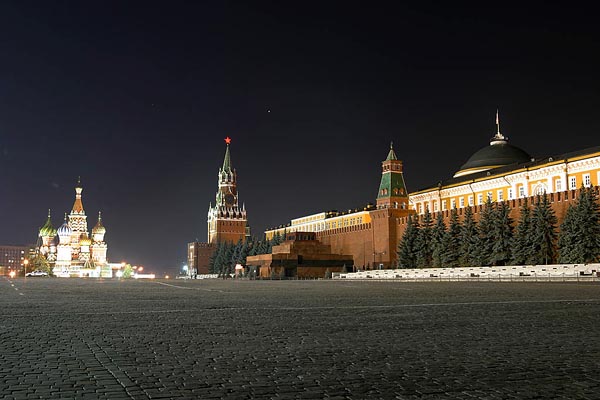
In this nicely symbolic photo by Seiji Yoshimoto at the NPO Intercos site, the red planet Mars is visible over the red star of the Kremlin! (Full photo page of Moscow scenes here – there are a lot of high-resolution photos on the one page.) Let’s hope that is a good omen! (As in landing there one day.)

From Novosti Kosmonavtiki news №677:

10/01/2008/00:02 – The cost of the Mars flight simulation experiment will exceed 15 million dollars

The total cost of the Russian project on the “Mars-500” flight simulation to the Red Planet, which will take place at the site of the Institute of Biomedical Problems (IMBP, Moscow), will exceed 15 million dollars, reported the project leader, the first deputy director of IMBP Victor Baranov. “If some additional expenditures appear, then general expenditures will be increased,” he added.

Among the first unplanned expenditures V. Baranov named was the elimination of some deficiencies and observations, that were revealed in the activities of the experimental complex during the daily technical experiment carried out during November. He also reported that the material reward of volunteers for the participation in the “Mars-500” experiment will compose 50 thousand Euros. This number was announced by the European space agency, which participates in the experiment. “We have an understanding with ESA that the payment for the Russian and European participants must not differ,” said V. Baranov.

He also did not exclude that the basic material reward of the highly professional participants will be above average. According to V. Baranov, there was also discussed the question of encouragement by rewarding those participants who carry out the experiment more honestly. “But this question will be linked with the personal contracts with each of the testers,” the Russian scientist specified.

The Mars flight simulation experiment will be prolonged more than 520 days – precisely this many days will be required in order to fly so far to the planet, to spend 30 days on its surface and then to return. All this time the six testers will be located in the isolated modules, fulfilling the functional duties of participants in the Martian expedition. Two participants in the experiment will be selected from ESA, which signed with the Institute of Biomedical Problems (IMBP) of RAN (Russian Academy of Science) an agreement on participating in the project. Four more will be selected by the IMBP specialists.

“Russia set to develop new launch vehicle despite problems”, RIAN, 11/1. The Angara rocket is supposed to launch from the «Восточный», Eastern space center, but the rocket has yet to be developed.

Tuesday, 18 September 2007

Russian space tourist?

Haven’t felt much like posting; just don’t feel much interested, so here is some collected news as remarked on in my other journal.

As-yet unconfirmed reports say that a Russian businessman-politician, Vladimir Gruzdev, looks set to be a space tourist in September 2008 or in 2009. I bet the cosmonauts won’t be happy about that! Especially those who have spent years waiting for their first flight (e.g. Dmitri Kondrat’ev – selected 1997, Oleg Kononenko – selected 1996, Roman Romanenko – selected 1997), only to have someone with loads of money “jump the queue”.

Energiya changed some of the links at their site, so I had to redo most of the links to them on my site (and blog), rather annoyingly! I think they are all working.

Cosmonaut Mikhail Kornienko climbed Mt. Kilimanjaro in Africa!

S.P. Korolev RSC Energia, Korolev, Moscow region. Cosmonaut tester of the S.P. Korolev Rocket and Space Corporation cosmonaut team Mikhail Borisovich Kornienko, upon his return to Moscow after climbing mountain Kilimanjaro (5895 meters high) as a member of a team of three mountaineers, was received by the Head of the Federal Space Agency A.N. Perminov.

M.B. Kornienko accomplished this climb while being on vacation. On the highest peak of Africa he left one copy of the Roskosmos commemorative badge and planted the flag of S.P. Korolev RSC Energia. The second copy of that badge that had been to the top of Kilimanjaro, M.B. Kornienko handed over to the Head of Roskosmos.

A.N. Perminov pointed out the high level of preparedness of the cosmonaut tester for working in extreme conditions, which allowed him, the only one of the whole team, to overcome the difficulties of the climb in its final phase.

Russian Federal Space Agency: Космонавт вышел на «малую» орбиту – покорил Килиманджаро (Cosmonaut has reached a “small” orbit – he conquered Kilimanjaro).

A Russian Proton-M rocket with a Japanese satellite onboard crashed on launch on 9/9.

“Russia To Get A New Space Port”, RIAN/SpaceDaily, 11/9.

On the last day of summer, the Russian Space Agency made a sensational announcement. Its head Anatoly Perminov painted an epic picture of Russia’s immediate future in space, specifically its manned part. A week and a half ago, during a final news conference with journalists at the MAKS-2007 International Air Show, to the surprise of many, he spoke modestly about the evolutionary path to be taken by the space industry. “Our primary objective,” he said, “is to stick to existing reliable systems already used in manned flights.” Evidently they found the air show to be the wrong place to disclose the Agency’s truly revolutionary ambitions.

“Female commanders set for landmark mission”, MSNBC.com, 13/9. Two female NASA astronauts will command the ISS (Peggy Whitson) and Space Shuttle (Pamela Melroy, STS-120 Discovery) next month. No Russian woman has been in space since Elena Kondakova in 1997, and none will for a few years yet (assuming the only current female cosmonaut, Elena Serova, successfully completes her candidate training). Russia are now dismayingly far behind in this area.

A Soyuz-U rocket successfully launched yesterday with an unmanned Foton spacecraft carrying various experiments (listed in Russian and English at the FKA site). Some fish and Mongolian gerbils (small rodents) are getting a ride into space as part of the experiments. A space tether experiment will also be performed (James Oberg’s comments about it at FPSpace).

“Mice and men: space gerbils blaze trail for humans to Mars”, Space Daily, 14/9. More on the gerbils getting their first and only spaceflight; unfortunately some of the hapless creatures will be dissected after landing. (A brief RIA Novosti news item on the creatures the Foton is carrying.)

From Novosti Kosmonavtiki news №653:

18/9/2007/00:01: Russian manned spacecraft will fly to Mars, possibly in 2020, Aleksandr Kaleri thinks

A Russian spacecraft with the crew aboard will fly to Mars, possibly in 2020. About this stated the chief of the flying space center of company Energiya, airman-cosmonaut Aleksandr Kaleri, at the All-Russian astronomical conference the “Space Boundaries of the 21st Century”, that was opened on 17 September in Kazan. “The flight duration will be two years with a one-month stay on Mars,” noted the cosmonaut. It is assumed that aboard the ship with a weight of up to 600 tons will fly the crew of 4-6 people. To put this ship immediately into orbit is impossible, therefore they will assemble it in orbit from the modules, said Kaleri.

According to him, the dimensions of modules and subsistence maintenance system are developed, the methods of creating the large constructions now are selected: so the length of each of two solar batteries will compose 700 meters. Studies with respect to the guarantee of reliability of flight are conducted. For example, for the protection from the solar radiation it is proposed the walls of crew quarters for the cosmonauts are to be filled with inert gas.

According to the most optimistic forecasts, the flights will begin in 2020, with the most pessimistic beginning in 2025. In the first flight only the circling around the “red planet” will be undertaken. The second flight will carry a full-scale landing module, but also without the embarkation of cosmonauts. And only in the third flight half of the crew will land on the planet, the cosmonaut concluded.

(Russian version, Русская версия)