Showing posts with label spacesuits. Show all posts

Saturday, 13 February 2010

Mars-500 spacesuits tested

From NK №836, rough computer translations of two Mars-related news items. First, a manned Mars mission is not in current Russian plans, disappointingly. I would like to see one happen before 2020! Hopefully before China or other countries send a mission there.

11/02/2010/00:05 – A piloted flight to Mars is not yet included in Russian Space Department plans

A piloted flight to Mars is not included in the upcoming plans of the Russian Space Department and is not included in the space program of Russia, the head of department Anatoly Perminov said Wednesday on air at the radio station “Voice of Russia”.

“In the foreseeable future no flights to Mars are planned. New modern or future systems of power impellent installations are for this purpose necessary; as well as these, there may also be nuclear installations developed,” Perminov noted.

For a performance of such flight, he considers it necessary at first to solve a number of scientific problems. “The ground experiment Mars-500 will soon begin, and a number of the European countries are actively participating in it.”

For a flight to the Red planet, according to Perminov, new power impellent installations will be required.

“Perhaps, these will be nuclear installations. Are we working on this? Yes. There are no secrets. Because the president of our country has set us this task. In one of programs there is development of power impellent nuclear installation. With its help it will be already possible in the future to reach Mars in under a year and and a half, and in the shortest possible time,” Perminov stated.

The head of the Russian Space Department has also confirmed the readiness of the Russian Space Department to co-operate from NASA in developing such systems. “It would be desirable, that such large-scale projects were international, with faster results, and lessening costs. We are ready to co -operate. If for some reasons it does not turn out, we will develop in parallel,” Perminov said.

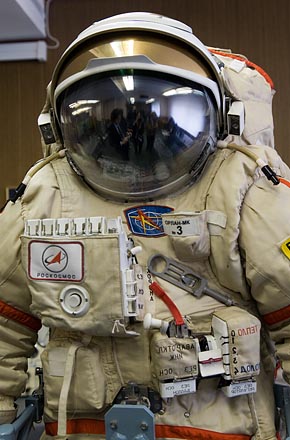
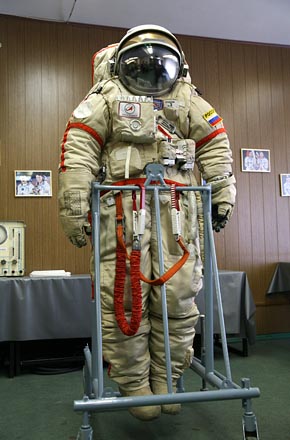
The spacesuits for Mars-500 are modified/recycled Orlan-DMA suits, an older version of the current Orlan-MK used in orbit on the ISS. They were successfully tested. There is a gallery at the Mars-500 site from early last year of a spacesuit being tested.

12/02/2010/00:05 – “Marsonauts” from experiment “Mars-500” will work on the surface of the Red Planet using Russian lunar tools

In the research-and-production enterprise NPP Zvezda situated near Moscow on Wednesday has passed a control “run” of a new spacesuit which will be involved in the “Mars-500” experiment, simulating a piloted flight to Mars.

Two testers for NPP Zvezda worked for hours in spacesuits on a surface imitating that of the Red Planet, carrying out various manipulations with special tools. One of the “marsonauts” broke up large chunks of rock, and then using the probe would pick up wooden blocks, simulating pieces of Martian soil, and put them in a pouch hanging from her utility belt. Another “pioneer” scooped up sand with a small shovel (the sand imitating loose soil) and dumped it in a special container.

“These tools were developed in the 60 years of the last century for a national lunar program,” explained one of the leaders of the Soviet lunar program from RSC Energiya, Oleg Tsygankov. After the program was canceled, the miraculously preserved instruments can now be used in the experiments on the preparation of manned flights to other planets, he said.

After collecting rocks, the space travelers imitated Michael Jackson’s famous moonwalk in their spacesuits and dropped to one knee, like a knight offering his hands and heart to his lady.

“The spacesuits are based on the old Orlan-DMA Russian suit,” which is different from the new Orlans which the ISS crews wear in space,” the chief of department NPP Zvezda, Gennadii Shchavelev, said. First of all, they are smaller in size: length and chest. As well, they weigh only 30 kg – four times less than the zero-g Orlans – as the testers on Earth are not helped by weightlessness. One more difference: the Orlans have a self-contained life-support system, while in the “Martian” spacesuits, air for cosmonauts moves through long hoses from special compressors.

The colour of the new “suits” is unusual also - unlike the white Orlans, their “Martian” colleagues are made of a brilliant peach-coloured fabric. “We could not decide on a color for the new spacesuits,” designer Galina Borisova said. “We looked at many fabrics – blue, steel, dark blue – but eventually settled on this color that is harmonious with the reddish Martian surface.”

“The spacesuits behaved impeccably, all systems functioned normally, no improvements are not required,” Shchavelev summed up the test run.

After drying, the “Martian” spacesuits will go to the warehouse, and then, after a fitting with the selected Mars-500 crew, the suits will be transferred to the “Martian spacecraft”, situated in the Institute of Biomedical Problems of RAS, which in April will begin the 520-day experiment.

Monday, 8 June 2009

First Orlan-MK EVA

Gennadii Padalka (EV1, Orlan-MK №5, red stripes) and Michael Barratt (EV2, Orlan-MK №6, blue stripes) performed the first EVA in the new spacesuits on 5/6 for 4h 54m (07:52-12:46 UTC). The spacewalk was successful, aside from an initial delay caused by a faulty sensor reading saying there was excess CO2.
Esther Dyson, Space Tourist in Training”, IEEE Spectrum, June 2006. Interview with the backup for space tourist Charles Simonyi.
A novel way of protecting ISS occupants from radiation is to use damp napkins! From NK №784:

22/05/2009/00:05 – Damp napkins will reduce the risk of adverse effects of space radiation

A special screen, which will serve as additional protection against radiation for the crews of the ISS, should appear on board the Station in early 2010.
“We have been successfully producing prototype draft-screen curtains and by the end of this year, the Rocket and Space Corporation Energiya specialists will put the product in a Progress cargo ship to be launched to the ISS in early 2010,” said Vyacheslav Shurshakov, Head of the Laboratory at the Institute of Biomedical Problems, part of the Russian Academy of Sciences, where the screen was developed.
The screen is equipped with curtain-pockets, in which will be inserted plastic packaging with wet towels used for personal hygiene and cleaning crews of the station.
The packaged napkins are impregnated with a material containing hydrogen, carbon and nitrogen, which effectively weaken the cosmic radiation, the scientist explained. Sensors are installed outside and inside the curtains to monitor radiation doses.
Additional protection for the ISS crew is provided by securing three layers of polyethylene packaging with wet towels on the walls of the cabin which, in the opinion of scientists, will further reduce the risk of the adverse effects of space radiation.
According to Shurshakova, the first results of the “Matryoshka”, «Матрешка» experiment on the ISS showed that the dose of radiation received by the vital organs decreases almost twice when you remove the person from the walls of the station to its center. “The Matryoshka-R with sensors installed on the ISS will allow us to test the effectiveness of the radiation protection provided by the sanitary napkins delivered to the Station,” he said.
It is anticipated that the experimental screens will be fitted in the cabins of the ISS Service Module Zvezda. If the effectiveness of the new protection is confirmed, future orbital stations and interplanetary ships will be equipped with similar screens.
The sanitary napkins can be used not only for radiation protection, but also to reduce noise in the cabin from constantly-operating machinery and devices, added the scientist.
The Phantom Torso Returns”, Space Daily, 28/5, has more about the Matryoshka experiment.
The Kazbek-UM seats in the Soyuz are to be made reusable:

26/05/2009/00:05 – Seats for the Soyuz Russian spaceships will be made reusable

The Research-and-production enterprise (NPP) Zvezda is working on prolonging the life of the Kazbek seat. “Whereas it was previously a single-use device, in connection with the increase in the number of manned launches a series of modifications is being made in order to enable its re-use,” said an interlocutor in the Russian space industry.
According to him, after the return of the ship from orbit, the seats will be returned to NPP Zvezda to evaluate their condition. Specialists will do a range of repair work, after which the seats can be used repeatedly.
The speaker recalled that the last major change in the design of the Kazbek seats were made during the development of the Soyuz TMA variant, calculated for the flight to the International Space Station of both Russian and American astronauts.
The requirements of the anthropometric parameters of NASA astronauts were greater than for the selection of cosmonauts in Russia [in other words, the Americans were better-fed :-)]
. In order to accommodate the Americans in the Soyuz, the seats had to be lengthened and increased in size, explained the interlocutor.
The Kazbek seat allows a cosmonaut to endure g-forces during launch and re-entry into the atmosphere, cushioning the blow when the Descent Module hits the ground.

Saturday, 9 May 2009

Future Russian spacesuit

A selection of items from Novosti Kosmonavtiki №781, including details of the spacesuit to follow the Orlan-MK: the Orlan-MKS.

08/05/2009/00:05 – Cosmonaut Romanenko is happy with the new Orlan-MK spacesuit

Hereditary Russian cosmonaut Roman Romanenko, flight engineer of the ISS-20/21 crew, was satisfied with NPP Zvezda’s new computerized spacesuit Orlan-MK while training in it in the Hydrolab at the Gagarin Cosmonaut Training Center.

“It is different from the previous model – in fact, somewhere in between the American EMU and Russian Orlan-M.” The main innovation is its full computerization – the suit itself “suggests” actions for the cosmonaut to take in case of emergencies. It is important that the computer tips can be disabled if you want; the cosmonaut himself can decide which mode of operation is preferable,” said Romanenko at a preflight press conference on Thursday at the Gagarin Cosmonaut Training Center.

07/05/2009/00:05 Participants in the Mars-105 experiment have been “in flight” already more than a month

The participants in the 105-day scientific experiment in which a flight to Mars is being simulated, have been in ground “Mars flight” already more than a month, said the Institute of Biomedical Problems, Russian Academy of Sciences.

“A third path shall be taken. The six testers ‘fly’ on. The most difficult stage is behind us: the creation of this team,” said the representative of the Russian Academy of Sciences IMBP, Paul Morgunov.

According to him, despite the fact that the crew was formed and tested in advance, the work in isolation brought about changes. “But the scientists were lucky: the crew harmonized. According to the reports of the participants, time dragged slowly at first, but now they are accustomed to, and have not even noticed as more than a month has passed in “flight”.

“Scientific data, and material already has been gathered for the next flight to Mars, but the most complex experiments are yet to come,” said the IMBP representative.

07.05.2009 / 00:05 In 2012, Russian cosmonauts will have a new survival suit

A new Russian survival suit for work in free space will be created in a few years, Sergei Pozdnyakov, the general director and the main designer of the research and production enterprise (NPP) Zvezda, said. “The first models will appear in 2012, and the definitive variant should be ready by 2015,” he said.

According to S. Pozdnyakov, the following series of survival suits will be called “Orlan-MKS” (modified, with a computer and a synthetic cover – модифицированный, с компьютером и синтетической оболочкой). For the survival suit’s cover, polyurethane will be used instead of rubber. “Polyurethane is a very reliable and durable material. Its structure is such, that even when damaged by a sharp object, the material does not tear open. Such reliability will allow us to use a double cover for modern survival suits, to make the new Orlan more mobile and comfortable,” he explained.

Use of the new cover will positively affect the survival suit’s service life. This will increase from 4-5 years to 6-7. At the same time the quantity of exits in which it will be possible to use the new Orlan will be increased. “The Orlan-M is calculated to last for 12 extravehicular activity of a duration of about 6 hours, the Orlan-MK for 15 EVAs, and the Orlan-MKS for 20 EVAs,” noted S. Pozdnyakov.

07/05/2009/00:05 – Cosmonauts of the new Russian spaceship Rus’ will not wear survival suits, being placed in tight capsules

In the new Russian piloted ship Rus’, «Русь», whose design outline is planned to be finished next year, instead of flight survival suits there may be individual tight capsules.

“There are ideas to place cosmonauts who do not take part in piloting the ship, in tight capsules instead of survival suits. The cosmonaut enters into such capsule, closes the hatch and sits in it like an egg at the dangerous stages of flight,” the general director and the main designer of the research and production enterprise Zvezda, Sergei Pozdnyakov, said.

However this is only an idea. As often in reality, this idea will become clear after requirements for the systems of protection and life-support of the new ship’s crew arrive at NPP Zvezda. “We wait for the initial data on the ship: the sizes, parametres of overloads, time of flight in case of cabin depressurization,” S. Pozdnjakov said.

The general director of the enterprise hopes that NPP Zvezda, together with Rocket & Space Corporation Energiya, will work together on designing new seats, a life-support system and waste-disposal for the ship.

07/05/2009/00:05 – A survival suit for work on the Moon’s surface can be created in a short time, says the General Director of NPP Zvezda

The Russian Orlan spacesuit, in which the Russian astronauts go into outer space, can, with little refinement, be used for walking on the moon. “We should start thinking now about creating the suit to work on the lunar surface. In principle, we can create a suit based on the Orlan – which, in turn, evolved from the Krechet spacesuit created for a Soviet lunar expedition,” said Sergei Pozdnyakov, Сергей Поздняков, the director and chief designer of the Scientific-Production Enterprise Zvezda. As he said, for a cosmonaut to work in the Orlan on the Moon, the design of the foot coverings needs to be changed.

“If such a task is assigned to us, we are ready to execute it quickly,” noted S. Pozdnyakov. According to him, for a cosmonaut to work in the Orlan on the Moon, the design of the shell toe needs to be changed.

New dinner table top priority as ISS expands”, Space Daily, 7/5. An ISS crew of 6 means a new dinner table will need to be constructed.

Friday, 8 May 2009

Orlan for Mars on Earth

On the IMBP Mars-500 site there is a photo gallery showing a modified Orlan spacesuit to be used by the participants when they do their simulated excursion onto the Mars surface. I am curious as to what spacesuit designs Russia is planning to use for future Mars missions – the spacesuit will need to be worn in ⅓ Earth gravity, so the current Orlan won’t be suitable as it weighs 120 kg. I can’t find any information online about this, though!

How Diverting! The Entertainment Aboard the Space Station”, Popvox blog, 5/5. A year ago, NASA Watch made a Freedom of Information request to NASA for a list of films on the ISS, and this PDF (1.8 MB) was the result, listing films and books (mostly from the USA side – the only Russian film mentioned is Хочу в Тюрму). The list has undoubtedly been added to by then. (Annoyingly, the list was scanned in as images, so I do not feel like typing them all out!)

Off topic: Rather oddly, I received an email from Blogger saying my blog had been identified as a potential spam blog! So if the blog has been inaccessible, that’s the reason! (I have already responded to the request to verify it, and the blog seems to have been approved.) Wonder what triggered that alert? There’s certainly nothing offensive on the blog (it’s G-rated!), though I do have a lot of links – but that’s necessary to comment on news articles and such.

Saturday, 18 April 2009

Cosmonaut recruiting changes

US Astronauts will Learn Russian. Talent for Science will Take High Priority in Russian Cosmonaut Selection”, Roskosmos, 15/4. NASA astronauts will be required to learn Russian and study the Soyuz spacecraft as this will be their only means of transport to the ISS after the Space Shuttle is retired (and there is much controversy over that!). Also, when recruiting future cosmonauts, those who are researchers will be more emphasized:

Selection process of the future cosmonauts is intended to be based on their abilities to implement scientific and research programs. The Commission also discussed additional recruitment of test cosmonauts and research cosmonauts in 2009 for the ISS program (until 2015). The meeting was led by Roscosmos Head Anatoly Perminov, chairman of the Inter-Agency Commission.

A.N. Perminov proposed to introduce some changes into the Commission Protocol. He stated that “not only pilots, but researchers from the universities shall be hired to become cosmonauts”. The main emphasis should be made on the talented young people, who study prospective scientific topics. These people would continue their work during the space mission, and after it.

Baikonur: Progress M-02M Prelaunch Operations”, Roskosmos, 16/4. This features some photos of the Orlan-MK spacesuit (№6) being tested at Baikonur; it is to be launched on the next Progress cargo ship.

Wednesday, 31 December 2008

New NASA Columbia report

NASA has released a Columbia Crew Survival Investigation Report (16.2 MB PDF – press release page) featuring a detailed description of the sequence of events for the crew and orbiter during its breakup. A summary from the report is below:

1.1.1 Events with lethal potential

There were five events identified with lethal potential to the crew.

  1. The first event with lethal potential was depressurization of the crew module, which started at or shortly after orbiter breakup.The majority of the SCSIIT findings related to the first lethal event were connected to the operational incompatibilities of the advanced crew escape suit (ACES) with the orbiter. The launch and entry suit was added in response to the Challenger accident, rather than as a part of the original vehicle design. The ACES was the successor to that suit. The suit protects the crew in many scenarios; however, there are several areas where integration difficulties diminish the capability of the suit to protect the crew. Integration issues include: the crew cannot keep their visors down throughout entry because doing so results in high oxygen concentrations in the cabin; gloves can inhibit the performance of nominal tasks; and the cabin stow/deorbit preparation timeframe is so busy that sometimes crew members do not have enough time to complete suit-related steps prior to atmospheric entry.

    As Columbia entered the atmosphere, one crew member was not yet wearing the ACES helmet and three crew members were not wearing gloves. Per nominal procedures, the crew wearing helmets had visors up. There was a period of about 40 seconds after the orbiter loss of control (LOC) but prior to depressurization when the crew was conscious and capable of action. Part of this short timeframe was undoubtedly employed in recognizing that a problem existed, as the indications of LOC developed gradually. The crew members could have closed their visors in this timeframe but did not. The SCSIIT attributed this to the training regimen, which separates vehicle systems training from emergency egress training and does not emphasize the transition between problem resolution and a survival situation. Once the cabin depressurization began, the rate of depressurization incapacitated the crew so quickly that even those crew members who had fully donned the ACES did not have time to lower their visors. Although circulatory systems functioned for a brief time, the crew could not have regained consciousness upon descent to lower altitudes due to the effects of the depressurization.

  2. The second event with lethal potential was unconscious or deceased crew members exposed to a dynamic rotating load environment with nonconformal helmets and a lack of upper body restraint. The orbiter lost control, probably when the hydraulic systems failed due to hot gas intrusion in the left wing. The resulting motion was not lethal but did require bracing by the crew. The forebody (crew module and forward fuselage) eventually separated and the crew module lost pressure at orbiter break- up. When it separated, the forebody began a multi-axis rotation at approximately 0.1 revolution/second. Loads due to deceleration significantly decreased at the moment of breakup due to the change in ballistic number, but began to climb as the forebody continued to decelerate.

    After the crew module depressurized and the crew lost consciousness, the seat inertial reel mechanisms failed to lock despite the off-nominal motion. The reels were not defective; they were simply not designed to lock under the conditions the forebody experienced. The upper harness straps failed at some point prior to the forebody breakup, causing the straps to recoil back into the inertial reel mech- anism. Because the reel mechanisms did not lock, the unconscious or deceased crew members were exposed to cyclical rotational motion while their upper bodies were inadequately restrained. Helmets that did not conform to the head and the lack of upper body restraint resulted in injuries and lethal trauma.

  3. The third event with lethal potential was separation from the crew module and the seats with associated forces, material interactions, and thermal consequences. This event is the least understood due to limitations in current knowledge of mechanisms at this Mach number and altitude. Seat restraints played a role in the lethality of this event. The breakup of the crew module and resultant exposure of the crew to entry conditions was an extremely significant event but was very difficult to characterize since many related events occurred in a short period of time. The consequences of exposure to entry conditions included traumatic injury related to seat restraints, high loads associated with deceleration due to a change in ballistic number, aero- dynamic loads, and thermal events. All crew were deceased before, or by the end of, this event. The ACES has no performance requirements for occupant protection from thermal events and may not provide adequate protection even for egress scenarios involving heat and flames. There is no known complete protection from the breakup event except to prevent its occurrence.
  4. The fourth event with lethal potential was exposure to near vacuum, aerodynamic accelerations, and cold temperatures. The ACES system is certified to operate at a maximum altitude of 100,000 feet, and certified to survive exposure to a maximum velocity of 560 knots equivalent air speed. The operating envelope of the orbiter is much greater than this. The actual maximum protection environment for the ACES is not known.
  5. The final event with lethal potential was ground impact. The ACES system provides protection from ground impact with a parachute system. The current parachute system requires manual action by a crew member to activate the opening sequence.

There are some “Redacted” sections; presumably containing details about the crew’s remains that the report authors didn’t want to be made public. There were reports of body parts found scattered over the landscape (sorry, this brings out my inner ghoul):

Reports of body parts being found started coming in Saturday night as emergency workers and residents searched hundreds of square miles of Texas and Louisiana for bits of what once was space shuttle Columbia.

In Hemphill, near the Louisiana state line, hospital employee Mike Gibbs reported finding what appeared to be a charred torso, thigh bone and skull on a rural road near what was believed to be other debris. Billy Smith, an emergency coordinator for three East Texas counties, confirmed the find.

“I wouldn’t want anybody seeing what I saw,” Gibbs said. “It was pretty gruesome.”

On a farm not far away, two young boys found a charred human leg, The Dallas Morning News reported Sunday. “From the hip to the foot, it’s all there, scorched from the fire,” said their father, Bob White.

I wonder if the bodies broke up during re-entry or on impact? Human bodies aren’t designed for high-g forces, as innumerable airplane crashes have demonstrated. [According to Dad, bodies that are found in pieces mean they have been shredded when in a fragmenting aircraft in the air; if not they turn into a “blob of jelly” when they impact the ground and all the bones shatter. So that’s some trivia you probably didn’t want to know.]

On a more cheerful note, Expedition 18 completed a spacewalk last week on 23 December wearing Russian Orlan spacesuits. Yurii Lonchakov (EV1, Orlan-M №26) and Michael Fincke (EV2, Orlan-M №27) were outside for 5h 38m (00:51-06:29 UTC). Reports: ISS Daily Report, NASA.

A random observation: I visit various spaceflight forums (see my links list) and it is rare to encounter other females! I don’t know why that is, as there are plenty of women in the aerospace industry (at least there are in the USA and Europe). (I did have a chance to begin a career in the industry a long time ago, but as with so much of my life, I botched that chance.)

Friday, 21 November 2008

10 years of the ISS

Nations Around the World Mark 10th Anniversary of International Space Station”, NASA, 17/11. 20 November marked 10 years since the first element of the International Space Station, the Zarya Functional Cargo Block («Заря» ФГБ, Функционально Грузовой Блок, Funktsional’no Gruzovoi Blok). James Oberg also provides an overview: “What a trip! Space station turns 10”, MSNBC, 20/11.

Buran – the Soviet ‘space shuttle’ ”, BBC News, 20/11. Article by Anatoly Zak of RussianSpaceWeb.com.

A new version of the Russian Orlan spacesuit, the Orlan-MK, was delivered to the ISS in September 2008 on Progress M-65 (Orlan-MK №1170004, blue stripes). Two more will be delivered in 2009: Orlan №005 (red stripes) on Progress M-66, and №006 (blue stripes) on Progress M-02M. As with previous Orlans, NPO Zvezda are the designers and makers of the MK. I have a page on my website about it.

Saturday, 13 September 2008

Hurricane havoc

Progress M-65 (30P) launched on 10/9 at 19:50:02 and was due to dock on 12/9, but this has been delayed until 17/9 due to Hurricane Ike forcing the evacuation of Houston Mission Control (and the rest of the city) – “Hurricane Ike disrupts traffic in space”, MSNBC.com, 12/9.

NASA has set up backup Mission Control teams for the space station near Austin, Texas, and in Huntsville, Ala. Yembrick said that the main Mission Control room in Houston is preferred to feather the space station’s U.S. solar arrays into an edge-on position to incoming spacecraft to avoid damage from thruster firings.

From orbit the hurricane looks deceptively calm and serene (ISS photos ISS017-E-015751 and ISS017-E-015752); like swirled cotton wool or whipped cream. NASA has a Hurricane Resource Page with updates, and the NASASpaceflight.com forum has a dedicated thread. The hurricane is a Category 2 and is very wide (nearly 1000 km across). The low-lying Texas coast means the storm surge will flood the region.

The Progress is carrying the first of the new Orlan-MK spacesuits, numbered 4; this is fitted with a digital computer in its life support backpack to process and transmit systems information, rather than the previous BRTA, БРТА radio-telemetry equipment. It will also indicate malfunctions and display the necessary recommendations to deal with these on a new special liquid crystal display (LCD) screen on the front chest part of the spacesuit. The Orlan-MK will be able to work in two modes: with the digital computer (as the MK) or without (as the previous M version).

Interesting tidbit: if a spacesuit’s serial number has a last even digit (2, 4, 6, etc.), then the spacesuit has blue stripes, if a last odd digit (1, 3, 5, etc.), then red stripes – a tradition of NPP Zvezda. (Via Anik) Thus Orlan-MK №4 has red stripes.

Some photo links of the spacesuits used for testing:

Florida lawmaker opposes giving NASA permission to buy Russian spacecraft”, The Write Stuff, 12/9. If NASA loses its Russian/Soyuz access to space, the blame can be laid squarely upon cranky U.S. politicians! “Russia invaded Georgia” is somewhat more accurately phrased as “Russia responded to Georgia’s invasion of South Ossetia”.

Former astronaut LeRoy Chiao has a reasonably balanced blog post on the topic: “U.S.-Russian relations”, 31/8.

Prime Minister Putin signed a directive allocating 45 billion rubles ($1.8 bln) in additional funding for Russia’s space program. Funds will go firstly toward the construction of the new Russian spaceport, Vostochnii, in the Amur Region. Secondly will be ensured compliance with all the manned programs, which Russia exercises in the framework of international cooperation, taking into account all their commitments to the ISS. The third aspect is spacecraft, designed to enhance the effectiveness of Russia’s economy, such as meteorology, weather forecasting and scientific research.

Wednesday, 16 July 2008

EVA-20 completed

Sergei Volkov (EVA-1, Orlan #27, red stripes) and Oleg Kononenko (EV-2, Orlan #26, blue stripes) completed their second spacewalk. This was the originally-scheduled spacewalk for various tasks. The duration was 5h 54m (17:08-23:02 on 15 July). Reports:

Friday, 11 July 2008

ISS EVA-20a completed

Phew! Spacewalkers remove explosive bolt”, MSNBC.com, 10/7. Sergei Volkov (EVA-1, Orlan #27, red stripes) and Oleg Kononenko (EV-2, Orlan #26, blue stripes) completed their first spacewalk to retrieve a suspected faulty pyro bolt from Soyuz TMA-12. The spacewalk lasted 6h 18m. More reports at NASA and this NASASpaceflight.com thread. Their next EVA is to take place on 15 July.

This blog entry regarded them as somewhat amateurish:

They fumbled and they stumbled, and wrestled with their space tools, but in the end, cosmonauts Oleg Kononenko and Sergei Volkov managed to cut through insulation and pull an explosive bolt from a Soyuz spacecraft parked at the International Space Station.

[…]

Nowhere near as polished as U.S.-trained spacewalkers, the Russians had problems finding their tools which were tethered to a special case and often tangled. At times the pair looked like a couple of amateur car mechanics with fishbowls on their heads, working with oven mitts, trying to change spark plugs with a spoon.

This was the first EVA for both; they also did not have extensive rehearsal training on Earth like the NASA Shuttle astronauts do. Russian EVA training tends to be more general, rather than focus on learning specific tasks like U.S. EVAs do (for Shuttle missions). The EVA was also somewhat unexpected (not initially scheduled). This item from Novosti Kosmonavtiki news №714 elaborates:

8/7/2008/09:28 – The ISS crew for the first time in the history of the Station conducted a second “general rehearsal” before going out in open space

A “general rehearsal” for the upcoming EVA will be held again today on the ISS. Sergei Volkov and Oleg Kononenko will hold a second so-called “dry run” in the Russian space suit Orlan-M for the EVA, scheduled for July 10, said Valerii Lyndin, the official representative of Moscow Mission Control Center. The first rehearsal was similar to that of June 26, he recalled.

The Russians dismantled ducts in the Pirs docking module from where they will step into space, then donned 130 kg Orlans and “take a walk” in them in the module. There is provision also for entrance to the docking compartment of the Soyuz attached to Pirs, in which the crew could return to Earth in case of emergency. In addition, the crew must test the system transition and living quarters.

On the ISS this is the first precedent of this prolonged and thorough preparation for an EVA; usually crew conducts one training session in their flight suits and one in the spacesuits. However, this time Volkov and Kononenko decided to twice practice abandoning the Station and entering the “lifeboat” in the Orlan-M spacesuits. The reasons for this are several. First, Volkov and Kononenko are novices; for them this is their first EVA. Certainly, they worked out in detail all EVA operations in the hydrolaboratory of the Zvezdni Gorodok/Star City; however, training on Earth is still not work in open space. Furthermore, this output is unplanned; the cosmonauts before the flight did not do extensive training for it. The novices have to inspect “the lifeboat” – the Soyuz spacecraft – and extract the cartridge, which the specialists consider the reason “for the disruption” to the ballistic descent of two previous expeditions – ISS-15 in October 2007 and ISS-16 in April this year. This is not a trivial task even for an experienced crew, since the Soyuz is not fitted with handrails unlike other ISS modules. And one additional difficulty: conditions are complicated by the unusual configuration of the Station, when the Soyuz spacecraft, which usually is docket to the end of the Russian segment, is “moored” to Pirs, from where cosmonauts exit into space. In the case of a contingency situation for Volkov and Kononenko, it is necessary for them to move directly into the Soyuz Orbital Module in their bulky spacesuits so they can, after removing their spacesuits, take their seats in the Descent Module of the Soyuz spacecraft vehicle, in which the third member of the ISS-17 crew – American Gregory Shamitoff – will already be waiting.

According to Lyndin, the only precedent for such operations before Volkov and Kononenko VKD are Russian Alexander Kaleri and NASA astronaut Michael Foale (ISS crew-9), but both had experience of several long-duration flights on the orbital complex Mir, and the ISS Station crew then consisted only of two people, so the cosmonauts did not have to worry about the safety of a third crew member.

After some comments (from the NASASpaceflight.com forum!), the blog author edited:

Many readers rightly point out (see the comments section) that this was the first spacewalk for these cosmonauts and that Russians don’t traditionally undergo the same level of highly choreographed EVA training as their U.S. counterparts. They also point out the spacewalk achieved its objectives and was a success. Agreed on all counts and important points. No disrespect was intended. Nevertheless, it was a markedly different experience from recent NASA spacewalks. – RB

More on cosmonaut training from NK news №214:

9/7/2008/00:09 – Russian cosmonauts will do parachute training in Siberia

The group of GCTC cosmonauts who are undergoing parachute training will be based in a separate helicopter regiment of the Siberian air force and air defense, said Lieutenant Vladimir Drik, temporarily Acting Assistant Commander of the Air Force, on Tuesday.

“The main program for the group, which will be prolonged to the middle of August, consists of jump training, which is part of a comprehensive training for the cosmonauts crews for work in space,” said Drik.

According to him, the special exercises for the training of cosmonauts, developed by domestic specialists, which are to be undertaken in just a few seconds of flight, make it possible to train for complex combined activities. During the exercises the instructors check the rapidity of reaction, the speed of decision-making of the cosmonauts and the clarity of their actions, specified the assistant Commander.

“During the jump the cosmonaut must be able to simultaneously keep track of many sources of information, and at the same time be prepared for any abnormal situations. Parachute jumping for the cosmonauts brings out the necessary qualities for spaceflight – concentration, attentiveness, courage,” said Drik.

“Will We Ever Reach Mars?”, RIAN/Space Daily, 7/7. Andrei Kislyakov opinion piece, mainly to do with the upcoming IMBP medical experiment (26/6 entry).

Thursday, 3 July 2008

Upcoming Russian spacewalks

Two Russian spacewalks in Orlan spacesuits are to take place at long last – the previous one was just over a year ago (6 June 2007). James Oberg gives an overview in “Next spacewalk will have an explosive twist”, MSNBC.com, 2/7.

Two Russian cosmonauts on the international space station practiced Thursday for a dramatic spacewalk planned in July, which will involve taking an explosive bolt from the exterior of a docked Soyuz spacecraft and bringing it into the station itself. The risky operation is aimed at figuring out why similar bolts on earlier Soyuz spaceships misfired, leading to two rugged, off-course landings over the past year. The cosmonauts hope to avoid similar problems when they use the currently docked Soyuz to return to Earth at the end of their mission in October.

The 2/7 ISS Daily Report provides an outline of both spacewalks (20A and 20):

EVA-20A Timeline Preview: Orlan EVA-20a by Volkov/EV1 & Kononenko/EV2 is scheduled to begin at ~2:18 p.m. EDT [18:18 UTC] (DC1 EV hatch open) on 10/7, to last an estimated 6 hrs. During the spacewalk, EV2 will be riding on the DC1-based Strela 1 crane, operated via hand crank by EV1, who will then join EV2. Main objective is the inspection of the Soyuz TMA-12 spacecraft at its first separation plane (Plane I) followed by removal of one pyrobolt for return to Earth. Before removing the separation bolt, EV2 will install temporary protective covers on the spacecraft’s DPO attitude control thrusters, open up the MLI (Multi-Layer Insulation), demate the pyrobolt’s electrical connector and cut the wiretie between the pyrobolts. MLI will then be reattached and the covers removed again. If enough time remains after the Soyuz activity, the spacewalkers will also install a docking target (for the new MLM/Multipurpose Laboratory Module) in the SM PkhO (Transfer Compartment) area for zenith port docking. [Background: Before their separation, Descent Module (SA) & Instrumentation Compartment (AO) are connected by five locks, each “zamok” containing two pyrobolts with individual electrical connection, of which only one needs to fire to release the lock. The locks are equally spaced around the 360-degree circumference of the separation plane, i.e., 72 deg apart. After the five locks have released, five pushers, also equally spaced, separate the two modules by pre-loaded spring force. Each lock and pusher is located at the apex (node) of two triangularly arranged aluminum pipes, i.e., altogether 20 inclined pipes, which make up the open truss structure between the modules.]

EVA-20 Timeline Preview (preliminary): The Orlan EVA-20 by Volkov (EV1) & Kononenko (EV2) on 7/15 is scheduled to begin at ~1:14 p.m. EDT [17:14 UTC] (DC1 EV hatch open), to last an estimated 5 hrs 30 min, i.e., concluding at approximately 6:44 p.m. [22:44 UTC] Part of the EVA will be supported by the DC1-based Strela 1 crane, operated via hand crank. Main objectives of the Russian spacewalk are:

  • Closeout ops on Soyuz TMA-12 Plane I inspection/pyrobolt removal (if not completed during EVA-20A);
  • Installation of a new docking target on SM PkhO (Transfer Compartment), Plane IV, for MLM (if not completed during EVA-20A);
  • Post-installation photography of the new docking target;
  • Inspection of mounting holes for an adapter of a Kurs antenna (4AO-VKA) on PkhO-RO (SM Working Compartment, small diameter section);
  • Transferring one “Yakor” foot restraint (of two) from the DC1 EVA ladder to the SM and installing it in an attachment socket at a PkhO handrail (two Yakors were installed on DC1 ladder during EVA-17A on 2/22/07);
  • Installing the VSPLESK (“Burst”) science payload on the SM RO (large diameter section); and
  • Removing the BIORISK-MSN (BIO-2) experiment container 1 from the DC1 for return to the station (BIORISK-MSN #1 was installed with two other BIO-2 containers during EVA-19 on 6/6/07).

Thursday, 26 June 2008

News tidbits

A news roundup from NK; the usual computer translations. Cosmonaut sea survival training, Russia’s space budget, another space tourist craft proposal, the new Russian Orlan-MK spacesuits, an IMBP experiment.

Novosti Kosmonavtiki news №210:

18/06/2008/00:08 – The annual training of cosmonauts began in the District of Sevastopol, with the support of the Black Sea Fleet rescuers

At the Black Sea on June 17 began the annual training exercises for the cosmonauts. According to Igor Dygalo, Assistant Commander-in-Chief of the Navy, “The training in the sea in the vicinity of Sevastopol Center is conducted by the GCTC cosmonauts in conjunction with the Office of Search and Rescue of the Black Sea Fleet of Russia.”

According to Dygalo, the purpose of exercises, which are a serious test for all participants in the upcoming flights, including backup crews and visiting crews, is “the development of the spacecraft crews’ skills of action after an unexpected splashdown of the capsule at descent.” Two Black Sea fleet vessels are provided for the cosmonauts’ training.

Weather in the area is conductive to the holding of the exercises: water temperature 21 degrees, cloudy, sea nearly completely calm.

20/06/2008/00:08 – Russia spends two times less in space than the USSR

Financing of Russian civil space has fallen more than twice since Soviet times, said Roskosmos. In 2007, the civilian space programs of Roskosmos was allocated $1.34 billion, while in 1989 the Soviet space program funding was $3.28 billion, said the report, published on the Federal Space Agency site.

From 1991 to 2004, Russia spent on space roughly the same as India. Only in 2004 did the budget of Roscosmos exceed that of the Indian Space Agency and amounted to $770 million. In 2006, funding for the Russian space program has been increased by another $100 million, the report said.

In so doing, it is still at $400 million below the cost of France for civilian space and $600 million below the cost of space in Japan. The European Space Agency is funding its space programme in the amount of $4.3 billion, that is more than three times as much as “generous” Russia. NASA’s space and aeronautics budget, the report noted, has grown from $11 billion to $17 billion since 1989. Over the past seven years, NASA costs are increasing annually by about $500 million.

Novosti Kosmonavtiki news №211:

24/06/2008/20:31 – Russian scientists began an experiment to prevent diseases requiring surgical intervention during interplanetary travel

At the Institute of Biomedical Problems (IMBP), Russian Academy of Sciences an experiment began on June 24 that will help scientists to develop a methodology for treatment of diseases requiring surgical intervention for future interplanetary expeditions, reported IMBP press secretary Pavel Morgunov.

“The experiment will last about a month, during which at least 8 healthy volunteers aged from 20 to 35 years will be required several times during the day to lie in conditions simulating the effects of microgravity (where the legs are up in the air at 15 degrees above the head),” he explained. In doing so, scientists will conduct infusion therapy (intravenous solutions introducing various drugs) and observe the redistribution of body fluids during the stay of subjects under the conditions of “weightlessness”.

In orbital flight when a disease requires an urgent operation, or is a critical condition, there is the opportunity to suspend the expedition as soon as possible and return the cosmonaut to Earth, recalled Morgunov, but this would not be possible during an interplanetary mission. Therefore, when preparing the system of medical support for an interplanetary flight, scientists are obliged to consider these principles and develop techniques for treatment of these diseases.

One of the fundamental components of surgical care and intensive therapy is infusion therapy. Modern hardware makes it possible to carry out infusion therapy even under weightlessness conditions. However, since there is no data on the impact of infusion in different environments on the parameters of the central and peripheral hemodynamics, gas exchange microcirculation and tissue in conditions of spaceflight, the scientists suggested a series of experiments modeling the effects of spaceflight to determine the impact on the effectiveness of various infusion media. According to Morgunov, “it is planned to assess the influence of some solutions on the volume of circulating blood, central and peripheral hemodynamics, the state of the microcirculation, tissue gas exchange and rheological properties of blood.”

After each day “resting”, the subject will undergo a thorough examination, because the main purpose of the experiment is “to compare the effectiveness of some infusion media in compensating for the losses of fluid in conditions simulating the effects of microgravity.”

24/06/2008/20:31 On the ISS next year crews will work in open space in the new “smart” Russian spacesuit

On the ISS, where crews are now working in open space, the complete replacement of the “Orlan-M” Russian spacesuit with the more modern “Orlan-MK” is scheduled.. The first Orlan-MK will be taken into orbit at the end of this year on a Progress Russian cargo ship, and in early 2009, to the International Space Station will receive two more, Sergei Pozdnyakov – general director of the “Zvezda” Scientific and industrial enterprise, where all domestic spacesuits are manufactured – said Tuesday.

The new spacesuits will gradually replace the ISS Orlan-M at the end of their life, which have faithfully “served” several crews.

The Orlan-MK is the fifth Orlan version and the first computerized Russian spacesuit, Pozdnyakov said. In the process of donning the suit, it prompts the cosmonaut for the sequence of system checks he must follow before going out in open space and reports on the status of these systems. If there are abnormal situations – for example, increased consumption of oxygen, etc. – relevant information is displayed on the signal panel, with a warning beep and instructions on what procedure to follow.

The new “intelligent” spacesuit would avoid situations like what happened during the exit of ISS Expedition 9 in June 2004. At the very beginning of EVA activities, the TsUP Mission Control Center specialists recorded an oxygen leak in Michael Fincke’s spacesuit, and the crew was forced to return to the station. The determination of the cause of the pressure drop in the Orlan took several hours, and the EVA was postponed for a few days. Now the spacesuit itself will “communicate” with the cosmonaut as to the reason for his “malaise”.

According to Pozdnyakov, ISS Expedition 18, which will be launched into orbit in October, has already trained to operate the Orlan-MK. If a cosmonaut forgets a procedure during an EVA, a special program will help him translate into the more simple Orlan-M management regime.

The new EVA suit weighs 120 kg and has a service life of 15 EVAs within 4 years of operation. In open space it protects the cosmonaut from the low barometric pressure, ionizing radiation, solar power, and micrometeorites. The system uses a high-performance thermal method of diverting the heat emitted by man through a water cooling garment. The intensity of heat removal is manually controlled by the cosmonaut by reallocating water flows coming in the heat exchanger for cooling.

24/06/2008/20:31 in the Black Sea near Sevastopol Russian, Canadian and Dutch astronauts are training

In the Black Sea near Sevastopol cosmonauts from Russia, Canada and the Netherlands are training. “The purpose of training is to prepare cosmonauts for a possible splashdown in the sea in the event of unexpected situations in orbit,” Yurii Gidzenko – pilot-cosmonaut, Hero of the Russian Federation, head of special training at the Cosmonaut Training Centre – told reporters .

“During one week we train two crew, which include not only Russian cosmonauts, but one astronaut each from Canada and Holland. They come to replace another two crews, who are also within seven days will be trained,” emphasized Gidzenko. In doing so, he clarified that “the technical equipment for training includes the Russian Black Sea Fleet ships and special equipment which was brought from the town of Star City.”

According Gidzenko, the sea training of cosmonauts was formerly conducted in Feodosia, Kudepste and other coastal cities. “For the past five years, cosmonauts have trained in Sevastopol. This is convenient and for us and the seamen the base is nearby with ships on the spot,” he said.

Gidzenko also noted the “close economic and scientific link” between Roscosmos and the National Space Agency of Ukraine. “We do not and never had problems with our Ukrainian colleagues,” the Russian pilot-astronaut asserted.

24/06/2008/20:31 – Russian small spacecraft “Dandelion”, designed exclusively for space tourism, to appear by 2012

A Russian small spacecraft (IAC) «Одуванчик» (Oduvanchik, “Dandelion”), designed exclusively for space tourism, will appear by 2012. This assumption was made on Tuesday at a press conference in Moscow by Igor Bulanov, Vice-Chancellor, Chairman of the department “Rocket and Space composite structures” at the Moscow State Technical University named after N.E. Bauman.

The specialized ship, which will “convey” only space tourists into orbit, is being developed by students and scientists at MSTU. According Bulanov “at the moment already started production of ship models.” “Tentatively, we expect to finish work by 2012,” he said.

According to the Vice-Chancellor, Dandelion can not be compared with any similar development in the world – it was “much cheaper and outperformed many other proposals.”

It is anticipated that Dandelion will take on board a pilot and four passengers or 600 kg of payload, and will perform a suborbital or orbital flights. It will be able to take off from a mobile automatic platform installed anywhere, and to land both with the aid of the parachutes and independently on a takeoff and landing runway.

The Glass ceiling In Space”, Space Daily, 17/6. On the dismal state of Russia’s women cosmonauts (only 3 made it into space, and there are currently no active ones, though there is one in the training group, Elena Serova).

Options for space tourists”, RIA Novosti, 23/6. Andrei Kislyakov opinion piece. Russia began space tourism, but has not managed it very well.

Pavel Vinogradov, a pilot-cosmonaut and deputy head of the Energiya Rocket Space Corporation, says: “Regrettably, space tourism is a big headache for us today. It does not resolve any financial problems, and undermines the foundations of our cosmonautics. We have to replace young cosmonauts with tourists… They are all good people but they are not professionals. Regrettably, we can only find room for them at the expense of professionals.”