Showing posts with label Sergei Krikalyov. Show all posts

Monday, 2 November 2009

Cosmonaut journal

Roskosmos seems to have taken inspiration from NASA and is (at long last!) hosting a journal by Maksim Suraev, now in orbit. It is currently only in Russian. [Also now in English at Russia Today]

“Why does the Cosmos attract me?”, Russian Cosmos magazine, November 2009. An interview with NASA Administrator Charles Bolden. He mentions Sergei Krikalyov as they both flew on STS-60 in 1994.

Progress M-MIM2/M-MRM2 («Прогресс М-МИМ2»), carrying the new module Poisk, «Поиск» (“Search”), is due to be launched on 10 November (the day after my birthday!). The Energiya site has a series of pre-launch preparation photos.

“Russian president backs nuclear spaceship”, MSNBC.com, 28/10. Russian officials said they wanted to build a nuclear-powered spaceship (the preliminary design ready by 2012, and 9 more years to build it), an announcement met with the usual skepticism (“Show me the money!”). I am not sure if the nuclear component is a reactor powering electrical propulsion engines, or an actual nuclear rocket propelling the ship. A diagram below, which illustrates the former version (from “Russian nuclear-powered spaceship” at the Orbiter Forum):

This entry at NASASpaceflight.com also mentions the proposal. According to another commentator:

It is basically the solar electric tug Energia proposed some years ago for a Mars mission, but they now replaced the huge solar power arrays by a nuclear reactor. The solar-powered version must have been too much in terms of required orbital assembly operations (mentioned in the following link), so they opted for the nuke.

Daniel Marin has an entry (in Spanish) at his blog – “Russian nuclear ships” – detailing various Russian developments for nuclear-powered space missions.

Thursday, 29 October 2009

Scandal in Star City

Former cosmonaut Aleksandr Volkov became Head of Star City Administration on 22/10. Coincidentally, he did two long space missons with Sergei (Mir Principal Expeditions 4 and 10). (Roskosmos interview, only in Russian). There was a scandal surrounding the initial candidate, as described in this news article (reproduced below), where Colonel of the FSB Nikolay Rybkin was arrested for allegedly organizing the illegal delivery of an exceptionally large contraband of Chinese goods through Baltic Customs. This caused much indignation in Star City as he was a popular figure, and some thought the arrest a set-up.

The Star City scandal

By: Aleksandr Emelianikov, Vladimir Bogdanov

Yesterday, Star City held mayoral elections for the first time. The elections took place in scandalous and highly strung conditions related to the recent arrest of the main candidate, resigned Colonel of the FSB Nikolay Rybkin.

The situation got so heated that many respectable residents of Star City wrote to the president, asking him to support the free will of the citizens. 63-year-old Rybkin was detained late night on the territory of Star City on June 24. The next day, Basmanny Court gave orders for his arrest.

Rybkin is suspected of organizing the illegal delivery of an exceptionally large contraband of Chinese goods through Baltic Customs. A dummy organization was used, Rosmoravia, and Rybkin, a former chekist (KGB serviceman), is one of the founders of the company. These goods, with an estimated cost of 10 million roubles, were later sold on the Russian market. The judicial investigation suggests that part of the contraband was directed to Moscow’s Cherkizovo market.

The criminal case against the members of Baltic Customs involved in the smuggling from China and selling the goods on the markets of Moscow Oblast and other regions, including on markets the group of companies of ACT, was initiated in February of this year. The cofounders of LLC Rosmoravia, Tarakanov and Potocky, have also been arrested.

The Head of the Investigation Committee, Aleksandr Bastrykin, announced that he will be fighting to eliminate the Cherkizovo market:

“We have been searching for those responsible for these illegal goods in the amount of $2 billion. No one knows who had delivered these products here,” he commented on the outcomes of the investigation for the first six months of the investigation during the board meeting of his committee. He continued to say that “this pigsty needs to be shut down, and we will bring it to an end in the near future. Though not everything is so simple. When one digs deeper into the problem, protection rackets come to light that one cannot even dream of.”

Rybkin’s arrest provoked a huge response in Star City. The suspect was considered a respectable figure of authority who did many things for Star City’s residents. He was considered a great sponsor of the town. One of his widely known acts was reintroducing twelve swans that inhabit the town’s lake. There was a time when Star City was proud of these birds, but during perestroika, someone ate the swans and sent the bones to the town’s administration. Rybkin, once again, ordered the swans from abroad. He restored fountains. Near his house, he built an exact copy of the home where Yury Gagarin was born and raised in the Smolensk Oblast, and opened a museum named after Gagarin.

According to our sources in the special services, the chekist headed the local counterintelligence department for the last 25 years. In his youth, for several years he was a radio-gunner on a Tu-16 bomber. He then graduated from the KGB school, and in 1976 began working at the cosmonaut training center where he ensured the protection of classified government intelligence on human spaceflight.

In his line of work with counterintelligence, he got promoted to the post of Deputy Chief of the Center. He completed missions abroad. In particular, he took part in rescuing hostages in Somalia and Ethiopia, for which he was awarded the Order of the Red Star. In 1995 he stopped a dangerous criminal who was responsible for 200 crimes, including 28 murders. For that, the former KGB man was awarded the Order of Courage.

Right after the arrest over the scandal, his attorney Roman Smadych announced that his client would be prepared to go on hunger strike if there was not going to be an impartial investigation into his case, or if he isn’t granted the constitutional right to participate in the Star City mayoral election. Rybkin, however, did not go on a hunger strike after all, and his surname can still be found on the list of mayoral candidates.

Many residents of Star City are connecting Rybkin’s arrest with the elections. They think that someone is trying to eliminate the leading candidate from the race.

Aleksandr Volkov, Commander of the Cosmonaut Corps (1991-1998), and Hero of the Soviet Union: “I’ve known Nikolai Rybkin for more than 30 years. I doubt I will be mistaken if I say that no one worries about Star City more than he does: he worked with pensioners, cared for the veterans of the Great Patriotic War and those of the Afghanistan war. This is a person who cares about the future of this town, and the people who live here.

“One ought to consider that many people cast their votes well before the court ordered his arrest. I know that Aleksey Leonov cast an early vote. He especially went to Shchyolkovo to vote. And if one were to judge from our two houses, the election day turnout must have been high as well. Everyone perfectly understands that the decision of who will lead Star City depends on our vote.”

A curious bit of trivia noted in the article is that some Australian black swans (one of which can be seen in this Roskosmos news report) inhabit the Star City lake! (Some hapless swans got eaten.)

«Звездный с трудом снимает погоны» (“Star City difficult to demilitarize”), Roskosmos, 23/10 (only in Russian). Interview with Sergei Krikalyov on the problems of administrating Star City and transferring it from military from civilian control. A lot of the infrastructure is old and needs upgrading. The Russian Air Force/Defence Ministry seems eager to secede control over Star City – I thought it would have been an asset? One reason for the transfer is cost-cutting by Minister of Defence Anatolii Serdyukov (source). Something they may regret?

Soyuz TMA-14 landed on 11 October. Guy Laliberté was still wearing that blasted red nose! (I really hate clowns.)

Tuesday, 21 July 2009

Sergei on the Moon

Cosmonaut/Star City Chief Sergei Krikalyov is quoted in this article at MSNBC.com, “Russia still blue over moon landing”:

“Beginning with the first flight with a primitive capsule, and then getting to the moon, it was a great achievement for humanity,” Russian astronaut Sergei Krikalev said.

“Of course, we would have liked to see the first man on the moon be Soviet, Russian, but that’s life… Our own achievements were very many,” he told Associated Press Television News.

[…]

Russian space officials meanwhile still seem to be dreaming about winning the next stage of the space race. They keep talking in tantalizing terms about mounting a manned mission to Mars, although they say that would take at least another 20 years to get off the ground.

“I think this is fine. It’s like sports – at one stage one person wins, at another it’s somebody else,” said Krikalev.

I wonder if he will go into space again; in 2005 he said he would be willing to fly to the Moon if a program was developed.

“Soviet Top Secret Space Project Gets Second Life”, Roskosmos, 20/7. The NK-33 rocket engines used in the unsuccessful N-1 lunar rocket project are still quite advanced, and Russia and the USA are co-operating to make use of them.

Thursday, 2 July 2009

Phobos-Grunt on schedule

According to Anatoly Zak who was at the Paris Air and Space Show on 15 June, and who spoke to the head of NPO Lavochkin Georgii Poleshyuk, the components of the Phobos-Grunt, «Фобос-Грунт» probe were being integrated, beginning 20 June. The probe’s main propulsion unit is the most complex and critical element. Everything will be transported to Baikonur Cosmodrome in September of this year.

Progress M-02M undocked from the ISS (Pirs docking module) on 30/6 for autonomous flight tests of its systems; it will redock on 2/7.

From NK №789:

19/06/2009 / 08:46 – The economic crisis could derail the creation of a new Russian cosmodrome

The economic crisis could prevent modernisation of the Russian space-rocket industry, and also disrupt the establishment of our own “window” in space – the Vostochnyi, Восточный cosmodrome, Vitalii Davidov declared on Thursday.

According to him, last year’s re-financing of the industry has dramatically increased.

“Before it was one per cent, and in order to re-branch had about 70 years, starting this year, especially for the next year we have planned investments in retooling the industry, which should have been raised by 15% -20% of the overall funding level,” said the official, speaking at a meeting of the working group on innovative legislation in the Presidential Administration of the Russian Federation.

He noted that the same magnitude of re-financing was needed during the implementation of programs for the Soviet space shuttle Buran in the late 1980s.

But Davydov fears that the crisis could disrupt plans for re-equipment: “What happened at the end of last year, this crisis, we thought it would not affect our plans, but today we realize it is not possible. This is a significant impact on our plans, especially in terms of security, including independent access to space, the development of the new cosmodrome on the territory of Russia,” said the Roscosmos Deputy.

Sergei Krikalyov’s photo has at last appeared on the Gagarin Cosmonauts’ Training Center website (the Russian version so far), so he must now have officially assumed command. According to Anik, he left the Cosmonauts’ Group of RSC Energiya on 27 March 2009.

Saturday, 23 May 2009

Loss of dignity

“Past and future of ‘New Space’ ”, Cosmic Log, 21/5. This entry concerns a documentary, Orphans of Apollo, on the attempts to privatize the Mir space station.

An earlier article from the New York Times, “American Megamillionaire Gets Russki Space Heap!”, 23 July 2000, is a curious and somewhat discomforting article on the eccentric millionaire who founded the short-lived MirCorp.

According to the Russian philosopher Grigori Pomerants, his country has slipped into “a state of mass disorientation” since the collapse of the Soviet empire. MirCorp’s presence here, surely, does not help. Anderson’s company comes with its fat wallets, its precocious grandmasters of capitalism, buying at deep discount the detritus of the space race, the Soviet Union, the cold war.

Cosmonaut Sergei Krikalyov gets a brief mention:

In Korolev, the morning of the docking, television crews trail muddy tracks as they push through the command-and-control center’s drab marble foyer. Everyone’s in a hurry – who are these rich investors? – and no one is wiping his feet. Upstairs, the control room proper resembles an aging 1950’s college lecture hall – rows of concentric half-circles, a projection screen up front. Old men fill the back landing, clasping hands and taking pictures. The engineers and cosmonauts of years past are on hand: Boris Chertok, 89 years old, who commanded the first space docking ever; Sergei Krikalev, still young and mustached [?], who in 1991 orbited overhead in Mir while the Soviet Union dissolved below, asking, “Is it true that Russia is going to sell the Mir space station, together with us?’’ All have seen communism, perestroika and failed capitalism; all regard Anderson’s impassioned, impertinent largess with irresolute, blank stares.

My own feelings on these attempts at privatization: has the Russian space program really come to this? Yurii Gagarin and Sergei Korolyov (if they were still alive) would have an apoplectic fit.

“Russia ‘to save its ISS modules’ ”, BBC News, 22/5. This report by Anatoly Zak says that Russian officials are speculating on the possibility of detaching the ISS Russian segment and keeping it going as an independent station/launching port for 20 or 30 years. Is it possible the detached Russian modules could be utilized as a basic spaceship to Mars, say with a module containing a nuclear reactor on the end added (to power electric engines)? This page from a 1987 book at Astronaut.ru features a spaceship design that looks a little like the Russian ISS segment, with a propulsion module and lander added.

Wednesday, 29 April 2009

Star City meeting

Roskosmos news: “Anatoly Perminov, Head of the Federal Space Agency, Held a Meeting with GCTC Management” concerning the reorganization of the Center from military to civilian control. Sergei Krikalyov, the new civilian chief of the Gagarin Cosmonaut Training Center, appears in two of the photos.

On April 27, Anatoly Perminov, Head of the Russian Federal Space Agency, held a meeting with the management of Gagarin Cosmonaut Training Center.

The meeting was attended by Alexey Panteleev, Vice Governor of the Moscow region, Valery Chernov, Territorial Settlement Minister of Government of the Moscow region, Vitaly Davyidov, State-Secretary-Deputy Head of Roscosmos, and the heads of Roscosmos Directorates.

Anatoly Perminov opened the meeting. In particular, he said:

“…GCTC history is linked tightly with foundation and evolution of the Russian and world human space programs. GCTC has everything required for crew training: modern unique labs and simulators, validated methods, high-quality expertise. The renewed Center will face more achievements in space exploration.

“Following the Order of the Russian Government, Roscosmos and Ministry of Defense now carry out the reorganization work to establish a Federal State Budget Entity under Roscosmos. There are some problems connected with GCTC hand-over to Roscosmos, and we discussed those with D.A. Medvedev, Russian President, at the meeting devoted to the Cosmonautics Day.

“The Act of the Russian President dated Jan. 19 also defines reorganization of the military city into a Restricted Administrative Territorial Settlement. Here, we appreciate the support provided by the Governor and the Government of the Moscow region a lot…

“Roscosmos and Ministry of Defence still have to do much to finalize liquidation process until July 2009. All the assets are to be handed over to Roscosmos, personnel is to get new appointments in the Federal State Entity, etc.

“All the issues regarding social protection of GCTC personnel will be solved.

“We have to work hard to establish a renewed Center, and to found a new City, which deserves its name of the Cosmonaut Training Center.

“I am sure that the personnel will support implementation of all current and future tasks related to cosmonaut training, and add more pages to the history book of the Russian space exploration.”

I wonder what this means for military cosmonauts – will they still be in the Russian Air Force, as NASA military astronauts are on assignment to NASA from their military services?

Wednesday, 1 April 2009

Territorial dispute

Various news reports have appeared across the Internet about ISS-19’s commander, Gennadii Padalka, saying that rules requiring the crew to use their own nations’ resources and not those of others (e.g. food items, exercise equipment) are hurting morale. (Yahoo news report – reproduced below in case it disappears; the relevant NASASpaceflight forum post.)

Report: cosmonaut grumbles about space bureaucracy

Associated Press Writer Vladimir Isachenkov – Mon Mar 30, 12:42 p.m. ET

Moscow – Squabbles on Earth over how cosmonauts and astronauts divide up the space station’s food, water, toilets and other facilities are hurting the crew’s morale and complicating work in space, a veteran Russian cosmonaut said, according to an interview published Monday.

Russia, the United States and other countries require cosmonauts and astronauts to eat their own food and follow stringent rules on access to other facilities, like toilets.

“What is going on has an adverse effect on our work,” Padalka, 50, was quoted as saying in an interview conducted before he and his crew mates blasted off to the station last Thursday. They arrived safely at the outpost Saturday.

Russian space agency spokesman Alexander Vorobyov said he would not comment until he had read the interview.

Padalka, who will be the station’s next commander, said the arguments date back to 2003, when Russia started charging other space agencies for the resources used by their astronauts. Other partners in space station responded in kind.

“Cosmonauts are above the ongoing squabble, no matter what officials decide,” said Padalka, a veteran of two space missions, according to the newspaper. “We are grown-up, well-educated and good-mannered people and can use our own brains to create normal relationship. It’s politicians and bureaucrats who can’t reach agreement, not us, cosmonauts and astronauts.”

He said he had inquired before the current mission whether he could use an American gym machine to stay fit.

“They told me: ‘Yes, you can.’ Then they said no,” he was quoted as saying. “Then they hold consultations and they approve it again. And now, right before the flight, it turns out again that the answer is negative.”

While sharing food in the past helped the crew feel like a team, the new rules oblige Russian cosmonauts and U.S. and other astronauts to eat their own food, Padalka said, according to the report.

“They also recommend us to only use national toilets,” he was quoted as saying.

Russian Soyuz and Progress spacecraft were the only link to the space station when the U.S. space shuttle fleet was temporarily grounded following the 2003 Columbia disaster. They have continued to ferry crews and supplies to the station, and a Soyuz capsule is permanently docked at the station to serve as a lifeboat.

Padalka was also quoted as criticizing the Russian portion of the station, saying it looks backward compared to other sections.

“It’s built on technologies dating back to the mid-1980s, at the very latest,” he said. according to the report. “We are lagging seven to 30 years back in various space technologies.”

Russia’s space program fell on hard times after the Soviet collapse and struggled to stay afloat by selling seats on its Russia tries to weather its worst financial crisis since 1998.

“Siberian Tiger” posted a more extensive translation of the article at the Orbiter Forum and NASASpaceflight.com.

“Russian-European crew starts ‘Mars mission’ ”, ESA news, 31/3. The selected crew began their 105-day stay on 31 March. ESA has a dedicated website to the experiment. The ESA participants will be keeping journals; unfortunately the Russian ones don’t appear to be (unless they are posting on a Russian site somewhere I don’t know of).

A brief note in NK news №773 about Sergei’s latest assignment to the Gagarin Cosmonaut Training Center:

1/4/2009 / 00:05 – Cosmonaut Sergei Krikalev becomes the leader of the civil Astronauts Training Center

The head of the Center of the civilian astronauts will be pilot-cosmonaut Sergei Konstantinovich Krikalyov, who is currently the Deputy General Designer of RSC Energia. All necessary documents were signed this week, said the head of Roscosmos AN Perminov. It was reported by a source in the Russian space industry, says Cyber Security.

Official FKA/Russian Space Agency press release:

By the order of the head of the Russian Space Department, from 27 March 2009, the Hero of the Soviet Union № 97, the Hero of Russia (the Gold Star of the Hero №1) Sergei Konstantinovich Krikalyov, is appointed to the post of the chief of the Federal state budgetary establishment, the Yu. A. Gagarin Russian State Scientific-Research and Test Centre of Cosmonaut Training Research (RGNIITsPK) since 30 March of this year.

On 27 March, as communicated by a submitted statement, the 1st class instructor-cosmonaut-verifier of the Open Society RKK Energiya, and the assistant to the Open Society general designer of RKK Energiya, Sergei Konstantinovich Krikalyov, has been released from the position of the 1st class test instructor-cosmonaut, according to the order of the head of the Russian Space Agency.

He is the first civil head (Начальник) of the GCTC, which was transferred from the Russian Ministry of Defence to become an agency reporting to Roscosmos (Federal Space Agency).

Wednesday, 15 October 2008

TMA-13 launched

Soyuz TMA-13 launched on 12/10 at 7:01:33 UTC and docked on 14/10 to the Zarya module at 8:26. TMA-12 is due to land on 24/10; its main issue is whether there will be another ballistic landing or not! Depending upon what counting method is used, this is the 100th Soyuz flight (What is the Number of Soyuz TMA-13 Mission to be Launched Soon?, Roskosmos site; also a CollectSPACE article).

Information about Soyuz space missions (for all Soyuz modifications).

Soyuz – the following vehicles bearing this name flew into space:

  1. Soyuz: 40 vehicles (Soyuz-1 – 23/4/1967, Soyuz-40 – 14/5/1981). Among these vehicles, Soyuz-2 (25/10/1968), Soyuz-20 (17/11/1975) and Soyuz-34 (06/6/1979) were launched unmanned. Though Soyuz-34 returned cosmonauts V. Lyakhov and V. Ryumin, who were launched in Soyuz-32, which returned to the Earth unmanned. In addition, one Soyuz launch – 5/4/1975 – failed; this vehicle followed suborbital trajectory during its mission (numbered Soyuz-18-1).
  2. Soyuz Т: 15 vehicles (Soyuz Т-1 – 16/12/1979, Soyuz Т-15 – 13/3/1986). In this row, Soyuz Т-1 (16/12/1979) was unmanned. A launcher exploded during prelaunch processing of one Soyuz Т-type vehicle (26/9/1983), and the cosmonauts escaped due to proper triggering of the launch escape system (numbered Soyuz Т-10А).
  3. Soyuz ТМ: 34 vehicles (Soyuz ТМ-1 – 21/5/1986, Soyuz ТМ-34 – 25/4/2002). Soyuz ТМ-1 (21/5/1986) was launched unmanned.
  4. Soyuz ТМА: 12 vehicles (Soyuz ТМА-1 – 30/10/2002, Soyuz ТМА-12 – 8/4/2008).

Totally, 101 Soyuzes were orbited from 1967 up to now. Out of this number, 97 vehicles were manned, (95 – up and down, 1 – only up, 1 – only down).

In addition to official Soyuzes, Kosmos vehicles (unmanned) were also launched.

If Kosmos vehicles are taken into account, we have even more Soyuz missions. Soyuz mission 100 can result from the count if we include:

  • 37 vehicles of Soyuz type (1, from 3 to 19, from 21 to 33, from 35 to 40)- launched manned
  • + 1 vehicle of Soyuz type (34) – returned manned
  • + 1 vehicle of Soyuz type – which made suborbital mission
  • + 14 vehicles of Soyuz Т type – launched manned
  • + 1 vehicle of Soyuz Т type (in which LES was triggered during a blow-up at the launch pad)
  • + 33 vehicles of Soyuz ТМ type – launched manned
  • + 12 vehicles of Soyuz ТМА type – launched manned.

Total: 99. In other words, Soyuz ТМА-13 can be considered the 100th mission in this case. However such estimation looks doubtful, and such procedure/method has never been used. I do not recommend to use this counting method, since it would be difficult to explain the way to obtain this number (100). Moreover, this number is not reasonable.

(Following the request from Roscosmos site, Mr. Aleksander Zheleznyakov prepared this answer.)

Somewhat alarmingly, the ISS toilet broke down again (same gas-separator issue), but was apparently fixed.

“Space Crew Conflicts Not Expected”, Aviation Week, 6/10. Sergei Krikalyov’s opinions on crew interactions during long space missions. He was in Scotland for the 59th International Astronautical Congress. Best quote:

Asked about disagreements in which one astronaut might consider another’s approach to a problem “stupid,” Krikalev drew applause from the audience when he said “the way we do it in Russian space program, U.S. space program, the European program, we don’t have stupid people in our programs.”

“What Will Flight To Mars Reveal”, RIAN/Space Daily, 13/10. The main challenge for interplanetary missions is creating a sustainable Life Support System (LSS); the ones on the ISS are still dependent upon regular supplies from Earth.

“The Long Countdown”, New York Times, 14/10. Quite a good article about NASA/Americans’ experiences in Star City. International relations there have much improved since the tense and uncertain 1990s.

Those who work side by side with their Russian counterparts say that strong relationships and mutual respect have resulted from the many years of collaboration. And they say that whatever the broader geopolitical concerns about relying on Russia for space transportation during the five years when the United States cannot get to the space station on its own rockets, they believe that the multinational partnership that built the station will hold.

[…]

But the shuttle will soon be out of the picture. Those who are most familiar with the nations’ joint efforts in space say that the controversial pause between American flights can go smoothly, if the politicians would only stay out of the way.

[…]

The American workers at Star City say that on a personal level, geopolitics simply do not matter. Mr. Thiessen said that when such issues came up in conversation with his Russian counterparts, they would say: “That’s politics. Let the government worry about the government. We’re engineers. Let’s solve this problem.”

And this anecdote is rather funny:

Those early days were also marked by wariness and distrust, and the first Americans had a strong impression they were being watched. Mark Bowman, an early contract employee in Russia who is now back in Moscow as deputy director of NASA’s human space flight program in Russia, recalled a weekly teleconference with his boss in Houston. “Thirty minutes into the call the line would go dead,” Mr. Bowman said. “And that would happen every 30 minutes.”

One day during the teleconference, Mr. Bowman warned 28 minutes in that the line was about to go dead and said testily, “I sure wish these damned KGB guys would get longer tapes.”

“The next telecon we had,” Mr. Bowman recalled, “I swear to you, it went 45 minutes and then it went dead.” Apparently, he said, his hosts had upgraded to 90-minute cassettes.

Wednesday, 27 August 2008

Happy 50th Birthday, Sergei

Cosmonaut Sergei Krikalyov turns 50 today! С днём рожденья, Сергей! (Not that he ever reads this…) I wonder what he will achieve in his next half-century? Maybe be 1st on Mars!

From Novosti Kosmonavtiki news №724:

28/08/2008/00:09 – The President of Russia, D.A. Medvedev, congratulated the pilot-cosmonaut S.K. Krikalyov on his 50th birthday

On 27 August the President of Russia, Dmitrii Medvedev, congratulated pilot-astronaut and deputy chief designer of Rocket and Space Corporation Energiya, Sergei Krikalyov, on his 50th birthday.

“You are deservedly considered one of the record holders among cosmonauts for the total length of time spent in orbit,” Mr. Medvedev said in his telegram. “Your truly heroic biography is an outstanding example of courage, strength of will and firmness of character. Your competence, organisational talents and professional and personal qualities have earned the deserved respect of your colleagues and friends.”

From the Energiya website:

August 28, 2008. S.P.Korolyov RSC Energiya, Korolyov, Moscow region.

An S.P. Korolyov RSC Energiya deputy general designer, instructor-cosmonaut-tester, 1st Class, Hero of the Soviet Union and of the Russian Federation, Sergei Konstantinovich Krikalyov turned 50 on August 27, 2008.

The President of the Russian Federation D.A. Medvedev sent him a congratulatory telegram, which, among other things, says: “You are rightfully considered one of the record-breakers among active cosmonauts with regard to the total duration of your orbital missions. Your truly heroic biography became an outstanding example of courage, will-power and fortitude. Your competence, managerial ability, professional and personal qualities earned you a due respect of your colleagues and friends” (news on the web site of the Russian President www.kremlin.ru).

On this significant day, S.K. Krikalyov was congratulated by Governor of St.Petersburg V.I. Matvienko, heads of the Federal Space Agency, management and staff of the S.P. Korolyov Rocket and Space Corporation Energiya, representatives of various companies and organizations in the Russian space industry and Russian Academy of Sciences, including the Gagarin Cosmonaut Training Center, Head of the town of Korolyov A.F. Morozenko, S.P. Korolyov RSC Energiya cosmonaut team, NASA representatives, friends and colleagues.

Dear Sergei Konstantinovich!

The management and staff of the S.P. Korolyov Rocket and Space Corporation Energiya heartily congratulate you on this significant day of your 50th anniversary!

Upon graduating with honors from the Leningrad Mechanical Institute in 1981, you took a job with the world-known Korolyov’s company, where you have been working for more than a quarter of a century now, having risen through the ranks from an engineer to a deputy general designer.

You worked on developing manuals for cosmonauts, proposals on displaying operator’s data on consoles of the Mir space station, updating the on-board documentation of the Salyut-7 space station. You worked at the Mission Control Center during several long-term missions. After communication was lost with Salyut-7 in 1985, you, as a member of a “ground crew”, took part in developing various options for procedures of flying and docking with the uncontrollable space station. Afterwards, this operation was successfully performed for the first time in history! The same year you joined the team of cosmonauts of NPO Energiya. You were training yourself and were taking an active part in training cosmonauts at the Gagarin Cosmonaut Training Center and at Baikonur.

You have accomplished six space missions to the muti-modular space station Mir, the unique creation of the 20th century, and the International Space Station, an ambitious international project of the 21st century, during which hundreds of sessions of scientific and applied research experiments were carried out, providing invaluable results for Russian and world science. And your pictures taken in space are the envy of any professional photographer!

Special milestones in your career are the activities on the International Space Station. Three times you worked onboard the station, and each of these missions was unique in its own way. The first mission was the first manned mission under the International Space Station assembly program, in the course of which US Node 1 module was docked to the Functional Cargo Module Zarya. Together with Space Shuttle Commander R. Cabana, you were the first to open the hatch leading to ISS. The second mission was under the program of the first expedition to ISS (ISS-1). It started the continuous operation of the ISS. You were the first to make habitable the Service Module Zvezda and Functional Cargo Module Zarya, and, later on, the Laboratory Module Destiny, and started scientific research under Russian and US programs. In the third mission you set up the absolute world record for the total space flight endurance of 803 days, which remains unbroken by any other nation in the world!

For the courage and heroism displayed during your missions into space, you were given titles of the Hero of the Soviet Union and the Hero of the Russian Federation, and awarded both Russian and foreign orders and medals. You are an honorary citizen of St. Petersburg. Your energy, commitment and perseverance in achieving your goal, high professionalism and erudition, communication skills and kindness towards people earned you due respect among your Russian colleagues and foreign partners. Everybody also knows about your achievements in sports: you have learned to fly several types of airplanes, including a foreign airplane, and you won prizes several times at the USSR, Europe and world championships.

On this great day, dear Sergei Konstantinovich, please accept our heartfelt wishes of good health, happiness and prosperity to you and your relatives, of new creative successes and luck in the course of flight design tests and operation of the rocket and space hardware for the sake of strengthening the power and prosperity of Russia.

– President, General Designer V.A. Lopota

Sergei Krikalyov

(Photo via Energiya)

Sunday, 6 July 2008

Sergei Krikalyov back on flight list

According to Sergei’s biography page at Astronaut.ru (in Russian), he has reappeared on the ISS crew list, initially as a backup for ISS-21A (for cosmonaut Aleksandr Kaleri on the prime crew):

In 2008, Sergei has tentatively been named as part of the backup crew of ISS-21A. According to these plans, the prime crew will launch on Soyuz TMA-18 in March 2010. This will be the first flight of a new modification of the Soyuz-TMA spaceship (700 – Series 1).

Friday, 11 April 2008

ISS RS delays

“Russian ISS segment construction delayed for 5 years”, RIA Novosti, 10/4. Insufficient funding means the completion of the ISS RS might be pushed back from 2010 to 2015, requiring Russia to request of the other partners that the ISS lifetime be extended to 2020.

Sergei Krikalyov news:

  • Energiya photo-report, 7/4: “Baikonur launch site, branch office of S.P.Korolev RSC Energia A meeting of the State commission was held. Director of Gagarin Cosmonaut Training Center V.V. Tsibliev reported about the crew readiness for the planned spaceflight. RSC Energia President and General Designer V.A. Lopota reported about readiness of the Soyuz FG/Soyuz TMA-12 rocket-space complex for further prelaunch processing. The State commission approved the prime and backup crews for the Soyuz TMA-12 spacecraft and the ISS-17 and also a decision was adopted to continue preparation of the Soyuz-FG/Soyuz TMA-12 rocket-space complex for fueling and launch at the set time on April 8, 2008, namely at 15 hr. 16 min Moscow time.” Sergei appears in photos 7, 8, 11.
  • «Космонавты могут снимать более качественно, чем спутники – Крикалев», RIA Novosti, 10/4.

Cosmonauts can photograph better than satellites, says Krikalyov

A skilled cosmonaut onboard the International Space Station can make a photo of the surface of the Earth, of a quality comparable to the pictures received from satellites that cost hundred millions of dollars; besides he, unlike the automatic device, can analyze a situation and make pictures at the appropriate angles, Russian cosmonaut Sergei Krikalyov considers.

Krikalyov, the record-holder for the total duration of flights on the Mir space station and the ISS, presented on Thursday an exhibition of photos from space, as part of the Institute of Space Research (IKI) exhibition “Science on the ISS Russian segment”.

“NASA experts expected that from a camera in a manual mode with a telephoto lens from board the ISS, the pictures would turn out with a resolution worse than 15 meters. However the photos taken through windows have shown, after a careful studying of the ground, that separate pictures are obtained with a resolution of 10 meters, and with using the nadir (a point opposite to zenith) – about 5 meters,” said Krikalyov, answering a question from RIA News.

He explained that automatic satellites cannot replace a person as some Earth sites are often overcast above, and only a person can – having analyzed real-time conditions – take pictures at the correct angle.

“Even NASA experts say that they are reconsidering their attitude to the photos taken in a manual mode by cosmonauts. Earlier they relied only on photos from satellites,” the cosmonaut said. He also said that with the advent of new digital technology on board the ISS may enable things previously inaccessible. “For example, Polar Lights [aurora] from space appeared recently, and I am confident that no one else has done such imagery,” said the cosmonaut.

Six-flight veteran Krikalyov said that he took both art photography, and images on behalf of the Roscosmos and NASA. He used film at first, then Nikon digital cameras with a 400-millimetre telephoto lens and an extender.

From Novosti Kosmonavtiki news №696:

11/04/2008/00:09 – A mini-satellite will be released from a Progress cargo ship for studying lightning

In 2009 in orbit a unique experiment will be carried out for the first time: after undocking from the ISS, the Progress space cargo ship will release a mini- satellite, «Чибис», “Chibis” (“Lapwing”), intended for studying lightning, reported Leo Zelenyi, the head of the Institute of Space Research (IKI) RAN (Russian Academy of Science). The Chibis “mini- satellite”, intended for studying lightning discharges, is planned to first be delivered to the ISS with the flight of the Progress cargo ship, after which the following Station crew will install a container with the small automatic spacecraft inside the Progress, which is usually deorbited. This ship, which depleted its resources as part of the ISS, not will be deorbited immediately, but instead raised in orbit by height about 500 kilometers, where the automated mini-satellite will be separated from the cargo ship, a scientist explained.

“The ship itself after this will be brought down from orbit and deorbited in the calculated unnavigable region of the Pacific Ocean,” added Zelenyi.

Cosmonaut Sergei Krikalyov added, from his side, that in RKK Energiya at present begins the fundamental decision of conducting of this unique experiment. “We must study the question of ballistics, make a decision about servicing the Progress before launch with an additional volume of fuel so that it would be sufficient to raise the cargo ship to an altitude of 500 kilometers,” said the cosmonaut. The mass of the Chibis satellite is 40 kilograms, scientific instruments weigh 12.5 kilograms, and additional equipment is 18.2 additional kilograms. The satellite is developed by the specialists of the Institute of Space Research.

Saturday, 5 April 2008

ATV docked

The ATV successfully docked to the ISS on 4/4. The NASA Human Spaceflight Gallery has some nice photos from its earlier test run for the docking on 31/3.

“Response to a reporter of a Russian periodical: Upper stages Block DM built by S.P.Korolev RSC Energia are of highest reliability” on the Energiya site; apparently even some Russian reporters can’t get the facts accurate on their own country’s space program! The name of the publication isn’t given.

Sergei Krikalyov sightings in photos (he is looking ever-greyer :-( – he’ll be 50 this year!):

The io9 blog mentioned a computer game based on a trilogy of novels by Russian author Alexander Zorich (actually two authors writing under the pseudonym); they write science fiction and fantasy novels, only available in Russia though (and not translated into English). The game is an alternative history where Russia has expanded into outer space and has contact (and conflict) with 4 alien races. I don’t know if I would like the novels or not if I were able to read them, but I would be curious to see how they would compare with the usual (and predictable) U.S./British sci-fi that dominates the novels available in Australia. (The sci-fi I like is of the “aliens and spaceships” sort.)

Saturday, 8 March 2008

A busy launch week

The European Space Agency’s unmanned ATV cargo spacecraft, Jules Verne, is due to launch tomorrow! At 04:03 UTC (3:03 p.m. in Melbourne). It will be the first new spacecraft (for the human space program) to enter orbit since China’s Shenzhou launch in 2003. The Space Shuttle, STS-123 Endeavour, is also to launch on 11 March at 6:28 UTC; the main components to be installed are the Japanese Experiment Module (Kibo), and the Canadian Special Purpose Dexterous Manipulator (SPDM) Dextre robotics system. A busy week in orbit, assuming both launch on time! (Russia is getting overshadowed a bit; it has not launched a module since Pirs in 2001 – though the ATV has some Russian components and will dock to the end of Zvezda – “Our Russian colleagues look at the ATV as though it were also their own vehicle”.)

“NASA wary of relying on Russia”, MSNBC, 7/3. With the imminent retirement of the Space Shuttle, Russian Soyuz spaceships will be the only way for NASA to get its astronauts into space until the Orion spaceship is developed.

I spent most of the afternoon doing 2 pages for my “RuSpace” site about Russian space toilets! (For the ISS and Soyuz.)

I didn’t make any posts last month (February); there wasn’t much that interested me!

The new Russian President was elected on 2 March: Dmitrii Medvedev (Дмитрий Анатольевич Медведев) – to no-one’s surprise! I wonder if he will take any interest in his country’s space program. (Vladimir Putin looks set to become Prime Minister.)

Some previous collected news tidbits:

“Russia has the corner on guns in space”, James Oberg, MSNBC, 12/2. An overview of the gun carried on board the Soyuz spaceship that the relevant authorities don’t want to acknowledge!

Perhaps a year or so ago, nobody would have raised an eyebrow over “trained spacefarers” being able to grab a gun at will, for whatever reason they felt like. But in the wake of the past year’s tragic violence involving professional astronauts and space center veterans, and in light of stories now surfacing over psychological crises on past missions (including one threatened suicide that the mission commander took very seriously), the open access to such lethal hardware needs reappraisal.

At the very least, the survival kit needs to be locked, with the key (or combination) in the possession of the capsule commander. The very presence of the gun probably also needs to be reviewed again, to determine if it is a critical piece of safety gear or a space disaster just waiting to go off.

I can just imagine the headline: “Psychotic astronaut slaughters crewmates on Space Station!”

“An interview with Richard Garriott”, The Space Review, 18/2. He is also updating his journal more regularly. He seems to be missing the greater variety of foods back home!

The United Nations flag is to be taken onboard the next Soyuz flight in April with Korean guest cosmonaut Ko San.

A tidbit of information about Sergei Krikalyov from his page at Space Encyclopedia ASTROnote is that “in December 2007 he was a candidate for the Deputies of the State Duma 5th convocation on the list of the All Russia political party ‘United Russia’, the regional group № 81 (St. Petersburg). Despite the fact that the party overcame the 5% barrier, being the 16th in the list of regional groups in the allocation of seats, in the number of deputies has not shown up.” Is he getting involved in politics?

From Novosti Kosmonavtiki news №687:

In Star City (Звездном городке, Zvezdni Gorodok) an exhibition was opened of the photographic works of airman-cosmonaut, Hero of the Soviet Union and Hero of Russia Sergei Krikalyov with the symbolic name “Paintings of the Creator”. Our planet Earth is presented in an unusual perspective – from space. All photographs were taken from onboard the International Space Station.

Wednesday, 30 January 2008

Soyuz TMA-10 ballistic landing cause determined

Via José (and also reported at MSNBC.com):

The reason for the rough landing of Soyuz TMA-10 has been determined

29/1/2008, Lenta.ru

The reason for the ballistic descent of the descent vehicle Soyuz TMA-10 with the ISS crew members onboard during 21 October 2007, was caused by damage to a cable in the spacecraft’s control panel, said RKK Energiya leader Vitalii Lopota.

“The Commission of Inquiry for the reasons for the contingency situation finished its work and established that the reason for ballistic descent was the cable fault, which connected the control panel with the Soyuz descent equipment,” said Lopota. According to him, RKK Energiya will take all measures to avoid a repetition of this situation.

On 21 October 2007 the descending ship capsule Soyuz TMA-10, on which was being returned the members of the 15th ISS Expedition – Russians Fyodor Yurchikhin and Oleg Kotov (more half a year in orbit) and the first cosmonaut of Malaysia, Sheik Muzafar Shukor (11 days in orbit) – passed from the controlled regime to ballistic. The capsule landed 70 kilometers from the planned landing place and the cosmonauts endured overloads up to nine gravities/units.

According to the chief ballastician of Mission Control Center (TSUP), Nikolai Ivanov, the overload was short-term and did not threaten the health and life of the cosmonauts. “The ballistic descent – into the regime of which the day before, the descent vehicle with the cosmonauts of the 15th Expedition and the first cosmonaut of Malaysia, the control system transferred in the section of descent into the Earth’s atmosphere – is not a nonstandard regime, and the overload to nine units, tested by the crew and which was being continued of approximately ten seconds, did not threaten their life and health,” said Ivanov. “There was a failure, but the Soyuz control system not only did not refuse, but, that – of principal importance – successfully transferred the descent vehicle into the more reliable regime of descent into the Earth’s atmosphere. If this happened, God forbid, with the American shuttle, in which a regime of ballistic descent is not provided, then it would be necessary to go with a funeral procession to meet the astronauts inside it.”

The difference between the ballistic and controlled descent is that the controlled automation constantly orients the descent vehicle by its flat lower part to the Earth, which ensures lift due to the incidental airflow, and it ensures minimum overloads for the crew up to four gravities/units, Ivanov explained. “The descent along the ballistic trajectory without the participation of lift is comparable with a falling stone, but if we permitted it to fall like a stone, then the overload would reach a limit incompatible with human life. Therefore we constantly rotated the descent vehicle around its axis, it achieved approximately one revolution after half a minute, what contributed (to transfer) the life-threatening ‘foot-head’ overload into the more acceptable ‘chest-spin’ overload due to the centrifugal force,” said the ballistics chief.

According to the 15th Expedition commander Fyodor Yurchikhin, “The rotation of the descent vehicle was sharp, rigid, with strong vestibular irritation, which I could feel from the left seat of the capsule in which I sat. The overload increased gradually, up to a tolerable 8.56 units. After overload at seven units we ceased to report to Earth about our health in order to concentrate on maintaining our respiration. But the crew members did not experience loss of sight and consciousness, and we understood that we just had to endure the ordeal.”

“Russia may build new shuttle spacecraft by 2015”, RIA Novosti, 29/1. Energiya’s spacecraft proposal (it has 6 projects, 2 of which it will submit to the Russian Space Agency in the near future) would likely have a lifting-body design and carry a crew of 6. More via Novosti Kosmonavtiki news №682: Sergei Krikalyov, Energiya’s deputy design project leader, is convinced that several different spacecraft designs will be required to realize Russia’s space projects. “It is not possible to create a ship which would equally be suitable for flights the Moon, Mars, and for the flights to near-Earth orbit. Therefore I do not exclude that not one manned ship will be built, but several,” emphasized the cosmonaut. He said the new ship will be constructed at the new spaceport.

Energiya chief Valerii Lopota said at the 31st Academic Readings in Cosmonautics conference that the Soyuz and Progress ships would be transferred over to digital technologies in the 2008-2009 period which would increase their reliability.

Monday, 7 January 2008

Mars-500 updates

“Mars-500 Simulated Space Mission”, 24/12: image gallery at RIA Novosti. The latest issue of Novosti Kosmonavtiki magazine, №1 2008, has an article about the recent Mars-500 experiment on its site: «В ИМБП стартовал проект «Марс-500»», “IMBP began the Mars-500 project”, including an interview with cosmonaut Sergei Ryazanskii (use Babelfish for a rough translation – the article is very long and I do not have the energy to struggle to correct the translator’s convoluted attempts!).

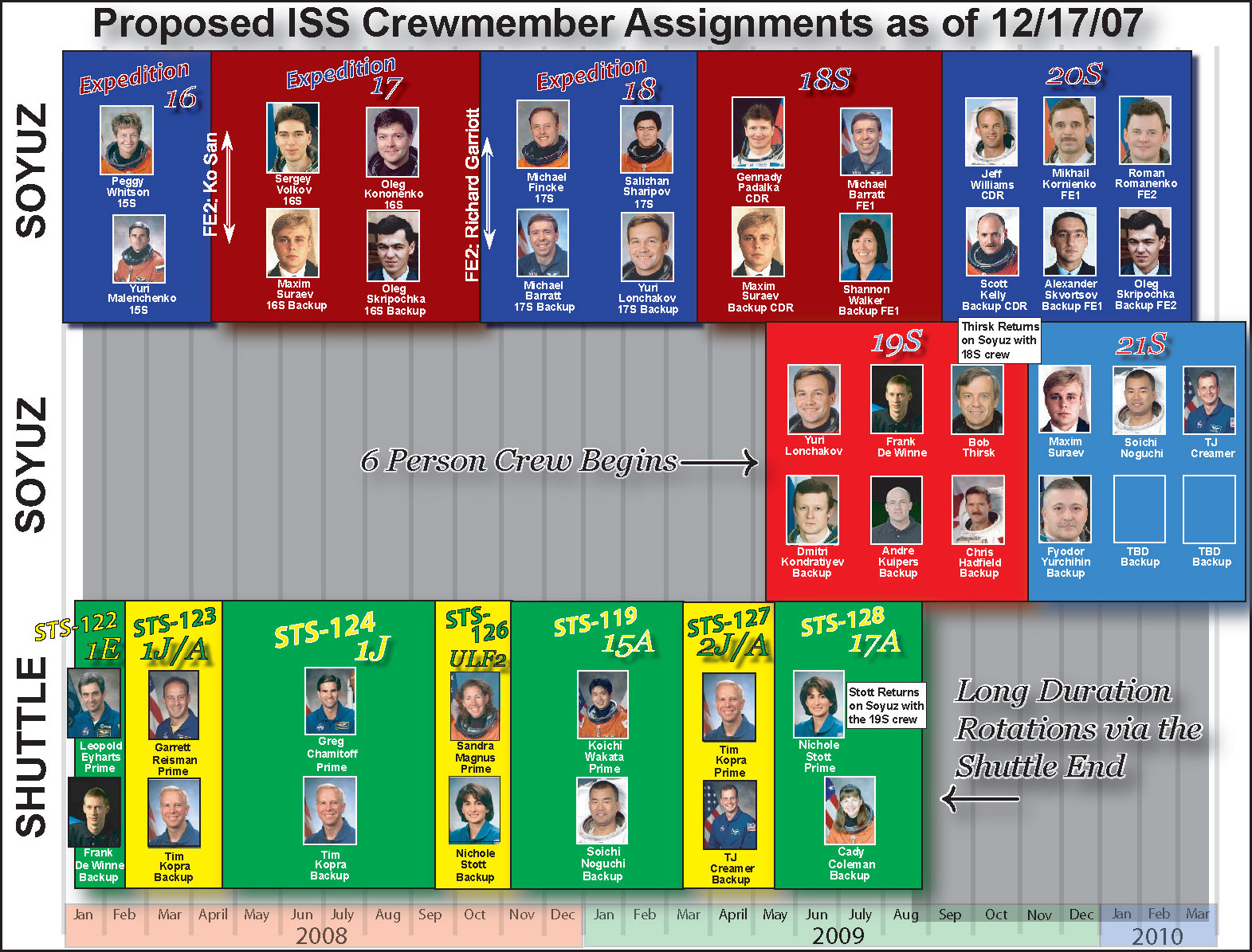
Sergei Krikalyov seems to have been dropped from the Soyuz TMA-14/ISS-19 crew as commander; he is no longer in the latest ISS flight crew roster up to ISS-21, though the roster is not yet finalized. (Via Olaf and this thread at the Novosti Kosmonavtiki forum, posted in August.) So perhaps he was moved to a later mission? Or will he be in management for a few years, though he is still an active cosmonaut?

ISS cosmonaut roster, December 2007
Expedition Prime crew Backup crew
ISS-17 Sergei Volkov, Oleg Kononenko Maksim Sura’ev, Oleg Skripochka
ISS-18 Salizhan Sharipov Yurii Lonchakov
ISS-18S (6-person crew begins) Gennadii Padalka Maksim Sura’ev
ISS-19S Yurii Lonchakov Dimitri Kondrat’ev
ISS-20S Mikhail Kornienko, Roman Romanenko Aleksandr Skvortsov, Oleg Skripochka
ISS-21S Maksim Sura’ev Fyodor Yurchikhin

Anatoly Zak has a new article on his website: “Russian space program: a decade review (2000-2010)”, 3/1. After the near-catastrophic social turmoil in the 1990s, Russia’s space program is slowly being reinvigorated, but it is dangerously dependent upon continued high oil prices for most of its funding.

Friday, 10 August 2007

Where’s Sergei?

After the restructuring of Energiya’s top management on 6 August, Sergei Krikalyov seems to have vanished from the Top Management page (he was elected Vice-President of Manned Flights on 5 February). (First noticed by Olaf.) Has he been removed from his position there after 6 months, or did they just neglect to mention him?

The interviews with Nikolai Sevast’yanov that were at the top of the Energiya website for some time were removed; here are links to all 4 of them at the site:

Thursday, 31 May 2007

Award and spacewalk

On 23 May, Sergei Konstantinovich Krikalyov, Vice-president of S.P. Korolev RSC Energia, pilot cosmonaut, Hero of the Soviet Union, Hero of the Russian Federation, was elected an honorary freeman/citizen of Saint-Petersburg. This decision was taken by the Deputies of the Legislative Assembly of Petersburg. Honorable citizens have the right to introduce laws for examination by the urban parliament, their pensions will be increased, and they do not have to pay public transport fares. The award was presented on the 27th, and photos (low-resolution only) of the presentation are available at the Official Portal of the Administration of St. Petersburg website. Photos showing Sergei (note the tie he is wearing!): 2, 8, 9, 10. Governor V.I. Matviyenko thanked cosmonaut Sergei Krikalyov for his help to St. Petersburg, his support of many undertakings and projects, and active participation in the public life of his native city. There is also a press release at the Energiya site (and a portrait photo).

Commander Fyodor Yurchikhin and flight engineer Oleg Kotov of Expedition 15 successfully completed their spacewalk this morning (the first time for both of them). There was a 45-minute delay in starting because of communications difficulties, but the rest of the spacewalk proceeded well for 5h 25m (19:05-00:30 UTC). Fyodor Yurchikhin was EV1, Orlan-M №26 (blue stripes), BRTA-13 telemetry system; Oleg Kotov was EV2, Orlan №0520025 (25) (red stripes), BRTA-18). (Relevant thread at NASASpaceflight.com.) The second spacewalk is on 6 June.

Tuesday, 10 April 2007

Another rich guy in orbit

…Big yawn. Just can’t get enthusiastic about that. The only time the Russian space program gets mentioned in the media here (Australia) is when a tourist goes up. A pertinent article at MSNBC.com: Russians fear becoming space cabbies – “Space experts worry new role will take away from needed development.” Which states exactly what I have been grumbling about in previous entries. The Russian space program has been reduced to a taxi service for bored rich space tourists and if that is all it is to be, they might as well end it. Sergei Korolyov would not be impressed with the way things are now.

However, this focus on tourism and making a profit has distracted the Russians from their original goal of building interplanetary space vessels. Rather, they are focusing on turning their portion of the ISS into a tourist and entertainment center in order to generate the funds to keep their operation aloft.

– Leaving Earth, Robert Zimmerman

For the record, Soyuz TMA-10 launched at 17:31:14 UTC on 7 April with ISS-15 and Visiting Crew-12 aboard, and docked at 19:10:44 on 9 April to the nadir port of the Zarya FGB module.

There is also a profile of cosmonaut Oleg Kotov – who is making his first spaceflight (at long last!) – by James Oberg at MSNBC.com. (The previous unflown cosmonaut to fly was Yurii Shargin on Soyuz TMA-5 in 2004.) The promised blogs of cosmonauts Kotov and Yurchikhin at Charles Simonyi’s site failed to eventuate, disappointingly.

More Sergei Krikalyov sightings at the launch: Energiya photo-report, April 6, 2007. Baikonur Cosmodrome, RSC Energia’s branch. Sergei appears in photos 1, 7, and 9 at a meeting of the State Commission the day before launch of Soyuz TMA-10. Energiya photo-report, April 7, 2007. Baikonur Cosmodrome, RSC Energia’s branch. Sergei appears in photos 14 and 16 at the final meeting of the crew and the State Commission.


Some news tidbits, from Space Daily:

Tuesday, 3 April 2007

Mars-500 update

ESA prepares for a human mission to Mars, ESA news, 2/4. ESA is also partaking in the Russian Mars-500 experiment, contributing to the research. The actual experiment seems to have been moved back to 2009 (from the latter half of 2007), with two shorter 100-day missions to take place in 2008 that will test the facility and procedures. A diagram of the complex can be found in a PDF on this page; I posted it at NASASpaceflight.com.

The Expedition 15/Soyuz TMA-12 crew launch on the 7th, so they are now at Baikonur Cosmodrome. Charles’ site takes about two minutes to load (on broadband) and you have to wait for it all to load before anything is visible. Flash-animated sites are evil!

Sergei Krikalyov was there as part of Energiya management: in Energiya photo-report, March 27, 2007. Baikonur Cosmodrome, RSC Energia’s branch. Sergei was at the Baikonur cosmodrome Krainii, Крайний airport with other Energiya managers to greet the Soyuz TMA-10 prime and backup crews. He appears in photos 3 and 6. Also in Energiya photo-report, March 28, 2007. The crew report on their readiness to proceed with their final training phase to General Designer N.N. Sevast’yanov and other managers. Sergei appears in photos 4 and 13.

Monday, 12 February 2007

Promotions

Mentioned in the Energiya official press release: February 5, 2007. Korolev, Moscow region, Sergei Krikalyov was given a new job as Vice-President of Manned Flights; his flight status is unchanged (backup for Soyuz TMA-12 to launch in March 2008, and commander of Soyuz TMA-14 in March 2009). (Discussed in this thread at NASASpaceflight.com.) Various other appointments were made in the organization. There is also speculation that the current President, Nikolai Sevast’yanov, might be replaced, a contender being Yurii Koptev (who was head of Rosaviakosmos in the 1990s, replaced by Anatolii Perminov), as some are unhappy with Nikolai’s performance and his tendency to make outlandish statements about Energiya’s future space exploration plans without the funding to back them up. His appointment was controversial in 2005. There would be problems with Yurii Koptev’s appointment though, as listed in Novosti Kosmonavtiki news №607:

  • As he replaced Anatolii Perminov, there might be some latent hostility between the two.
  • He is not accustomed to heading a large enterprise like Energiya.
  • He made the unpopular decision to deorbit the Mir Space Station, which many would hold against him.
  • He is old (born in 1940); Energiya wants to “promote young managers in order to implement long-term space programs.”

The shareholders’ meeting is in May, so see what transpires then.

The deputy director of the Institute of Medical-Biological Problems, Valerii Bogomolov, said Russia had no plans to strengthen the psychological testing of its cosmonauts following the Lisa Nowak case, as the psychological requirements are already at a high level. It is the first time something like this has occurred in the NASA Astronaut Group, and is not related to her space flight which was over half a year ago. In the near future, Russian experts will discuss the case with NASA medical personnel and those of other countries in the ISS program, and advise them to strengthen the psychological requirements when selecting astronauts, as Lisa Nowak’s case has caused unfavorable publicity. It will also not affect the selection of candidates for the Mars-500 isolation experiment.