Showing posts with label NASA. Show all posts

Monday, 15 February 2010

Into the sunset

One of the ISS-22 crew took a striking photo of STS-130 Endeavour silhouetted against an orbital sunset (the photo is a bit blurry). It seems pointedly symbolic! There are just 4 more flights after this, in 2010 (if the schedule holds): STS-131, -132, -134, -133.

Cranky curmudgeonly Apollo astronaut Jack Schmitt (who has featured here before) wrote another opinion piece on the U.S. space program changes, “New Space Policy Cedes Moon To China, Space Station To Russia, And Liberty To The Ages”, full of the usual “paranoid patriot” hysteria about the loss of America’s dominance in space. Mate, there’s plenty of room out there for everyone! The article seems to have been removed from the site where I originally read it, but there is a copy on another blog. Some extracts below and my trite commentary (there should be a “drinking game” for everytime the words “leadership” and “freedom/liberty” are mentioned for these types of articles).

The Administration finally has announced its formal retreat on American Space Policy after a year of morale destroying clouds of uncertainty. The lengthy delay, the abandonment of human exploration, and the wimpy, un-American thrust of the proposed budget indicates that the Administration does not understand, or want to acknowledge, the essential role space plays in the future of the United States and liberty. This continuation of other apologies and retreats in the global arena would cede the Moon to China, the American Space Station to Russia, and assign liberty to the ages.

Just a bit histronic. “Wimpy, un-American thrust”?? That sounds…suggestive.

Histories of nations tell us that an aggressive program to return Americans permanently to deep space must form an essential component of national policy. Americans would find it unacceptable, as well as devastating to liberty, if we abandon leadership in space to the Chinese, Europe, or any other nation or group of nations. Potentially equally devastating to billions of people would be loss of freedom’s access to the energy resources of the Moon as fossil fuels diminish and populations and demand increase.

Again the obsession with leadership. Diminishing resources will be better coped with by learning to live more sustainably and decreasing population growth, rather than hold out a nebulous hope of magically solving these problems by exploiting the Solar System’s resources (not with current spaceship technology we won’t!).

Returning to the Moon and to deep space constitutes the right and continuing space policy choice for the Congress of the United States. It compares in significance to Jefferson’s dispatch of Lewis and Clark to explore the Louisiana Purchase. The lasting significance to American growth and survival of Jefferson’s decision cannot be questioned. Human exploration of space embodies the same basic instincts as the exploration of the West – the exercise of freedom, betterment of one’s conditions, and curiosity about nature. Such instincts lie at the very core of America’s unique and special society of immigrants.

The frontier myth cited yet again *groan*. The exploration of the West came at the cost of the original inhabitants (Native Americans).

With a permanent resumption of the exploration of deep space, one thing is certain: our efforts will be as significant as those of our ancestors as they migrated out of Africa and into a global habitat. Further, a permanent human presence away from Earth provides another opportunity for the expansion of free institutions, with all their attendant rewards, as humans face new situations and new individual and societal challenges.

Outer space = Libertarian paradise? He’s been reading too much Heinlein.

Returning to the Moon first and as soon as possible meets the requirements for an American space policy that maintains deep space leadership, as well as providing major new scientific returns. Properly conceived and implemented, returning to the Moon prepares the way to go to and land on Mars. This also can provide a policy in which freedom-loving peoples throughout the world can participate as active partners.

Moon’s been done. It’s boring! Go to Mars.

Again, if we abandon leadership in deep space to any other nation or group of nations, particularly a non-democratic regime, the ability for the United States and its allies to protect themselves and liberty will be at great risk and potentially impossible. To others would accrue the benefits – psychological, political, economic, and scientific – that the United States harvested as a consequence of Apollo’s success 40 years ago. This lesson has not been lost on our ideological and economic competitors.

How about trying co-operation rather than competition? Space colonization is too big and expensive for any one country to do it alone.

Monday, 2 November 2009

Cosmonaut journal

Roskosmos seems to have taken inspiration from NASA and is (at long last!) hosting a journal by Maksim Suraev, now in orbit. It is currently only in Russian. [Also now in English at Russia Today]

Why does the Cosmos attract me?”, Russian Cosmos magazine, November 2009. An interview with NASA Administrator Charles Bolden. He mentions Sergei Krikalyov as they both flew on STS-60 in 1994.

Progress M-MIM2/M-MRM2 («Прогресс М-МИМ2»), carrying the new module Poisk, «Поиск» (“Search”), is due to be launched on 10 November (the day after my birthday!). The Energiya site has a series of pre-launch preparation photos.

Russian president backs nuclear spaceship”, MSNBC.com, 28/10. Russian officials said they wanted to build a nuclear-powered spaceship (the preliminary design ready by 2012, and 9 more years to build it), an announcement met with the usual skepticism (“Show me the money!”). I am not sure if the nuclear component is a reactor powering electrical propulsion engines, or an actual nuclear rocket propelling the ship. A diagram below, which illustrates the former version (from “Russian nuclear-powered spaceship” at the Orbiter Forum):

This entry at NASASpaceflight.com also mentions the proposal. According to another commentator:

It is basically the solar electric tug Energia proposed some years ago for a Mars mission, but they now replaced the huge solar power arrays by a nuclear reactor. The solar-powered version must have been too much in terms of required orbital assembly operations (mentioned in the following link), so they opted for the nuke.

Daniel Marin has an entry (in Spanish) at his blog – “Russian nuclear ships” – detailing various Russian developments for nuclear-powered space missions.

Sunday, 26 July 2009

What never was

From NK №796. Reminisces by Academican Mikhail Marov on why the USSR’s manned lunar program was unsuccessful, and of watching the Moon landing from TsUP.

21/07/2009/20:53 – The Soviet machines did as much science as the American “Apollo” – scientist

The Soviet program for the exploration of the Moon using robotic missions brought about the same amount of basic science knowledge as the U.S. “Apollo” manned missions, but were much cheaper, said Academician Mikhail Marov, who was one of the developers for the Soviet lunar program.

“I can say that we have got equivalent results, because we have sampled a substance, we investigated, and it was a major task. Moreover, we received very meaningful results from the automatic lunar rover or mobile devices, they worked on the surface for many months,” said the Agency representative.

However, he stressed that he does not want to minimize the scientific value of these flights. Marov recalled that one of the members of the Apollo expedition – Harrison Schmitt – a professional geologist: “And he walked on the moon with hammers, and, of course, he, being a professional, garnered much important geological information.”

“Man is a very important component, because he is much more able to multi-task, he is able to adapt to the challenges he poses for himself. But this in no way underestimates the role of machines as well,” said the Agency representative.

21/07/2009/20:53 – The Soviet moon landing program was prevented by the death of Korolyov – opinion

That the Soviet program of manned flights to the Moon did not take place is largely due to the sudden death of Chief Designer Sergei Korolyov, and also because of problems with the carrier – the N-1 rocket, said one of the participants of the Soviet lunar program, Academician Mikhail Marov.

Korolyov had always dreamed about exploring the Moon and, of course, it is surprising that less than two years after launching the first satellite we were able to implement the first launches to it, said Marov.

He recalled that the Soviet probe Luna-2 in September 1959 was the first one in the world to land on the lunar surface. Then this program was successfully developed, but in 1961, following the flight of Gagarin, the “Moon race” started – U.S. President John Kennedy's message to Congress set a target of within 10 years to plant people to the moon, and thus negate the achievements of Soviet space exploration.

“We could not surpass this, and our efforts at the Design Bureau Korolyov start the program to grow. But there were many difficulties, and the main difficulty was the development of the heavy vehicle N-1 – the equivalent of the American Saturn-5, with the help of which were carried out expeditions to the Moon,” said Marov. The N-1 heavy vehicle, which was to bring the Soviet L3 lunar spacecraft to the Moon, had suffered setbacks since the first launch in February 1969. All four test launches ended in disaster. The American lunar vehicle Saturn-5 first launched in November 1967.

“If you now look at the situation in retrospect, I believe that our failure to a very high degree was associated with the sudden death of Korolyov in January 1966, and this, of course, had very, very harmful consequences,” said the Academician. Korolyov died in January 1966, several days after a routine operation.

21/07/2009/20:53 – Soviet-era TsUP met the landing of Americans on the Moon with silence – Academician

The Soviet military, engineers and scientists, observing the disembarkation of American astronauts on the moon in the Mission Control Center near Moscow, responded to this event with silence, remembers one of the participants of the Soviet lunar program, academician Mikhail Marov.

Exactly 40 years ago, on 20 July 1969, American astronauts Neil Armstrong and Buzz Aldrin left the landing module Eagle and became the first humans to set foot on the lunar surface. “I watched this in the mission control center, Korolyov, Moscow. This information was not broadcast on normal television, but was broadcast on the big screen in TsUP. We observed all phases of flight carefully, but the culmination, of course, was the landing,” said Marov, who already in those years was one of the leading researchers of the Institute of Applied Mathematics, Keldysh, which was developed by the Soviet lunar program of study.

He remembers that he experienced contradictory feelings, which in his opinion, did not differ from those of colleagues.

“First – this is certainly admirable – I saw such a landmark event, which was a few years ago and the dream it was not easy. And, of course, I was delighted that this was realized in the lifetime of my generation when I could witness it,” said the scientist. “And the second feeling was, but why have we not done this. We are also able to do it.”

However, those assembled in TsUP did not express their emotions. “For the most part they were silent. At the time, space was controlled by the military to a very strong degree. There were a lot of military generals, conservative, tough-minded people. They were silent. There was admiration, applause,” remembers Marov. According to him, the professionals assembled understood what a colossal achievement this was, and how this was a great engineering achievement.

“Although later it became clear that Americans on several occasions were literally on the verge of breakdown, including the first flight, but they did have great flexibility in system management, and had superbly trained crew to ensure perfect execution of the program,” said the Academician.

Russia getting humans first to Mars would make up for the disappointment of missing out on the Moon.

Unraveling Russia’s moon riddles”, James Oberg, MSNBC.com, 24/7. Many Soviet-era space artifacts ended up being auctioned off in the West, rather sadly, because those in the space program at the time needed money more.

Saturday, 25 July 2009

Armchair experts

One source of continuing amusement and exasperation is the pontificating of the “armchair experts” regarding the future of the U.S. space program. They proliferate on spaceflight forums. Many are of the opinion that NASA should “get out” of designing and launching rockets, and leave this to the “expertise” of private industry (despite NASA employing hordes of experts and launched rockets for 50 years or so). This commenter on a NASA Watch article had what I thought was a great rebuff:

Sorry to rain on the “private space is great” parade, but as of today they have yet to make even one orbit of this rock for all of the money they’ve spent.

What happened to the second flight of SpaceShipOne? No floating candy as it falls back to Earth, unable to break free of the gravity well.

Listen up, people! This isn’t aviation, nor ocean sailing. It’s spaceflight, and it’s much more difficult to accomplish than it looks. Sure, NASA and the Russians make it look easy, but 50 years ago, it wasn’t. And if you are realistic about it, it still is not easy. Other than submarining, it’s the most difficult activity known to humanity.

So keep on trumpeting the “accomplishments” of the private space industry, but don’t be so quick to turn over access to space to the same people who brought us the meltdown of our financial system. 30 years ago, trusting Wall Street with your retirement made as much sense as playing the ponies. It still does.

Meanwhile, Stevie Wonder created a song just for the “private space industry”: “You Haven’t Done Nothing”.

Orbit the planet. Bring the pilot back alive. Then we’ll talk.

“Perhaps a better analogy would be ‘Why doesn’t the federal government farm out its automobile transportation needs to Hertz or Avis or Enterprise Rent-A-Car’ ‘Why should the government own cars?’ ‘The government should get out of the car ownership business’.”

Yes, by all means, let’s turn this over to companies who will collude to give the government a “special rate”. And please, spare me any talk about “competition”.

When Warren Buffett and Bill Gates pony up their billions for private spaceflight, then we the taxpayers will do the same.

We buy enough snake oil every day!

– Posted by: Dave H. at July 24, 2009 9:01 p.m.

There doesn’t seem to be the equivalent for the Russian space program; perhaps there are some on Russian-language forums, but I can’t read these.

Alexey Leonov: ‘I Could See Armstrong Bouncing on the Moon’ ”, Roskosmos, 20/7 (a better-formatted version at Russia Today). A lengthy interview with cosmonaut Aleksei Leonov on various topics, including the Apollo Moon landings (he gets irate at those who believe the program was faked), Yurii Gagarin’s death, and the prospect of a Mars mission (not any time soon).

Cosmonaut Gennadii Padalka, currently in orbit on the ISS, accumulated 500 days in space on 18/7, over 3 missions (Soyuz TM-28, TMA-4/ISS-9, TMA-14/ISS-19).

Monday, 13 July 2009

Moon melancholy

The 40th anniversary of the first Apollo Moon landing is coming up, so there is a lot of blather and angst in the media and on various forums. No Russian cosmonaut has yet been out of low Earth orbit – one wonders if they ever will. The anniversary has inevitably brought out the Paranoid Patriots, as evidenced in these quotes:

Now potential rivals such as China seek to challenge US dominance in space, and some see the new space race as once again a battle between ideologies.

“From the point of view of the future of the western world and its Asian allies it’s imperative that the US, Europe, Japan, Australia, Canada and other like-minded countries be competitive in deep space,” Moonwalker and geologist Harrison Schmitt told AFP.

Schmitt said he believed that “non-democratic nations of the world, China, Russia and maybe others, fully intend to be dominant in space…[and] gain that kind of prestige, that kind of advantage in technology and education and other fields that come with being the dominant space power.

“With the Apollo program we taught them how,” said Schmitt, who was the last astronaut to step out of a lunar craft and onto the moon surface in 1972.

– “Space, man’s greatest challenge, 40 years after Moon walk”, Space Daily, 12/7/2009

STS-127 Atlantis is still trying to launch; it has had 4 scrubs so far! Originally to have launched on 13 June, the first delay was due to a hydrogen gas vent leak; the second because of a work light knob embedded between the pressure pane on Atlantis’ pilot window and the dashboard panel, and the last two because of thunderstorms. The next attempt is in a few hours. A very frustrating process for all involved, as the orange External Tank has to be drained and refueled each time, and the Shuttle crew has to prepare themselves, only to be disappointed. (Maybe they should try sacrificing a goat.) The Soyuz manned rocket launches are, in contrast, rarely delayed (I don’t know if any have been).

Posters at the Novosti Kosmonavtiki forum are not too impressed with the proposed names (6/7/2009 entry) for the next 3 Russian ISS modules, describing them as “utilitarian”, lacking in romanticism, difficult to pronounce (i.e. too long) and imitating NASA’s pointedly symbolic names. Some proposed are: «Спектр», Spektr (Spectrum), «Природа» Priroda (Nature), «Радуга», Raduga (Rainbow), «Горизонт», Gorizont (Horizon). The names are “recycled” (used on previous projects, such as the Mir space station) but are nicer than the officially-proposed ones.

Progress M-02M successfully performed a re-rendezvous test today to verify the new passive KURS-P system antennas and TORU target installation accuracy at the SM PkhO (Service Module Transfer Compartment) zenith port. There was some nervousness about this as a similar 1997 Progress (M-34) rendezvous with Mir bumped into the space station.

Wednesday, 31 December 2008

New NASA Columbia report

NASA has released a Columbia Crew Survival Investigation Report (16.2 MB PDF – press release page) featuring a detailed description of the sequence of events for the crew and orbiter during its breakup. A summary from the report is below:

1.1.1 Events with lethal potential

There were five events identified with lethal potential to the crew.

  1. The first event with lethal potential was depressurization of the crew module, which started at or shortly after orbiter breakup.The majority of the SCSIIT findings related to the first lethal event were connected to the operational incompatibilities of the advanced crew escape suit (ACES) with the orbiter. The launch and entry suit was added in response to the Challenger accident, rather than as a part of the original vehicle design. The ACES was the successor to that suit. The suit protects the crew in many scenarios; however, there are several areas where integration difficulties diminish the capability of the suit to protect the crew. Integration issues include: the crew cannot keep their visors down throughout entry because doing so results in high oxygen concentrations in the cabin; gloves can inhibit the performance of nominal tasks; and the cabin stow/deorbit preparation timeframe is so busy that sometimes crew members do not have enough time to complete suit-related steps prior to atmospheric entry.

    As Columbia entered the atmosphere, one crew member was not yet wearing the ACES helmet and three crew members were not wearing gloves. Per nominal procedures, the crew wearing helmets had visors up. There was a period of about 40 seconds after the orbiter loss of control (LOC) but prior to depressurization when the crew was conscious and capable of action. Part of this short timeframe was undoubtedly employed in recognizing that a problem existed, as the indications of LOC developed gradually. The crew members could have closed their visors in this timeframe but did not. The SCSIIT attributed this to the training regimen, which separates vehicle systems training from emergency egress training and does not emphasize the transition between problem resolution and a survival situation. Once the cabin depressurization began, the rate of depressurization incapacitated the crew so quickly that even those crew members who had fully donned the ACES did not have time to lower their visors. Although circulatory systems functioned for a brief time, the crew could not have regained consciousness upon descent to lower altitudes due to the effects of the depressurization.

  2. The second event with lethal potential was unconscious or deceased crew members exposed to a dynamic rotating load environment with nonconformal helmets and a lack of upper body restraint. The orbiter lost control, probably when the hydraulic systems failed due to hot gas intrusion in the left wing. The resulting motion was not lethal but did require bracing by the crew. The forebody (crew module and forward fuselage) eventually separated and the crew module lost pressure at orbiter break- up. When it separated, the forebody began a multi-axis rotation at approximately 0.1 revolution/second. Loads due to deceleration significantly decreased at the moment of breakup due to the change in ballistic number, but began to climb as the forebody continued to decelerate.

    After the crew module depressurized and the crew lost consciousness, the seat inertial reel mechanisms failed to lock despite the off-nominal motion. The reels were not defective; they were simply not designed to lock under the conditions the forebody experienced. The upper harness straps failed at some point prior to the forebody breakup, causing the straps to recoil back into the inertial reel mech- anism. Because the reel mechanisms did not lock, the unconscious or deceased crew members were exposed to cyclical rotational motion while their upper bodies were inadequately restrained. Helmets that did not conform to the head and the lack of upper body restraint resulted in injuries and lethal trauma.

  3. The third event with lethal potential was separation from the crew module and the seats with associated forces, material interactions, and thermal consequences. This event is the least understood due to limitations in current knowledge of mechanisms at this Mach number and altitude. Seat restraints played a role in the lethality of this event. The breakup of the crew module and resultant exposure of the crew to entry conditions was an extremely significant event but was very difficult to characterize since many related events occurred in a short period of time. The consequences of exposure to entry conditions included traumatic injury related to seat restraints, high loads associated with deceleration due to a change in ballistic number, aero- dynamic loads, and thermal events. All crew were deceased before, or by the end of, this event. The ACES has no performance requirements for occupant protection from thermal events and may not provide adequate protection even for egress scenarios involving heat and flames. There is no known complete protection from the breakup event except to prevent its occurrence.
  4. The fourth event with lethal potential was exposure to near vacuum, aerodynamic accelerations, and cold temperatures. The ACES system is certified to operate at a maximum altitude of 100,000 feet, and certified to survive exposure to a maximum velocity of 560 knots equivalent air speed. The operating envelope of the orbiter is much greater than this. The actual maximum protection environment for the ACES is not known.
  5. The final event with lethal potential was ground impact. The ACES system provides protection from ground impact with a parachute system. The current parachute system requires manual action by a crew member to activate the opening sequence.

There are some “Redacted” sections; presumably containing details about the crew’s remains that the report authors didn’t want to be made public. There were reports of body parts found scattered over the landscape (sorry, this brings out my inner ghoul):

Reports of body parts being found started coming in Saturday night as emergency workers and residents searched hundreds of square miles of Texas and Louisiana for bits of what once was space shuttle Columbia.

In Hemphill, near the Louisiana state line, hospital employee Mike Gibbs reported finding what appeared to be a charred torso, thigh bone and skull on a rural road near what was believed to be other debris. Billy Smith, an emergency coordinator for three East Texas counties, confirmed the find.

“I wouldn’t want anybody seeing what I saw,” Gibbs said. “It was pretty gruesome.”

On a farm not far away, two young boys found a charred human leg, The Dallas Morning News reported Sunday. “From the hip to the foot, it’s all there, scorched from the fire,” said their father, Bob White.

I wonder if the bodies broke up during re-entry or on impact? Human bodies aren’t designed for high-g forces, as innumerable airplane crashes have demonstrated. [According to Dad, bodies that are found in pieces mean they have been shredded when in a fragmenting aircraft in the air; if not they turn into a “blob of jelly” when they impact the ground and all the bones shatter. So that’s some trivia you probably didn’t want to know.]

On a more cheerful note, Expedition 18 completed a spacewalk last week on 23 December wearing Russian Orlan spacesuits. Yurii Lonchakov (EV1, Orlan-M №26) and Michael Fincke (EV2, Orlan-M №27) were outside for 5h 38m (00:51-06:29 UTC). Reports: ISS Daily Report, NASA.

A random observation: I visit various spaceflight forums (see my links list) and it is rare to encounter other females! I don’t know why that is, as there are plenty of women in the aerospace industry (at least there are in the USA and Europe). (I did have a chance to begin a career in the industry a long time ago, but as with so much of my life, I botched that chance.)

Friday, 26 September 2008

Shenzhou-7 launches

China’s third manned space mission, Shenzhou-7, launched yesterday at 13:10 UTC with 3 taikonauts onboard. They are only staying in orbit for 68 hours, less than 3 days. The spacewalk will take place between the 29th and 30th orbits of Earth and last for around 20 minutes.

A trivia note is that this is the first Shenzhou with a toilet!

No toilet was on board of the previous two manned spaceships. The men had to wear diapers. But this time a toilet is set up. The toilet seat is tailor-made to the astronauts’ physiques and it also includes a separate urinal.

From Novosti Kosmonavtiki news №731:

26/9/2008/00:05 – Roskosmos believes China is not a competitor but a partner

China’s space program is not considered by Roskosmos as a competitor. “We do not see China as a competitor rather see it our partner in the exploration of outer space,” said Aleksander Vorobyov, the head of the Roscosmos press service on Thursday, commenting on the launch of China’s third manned spacecraft Shenzhou-7 with three cosmonauts.

He congratulated China on the successful launch, recalling that the Russian and Chinese space agencies are cooperating on a wide range of works, including the first EVA of Chinese astronauts into space. One of the spacesuits on the ship Shenzhou-7, was produced in Russia.

In the coming years, Russia and China will organize joint projects of the exploration of Mars and the Moon with automated spacecraft. The project “Phobos-Grunt”, whose main task is to deliver to Earth samples of soil Martian satellite Phobos, the Russian interplanetary station will carry a Chinese autonomous vehicle to carry out Martian research. In turn, Russian specialists are directly involved in the Chinese lunar research program (orbiting, photography, landing on the surface, sampling soil and delivering it to Earth).

26/9/2008/00:05 – Russia needs to reorient its space program to co-operate with China

Russia should think about strengthening its co-operation in space with China, said a member of the K.E. Tsiolkovskii Russian Academy of Space.

“Today we need to think about who are our key partners in space. Perhaps the time has come to switch our focus from the West to the East. Economic, technological and political centers are concentrated in the Asia-Pacific region, where a vigorously developing China, Japan and South Korea are located,” a Russian expert, Aleksandr Ionin, commented during the launch of the third manned Chinese spacecraft.

In this context, said A. Ionin, the decision to build a cosmodrome in the Far East from a strategic perspective is the right step. He called for increasing cooperation with China in space. “Our country, unlike the U.S., does not suffer the affliction of an ambitious world leader and is ready to engage in manned and unmanned space,” said A. Ionin.

According to him, launching China’s third manned spacecraft during the flight of which a taikonaut will attempt an EVA, “this is a big step for China, but a small accomplishment for the world of space. In today’s world, beginning of EVA, which the Soviet Union and the U.S. have carried out more than 40 years ago, is a normal activity,” said the expert.

A development for a protective Martian diet:

26/09/2008/00:05 – Cosmonauts going to Mars will drink “light water” during the flight

Cosmonauts on the interplanetary flights may drink “light water” – water from which has been removed the heavy hydrogen isotopes and oxygen and possessing positive biological side-effects, which in particular, provide protection from radiation, Russian scientists said.

As the professor of the Institute of Biomedical Problems Yurii Sinyak reported at the conference in Moscow, dedicated to the development of life-support system for space flights, studies showed that “light water”, where deuterium and heavy oxygen are absent or their content considerably lowered, on the contrary, possess a number of useful biological properties.

In the experiments at the IMBP it was shown that light water protects from radiation: mice that received a significant radiation dose, had the longer lifetime, if they drank light water.

Furthermore, the anti-carcinogenic properties of light water was discovered; experiments showed that it slows down an increase in some types of tumors.

In experiments on Japanese quail birds, those that drank light water had a higher weight.

Professor Yurii Sinyak noted that studies of water with the changed isotopic composition began from the study of melt water, which also possessed a number of useful properties. He expressed the opinion that these properties were connected precisely with its isotopic special features.

“We decided to completely remove deuterium and then to verify how it worked. Then they began to remove heavy oxygen. They decided to test on plants, then on animals and finally man, to explain its anti-carcinogenic and anti-radiation properties,” said the agency representative.

He explained that the anti-radiation properties of light water are especially important for space flights. “If we fly to Mars, there there is no shielding from magnetic belts (Earth is protected from the cosmic rays by its magnetic field); therefore the danger will considerably higher for cosmonauts. It is necessary to search for methods both chemical and mechanical to reduce such radiation exposure,” said the professor. At the same time he emphasized that “everything which in space is achieved, is applicable on the Earth.”

(Article also at the Russian Federal Space Agency site, in Russian: «Космонавты в полете на Марс будут пить легкую воду», 25/9/2008)

“The US Has No Option But To Use Russia’s Soyuz Craft”, RIAN/Space Daily, 23/9.

NASA administrator Michael Griffin has described extending the service life of the hopelessly outdated shuttles, costing an additional $4 billion, as a jihad. Hence, he believes, the first and most obvious likelihood is that there will be no American astronauts or cosmonauts from U.S. or international partners on the space station after December 31, 2011. Only Russians will be there, he said.

The American concern has not a leg to stand on: Russia has always been noted for the scrupulous observance of its commitments. It never broke them even during the Cold War. Still, it will not give free rides to the Americans. The problem needs to be solved before 2009: Russian ships have a two-year production cycle.

Russia does not yet believe that the Americans can quit a multi-billion dollar project and let down their European, Canadian and Japanese partners. What’s more, Griffin said the ISS’s life could be extended beyond the established deadline of 2015. He said the U.S. was committed to building and using the station for most of the next decade. He added that the ISS held the main niche in U.S. space policy over the coming years and that medical and biological research on it would contribute to future Moon and Mars expeditions.

Typical of the negative attitude of many towards such co-operation is this post at NASASpaceflight.com, from the generation who grew up during the worst of the Cold War. Perhaps when my generation and those following (born in the 1970s onwards) are in power this nonsense will fade into the past?

I am in my 38th year as an engineer, I have worked Apollo, Shuttle and part time with Constellation. I normally only comment about the orbiters on this fine website as there’s a heart warming amount of interested people. However for the first time in my career I am now considering immediate retirement.

This is related to the passing of the INKSNA waiver, because NASA, and the U.S. showed how weak we are to countries like Russia, Iran and anyone else who have little regard for us.

Led by Mike Griffin, and a number of gullible politicians, we have sacrificed not only our domestic manned launch capability, but we have roadblocked domestic options to bridge the gap, with no regard for national security.

Well, you only have yourselves (namely, clueless U.S. politicians) to blame!

The next time Russia invades an ally of the U.S. and we see lots of angry reaction from the elected few, turn off the television, because they are liars.

More accurately, “when Russia responded to the Georgian invasion of South Ossetia”, but who cares about the facts? And since when was Georgia such an important ally anyway?

We’ve just approved billions of tax payers dollars to be taken out of the pockets of hard working American engineers, and into the pockets of the regime in Moscow. I’m old enough to remember the Soviet threats to my family and myself and a leopard does not change its spots, as we have seen recently. The message is “invade as many of our allies as you wish, we’ll stamp and shout, but we’ll also happily keep writing checks. Feel free to tell us to sit down and be a good USA.”

Griffin will tell you Shuttle is at the risk of a 1/8 chance of a disaster: An insult to the hundreds of engineers who have worked tirelessly after Columbia, which was a FREAK accident, and people like myself who have worked hard after Challenger, which was a FREAK accident, to ensure over 100 safe missions. And you think Soyuz is safe? It nearly killed its crew on the last two landings.

Two “freak” accidents? Perhaps indicative of design flaws? The Soyuz isn’t 100% safe either, but the two off-nominal ballistic landings were back-up modes and they certainly did not “nearly kill” their crew (though they caused some discomfort).

I won’t bother to post a snarky reply in that thread as it will likely just get deleted.

Saturday, 13 September 2008

Hurricane havoc

Progress M-65 (30P) launched on 10/9 at 19:50:02 and was due to dock on 12/9, but this has been delayed until 17/9 due to Hurricane Ike forcing the evacuation of Houston Mission Control (and the rest of the city) – “Hurricane Ike disrupts traffic in space”, MSNBC.com, 12/9.

NASA has set up backup Mission Control teams for the space station near Austin, Texas, and in Huntsville, Ala. Yembrick said that the main Mission Control room in Houston is preferred to feather the space station’s U.S. solar arrays into an edge-on position to incoming spacecraft to avoid damage from thruster firings.

From orbit the hurricane looks deceptively calm and serene (ISS photos ISS017-E-015751 and ISS017-E-015752); like swirled cotton wool or whipped cream. NASA has a Hurricane Resource Page with updates, and the NASASpaceflight.com forum has a dedicated thread. The hurricane is a Category 2 and is very wide (nearly 1000 km across). The low-lying Texas coast means the storm surge will flood the region.

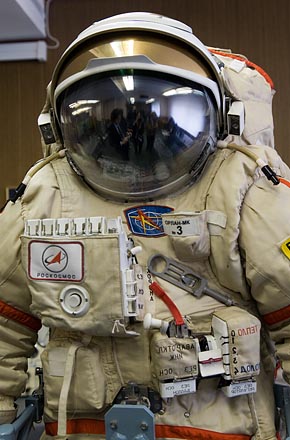
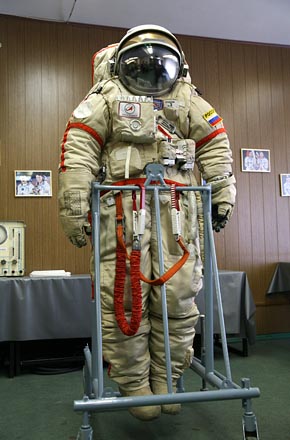
The Progress is carrying the first of the new Orlan-MK spacesuits, numbered 4; this is fitted with a digital computer in its life support backpack to process and transmit systems information, rather than the previous BRTA, БРТА radio-telemetry equipment. It will also indicate malfunctions and display the necessary recommendations to deal with these on a new special liquid crystal display (LCD) screen on the front chest part of the spacesuit. The Orlan-MK will be able to work in two modes: with the digital computer (as the MK) or without (as the previous M version).

Interesting tidbit: if a spacesuit’s serial number has a last even digit (2, 4, 6, etc.), then the spacesuit has blue stripes, if a last odd digit (1, 3, 5, etc.), then red stripes – a tradition of NPP Zvezda. (Via Anik) Thus Orlan-MK №4 has red stripes.

Some photo links of the spacesuits used for testing:

Florida lawmaker opposes giving NASA permission to buy Russian spacecraft”, The Write Stuff, 12/9. If NASA loses its Russian/Soyuz access to space, the blame can be laid squarely upon cranky U.S. politicians! “Russia invaded Georgia” is somewhat more accurately phrased as “Russia responded to Georgia’s invasion of South Ossetia”.

Former astronaut LeRoy Chiao has a reasonably balanced blog post on the topic: “U.S.-Russian relations”, 31/8.

Prime Minister Putin signed a directive allocating 45 billion rubles ($1.8 bln) in additional funding for Russia’s space program. Funds will go firstly toward the construction of the new Russian spaceport, Vostochnii, in the Amur Region. Secondly will be ensured compliance with all the manned programs, which Russia exercises in the framework of international cooperation, taking into account all their commitments to the ISS. The third aspect is spacecraft, designed to enhance the effectiveness of Russia’s economy, such as meteorology, weather forecasting and scientific research.

Saturday, 8 March 2008

A busy launch week

The European Space Agency’s unmanned ATV cargo spacecraft, Jules Verne, is due to launch tomorrow! At 04:03 UTC (3:03 p.m. in Melbourne). It will be the first new spacecraft (for the human space program) to enter orbit since China’s Shenzhou launch in 2003. The Space Shuttle, STS-123 Endeavour, is also to launch on 11 March at 6:28 UTC; the main components to be installed are the Japanese Experiment Module (Kibo), and the Canadian Special Purpose Dexterous Manipulator (SPDM) Dextre robotics system. A busy week in orbit, assuming both launch on time! (Russia is getting overshadowed a bit; it has not launched a module since Pirs in 2001 – though the ATV has some Russian components and will dock to the end of Zvezda – “Our Russian colleagues look at the ATV as though it were also their own vehicle”.)

NASA wary of relying on Russia”, MSNBC, 7/3. With the imminent retirement of the Space Shuttle, Russian Soyuz spaceships will be the only way for NASA to get its astronauts into space until the Orion spaceship is developed.

I spent most of the afternoon doing 2 pages for my “RuSpace” site about Russian space toilets! (For the ISS and Soyuz.)

I didn’t make any posts last month (February); there wasn’t much that interested me!

The new Russian President was elected on 2 March: Dmitrii Medvedev (Дмитрий Анатольевич Медведев) – to no-one’s surprise! I wonder if he will take any interest in his country’s space program. (Vladimir Putin looks set to become Prime Minister.)

Some previous collected news tidbits:

Russia has the corner on guns in space”, James Oberg, MSNBC, 12/2. An overview of the gun carried on board the Soyuz spaceship that the relevant authorities don’t want to acknowledge!

Perhaps a year or so ago, nobody would have raised an eyebrow over “trained spacefarers” being able to grab a gun at will, for whatever reason they felt like. But in the wake of the past year’s tragic violence involving professional astronauts and space center veterans, and in light of stories now surfacing over psychological crises on past missions (including one threatened suicide that the mission commander took very seriously), the open access to such lethal hardware needs reappraisal.

At the very least, the survival kit needs to be locked, with the key (or combination) in the possession of the capsule commander. The very presence of the gun probably also needs to be reviewed again, to determine if it is a critical piece of safety gear or a space disaster just waiting to go off.

I can just imagine the headline: “Psychotic astronaut slaughters crewmates on Space Station!”

An interview with Richard Garriott”, The Space Review, 18/2. He is also updating his journal more regularly. He seems to be missing the greater variety of foods back home!

The United Nations flag is to be taken onboard the next Soyuz flight in April with Korean guest cosmonaut Ko San.

A tidbit of information about Sergei Krikalyov from his page at Space Encyclopedia ASTROnote is that “in December 2007 he was a candidate for the Deputies of the State Duma 5th convocation on the list of the All Russia political party ‘United Russia’, the regional group № 81 (St. Petersburg). Despite the fact that the party overcame the 5% barrier, being the 16th in the list of regional groups in the allocation of seats, in the number of deputies has not shown up.” Is he getting involved in politics?

From Novosti Kosmonavtiki news №687:

In Star City (Звездном городке, Zvezdni Gorodok) an exhibition was opened of the photographic works of airman-cosmonaut, Hero of the Soviet Union and Hero of Russia Sergei Krikalyov with the symbolic name “Paintings of the Creator”. Our planet Earth is presented in an unusual perspective – from space. All photographs were taken from onboard the International Space Station.

Thursday, 4 October 2007

Anniversaries

Today is 50 years since the launch of Sputnik.

In that BBC article it is noted that the Russian space program “have been given $12bn (£6bn) to spend over the next decade – a small amount compared with NASA’s budget but enough for the Russians to have ambitious plans.” NASA’s budget for one year is about $16 billion.

More articles from the past couple of weeks:

“Russia aims for new far east space launch pad by 2020”, The Raw Story, 21/9; RIAN 26/9.

From Novosti Kosmonavtiki news №655:

25/09/2007/00:01: The head of Roskosmos is convinced that it is necessary to more actively involve young cosmonauts from the Russian force

The leader of the Roskosmos Federal Space Agency, Anatolii Perminov, is convinced of the necessity of more actively involving young cosmonauts from the Russian force. About this he stated on Thursday during the traditional tea drinking with the prime and duplicating crews of the 16th Expedition to the ISS, reports ITAR- TASS.

After noting that the “Cosmonaut Training Center and Rocket & Space Corporation Energiya insure themselves by sending experienced cosmonauts into orbit,” Perminov added: “but I always support those who have yet to fly, since I have no doubts that the young will manage.”

In the Russian group about two dozen astronauts have sat “on the replacement bench” for 10 years or more. They are habitually refered to as “young”, but most of these guys are over 30 years old.

But this 16th expedition, which starts on 10 October, will be very difficult; therefore it is good that an experienced crew flies, Perminov believes.

The next paying space tourist to go up will be Richard Garriott, in October 2008. He has a rather formidable CV, and is the son of former NASA astronaut Owen Garriott. Though as pointed out by a NASA Watch reader, he will be the second 2nd-generation astronaut to launch – Sergei Volkov (son of Aleksandr) will launch in April 2008 – not the first as reported by Space Adventures. He is also the creator of a rather nice-looking MMORPG called Tabula Rasa (I have been admiring the graphics on the site and wishing I could design things like that).

Game guru going into space”, Cosmic Log entry, 28/9.

50 years after Sputnik, Russia revives space ambitions”, Space Daily, 30/9.

As Russia commemorates the 50th anniversary on Thursday of the launch of Sputnik 1 and the start of the Space Race, there is a sense of cautious optimism among its space scientists, says Igor Lysov, an expert with monthly magazine Space Industry News. Next year, state spending on space is projected to equal about 1.5 billion dollars (one billion euros). As Lysov observes: “That’s 11 times less than the financing for NASA but 10 times better than the financing for the Russian space programme a decade ago.”

[…]

Nonetheless, uncertainty remains due to funding problems and Russia’s difficulties countering a brain drain of its most talented scientists, says the head of spacecraft designer RKK Energia, Leonid Gorshkov. “Even if commercial projects help us survive, the development of the space programme is impossible without state support,” said Gorshkov.

The discovered space”, RIA Novosti, 3/10.

2007 sees four space related anniversaries: 150 years since the birth of Konstantin Tsiolkovsky, the theoretician of cosmonautics, who translated the bold dream of space flight into maths; 110 years since the birth of Alexander Chizhevsky, the founder of geliobiology, a new field of research into the influence of solar and geomagnetic activity on living beings; 100 years since the birth of Sergei Korolyov, who put cosmonautics on a practical plane, and 50 years since the start of the space era, ushered in by the launch of the Earth’s first artificial satellite.

Russian science to ride on NASA probes”, MSNBC.com, 3/10. Plans for Russian science instruments to be installed on NASA probes to the Moon and Mars. The Russian unmanned exploration program seems to only exist in this form now – hitching rides on others’ spacecraft.

Found an article, “What’s Wrong With Libertarianism”, while wandering around the Hard Science Fiction site. There seem to be many people in the space community who proscribe these views (the ones who optimistically believe the private space industry will take over from governments in exploring space). I find Libertarianism a detestable philosophy – my view is that corporations and business cannot be trusted to ensure the public good – that is why we have governments.

An example of the space Libertarians is the Space Liberates Us! site (found via NASA Watch, who posted about a contributor who died). There is a place for private space exploration (mainly near-Earth space tourism), but I don’t believe it will ever replace government-funded programs.

Thursday, 12 July 2007

Russian loos rule!

As evidence that Russian space toilets are superior :-), NASA will be paying Energiya $19 million to construct another toilet to be installed in the U.S. segment, to cater for the crew increase to 6 in 2009 (the loo will be installed in 2008). (This was even reported in Saturday’s The Age.) There is a thread on the topic at NASASpaceflight.com.

I found an official website, Angkasawan Programme Website, for the Malaysian cosmonauts to go up on the next Soyuz flight (TMA-11). Spacemen are called “Angkasawan” in Malaysian. They are also keeping a blog, which is interesting reading (though they need to close the earlier entry comments as the pesky spammers are posting). The site is, thankfully, not as cumbersome as Charles Simonyi’s Flash-animated site (though it still uses tables for layout, tsk, tsk).

The programme is part of an offset agreement between Malaysia and Russia in relation to Malaysia’s purchase of Russian-made Sukhoi-30MKM fighter jets. Through this package, the Russian government agreed to train two Malaysians, one of which will make the journey while the other one will act as his backup. The Russian Government will bear the costs.

If the Australian government would buy Su-30s perhaps we could get to send up an Australian in exchange! Wishful thought...

Russia Declares Its Independence In Space”, Space Daily, 12/7. A short history of the Plesetsk Cosmodrome, Russia’s only independent launch center (i.e. not dependent upon other countries, such as the Baikonur Cosmodrome in Kazakhstan is).

Tuesday, 10 April 2007

Another rich guy in orbit

…Big yawn. Just can’t get enthusiastic about that. The only time the Russian space program gets mentioned in the media here (Australia) is when a tourist goes up. A pertinent article at MSNBC.com: Russians fear becoming space cabbies – “Space experts worry new role will take away from needed development.” Which states exactly what I have been grumbling about in previous entries. The Russian space program has been reduced to a taxi service for bored rich space tourists and if that is all it is to be, they might as well end it. Sergei Korolyov would not be impressed with the way things are now.

However, this focus on tourism and making a profit has distracted the Russians from their original goal of building interplanetary space vessels. Rather, they are focusing on turning their portion of the ISS into a tourist and entertainment center in order to generate the funds to keep their operation aloft.

Leaving Earth, Robert Zimmerman

For the record, Soyuz TMA-10 launched at 17:31:14 UTC on 7 April with ISS-15 and Visiting Crew-12 aboard, and docked at 19:10:44 on 9 April to the nadir port of the Zarya FGB module.

There is also a profile of cosmonaut Oleg Kotov – who is making his first spaceflight (at long last!) – by James Oberg at MSNBC.com. (The previous unflown cosmonaut to fly was Yurii Shargin on Soyuz TMA-5 in 2004.) The promised blogs of cosmonauts Kotov and Yurchikhin at Charles Simonyi’s site failed to eventuate, disappointingly.

More Sergei Krikalyov sightings at the launch: Energiya photo-report, April 6, 2007. Baikonur Cosmodrome, RSC Energia’s branch. Sergei appears in photos 1, 7, and 9 at a meeting of the State Commission the day before launch of Soyuz TMA-10. Energiya photo-report, April 7, 2007. Baikonur Cosmodrome, RSC Energia’s branch. Sergei appears in photos 14 and 16 at the final meeting of the crew and the State Commission.


Some news tidbits, from Space Daily:

Tuesday, 27 March 2007

Back from the dead!

After deleting my website and blog in a fit of depression last month (February) (and perhaps due to a bit of PMS), we are back – Blogger were able to restore the blog (email for this is support@blogger.com – it is quite hard to find contact details in the Help section). Some annoying company also grabbed the URL to redirect it to their stupid commercial site (which is another reason not to delete – opportunistic spammers wait to grab the URL). So the two or three people who actually read this blog (and presumably weren’t too bored by it) can continue to be riveted by my ramblings :-).

Now for some catching up! I’ll just go through the postings in my manual journal. There is rather a lot, sorry!

February news

Expedition 14 completed a spacewalk wearing the Orlan spacesuits on 22 February – see Spacewalkers Successfully Retract Progress Antenna at NASA.

Space junk in Siberia, CollectSpace.com. Russia launches its rockets over land as its launch centers are not near any ocean, and the accumulated debris is a source of environmental pollution from the toxic fuels used (though the locals can make a trade in scrap metal from the rockets). The photo essay Spaceship Junkyard at Slate.com shows images of crashed rockets. I am not sure if there is any organized clean-up by the government. It poses a vexed question of whether the environment or space program should have priority.

Why are we fighting for the Moon again?”, Andrei Kislyakov, RIA Novosti, 19/2 on why is the space race to the Moon being re-enacted again?

More details on the retraction of the stuck Progress antenna during the last spacewalk – it took quite a lot of effort – and the problems with Mikhail Tyurin’s Orlan spacesuit (the “phantom torque” experienced on previous spacewalks does appear to be due to “high-velocity water molecule ejection by the sublimators of the Russian spacesuits.”

A possibly interesting new novel featuring a Soviet cosmonaut. I hope the ending isn’t disappointing – i.e. that he defects! Probably won’t be available in Australia though (as usual). Though the excerpt (which I just read) is somewhat stomach-churning (involves rape and graphic violence). Ugh – maybe I will give it a miss!

A RIA Novosti letter:

Sir, thank you for producing such an informative and useful online resource. I am writing today in response to the opinion editorial piece by writer, Andrei Kislyakov. As a person who came of age during the “bad old days” of the cold war space race, I was steeped in the competitive nature of those endeavors. Now that I have gone back and studied the awesome and heroic achievements of the Soviet and Russian space programs, I really appreciate the talent and courage displayed by Korolev and the cosmonaut community. NASA has a great deal to learn from the logical, step-by-step approach used by Russia’s space pioneers. Too often our space program is driven by short-term politics in Washington. You can count me as one American who does not ever wish to see again the close-minded space races of the past. America and Russia should work together and share their strengths, not work against each other. Thank you for the fine piece. Ad Astra!

Vernon Helvey, 21/2

The Soyuz launch base construction site in French Guiana was officially opened on 26 February. A commemorative stone from the Soyuz L-1 launch pad at Baikonur was placed at the new site. It is possible that manned launches could take place there in the future (especially if Russian relations with Kazakhstan break down). Though French Guiana is a colony (which some people there oppose); it has many social problems.

March news

The Independent Safety Task Force’s final report is online (as a PDF). Makes for some interesting reading! The Russian Segment unfortunately doesn’t get a good report, though the problems are old ones. Some extracts:

Acoustics (p.57)

An important aspect of human space flight is the control of the ambient noise level in the crew’s working and sleeping environment. The ISS acoustic environment has been high in the Russian SM, with continuous noise levels exceeding limits by 5-10 dBA in work and sleep areas. Hearing protection systems have been provided and are necessary for the crew while in the SM; however, comfort and the operational need to communicate prevent continuous use of hearing protection. Acoustic mitigation hardware has been developed and launched for the highest noise-contributing hardware in the SM, and installation of some of this hardware has improved the acoustic environment. As limited crew time is available, additional hardware will be installed that is expected to bring the SM acoustic levels to within design specifications. Hearing acuity of the crew is monitored before, during, and after the mission. There has been a permanent hearing threshold shift (hearing damage) at the highest frequency tested (8000 Hz) in one U.S. ISS crew member. There have also been temporary hearing deficits documented in other U.S. and Russian crew members, all of which recovered to pre-mission levels. The ISS Program continues to monitor the acoustic environment, and is making efforts to adequately address this threat to crew health.

5.1 Micrometeoroid and Orbital Debris (p.60)

It should be noted that Russians technical specialists believe that the U.S. models are too conservative in their predictions related to potential MMOD damage. This is based upon their experience from operating the Mir space station, where only four MMOD events are known to have occurred in its 15 years of flight. The Russians have a debris strike measuring system deployed on the Station that measures MMOD strikes on the system.

In general, NASA, ESA, and JAXA elements meet the specification for MMOD protection. The Russian docking compartment does not meet this requirement; however, it is a small contributor to the total MMOD risk. Russian hardware elements that were designed before they were intended for use on the ISS (i.e., Russian SM, Soyuz, and Progress) fall short of meeting the specifications. Modifications are being implemented to increase the SM MMOD protection as follows:

  1. Conformal debris panels installed on the SM outer skin
    • Flight UF-2 delivered six debris panels in June 2002 that remain stowed but uninstalled.
    • Flight 12A.1 delivered 17 more debris panels in December 2006 to be stowed on orbit.
    • Installation of these panels is planned during spacewalks in April 2007.
  2. Orientation of the SM solar arrays in the vertical position relative to the velocity vector (this option is available after the NASA power configuration is completed, enabling NASA to supply additional power to the Russian elements)
  3. Deploying additional “wings” forward of the SM arrays

Technical agreements on possible enhancements to the Russian Progress and Soyuz vehicles have been made, but implementation is pending a Russian decision to proceed. The primary impact of the enhancements would be approximately 48 pounds of additional launch weight for each vehicle.

[…]

The data above do not include the Russian multipurpose laboratory module (MLM), which is currently under development. The MLM meets the Program’s specified requirements for MMOD protection, and its installation does not significantly alter the overall ISS MMOD posture.

5.11 Service Module Windows
Observations

The 13 SM windows are Russian-heritage hardware for which designers did not consider currently available data regarding MMOD in their design. The design consists of a two-windowpane (primary and secondary) configuration with the volume between the panes pressurized. This results in the external pane being the primary pressure pane. Unlike other windows on the ISS, most Russian windows do not have an external debris pane to protect against MMOD or an internal scratch pane to protect against damage caused by inadvertent crew activities. The probability of a critical failure (i.e., loss of a primary pane) is estimated by NASA to be one chance in six for all SM windows combined and one chance in nine for SM windows 1 and 2 over a six-year period. Loss of the primary pane would result in loss of redundancy in the window with respect to maintaining ISS atmospheric pressure. Early in the NASA assessment of the SM windows there were concerns that failure of the primary pane might cause failure of the secondary pane as well due to near instantaneous change in differential pressure since the volume between the two panes is pressurized. However, tests conducted by NASA using SM window hardware have demonstrated that the loss of the primary pane does not result in the loss of secondary pane.

Should the primary window pane fail, the concern is the need for protection of the secondary pane from damage that might cause a loss of ISS pressure. This protection involves first the determination that the primary pane has failed and then the installation of an internal cover to prevent further damage that might result in a failure of the final remaining pane. There are insufficient pressure covers on orbit at this time to protect against existing and future damage to primary window pressure panes.

Detection of a primary pane failure requires regular and methodical inspection and photography of the SM window so that analysis can be conducted to determine the structural integrity of the pane in question. Well-defined window inspection and photography procedures have not been developed to date, and routine inspections and photography have not been performed. NASA and Russian technical experts agreed on an implementation plan in September 2006, but it is unclear whether Russian management will implement its part of the plan.

Recommendation

5.11.1 The ISS Program should proactively, methodically, and routinely monitor the SM windows for critical damage and be prepared to implement protection of the secondary pane by having hardware available on board or as launch-on-need for implementation.

There are also some concerns about the upcoming ATV flight:

Observations (ATV)

There will be no test flights of the integrated ATV before the first vehicle will rendezvous and dock with the ISS. The ATV safety strategy is operationally implemented at three levels.

  1. On the first flight, flight safety demonstrations will be conducted before the proximity operations safing functions might be required.
  2. A two-fault-tolerant vehicle design protects the ISS from critical and catastrophic hazards.
  3. Flight crew and MCC monitoring and control protect against unexpected scenarios.

The guidelines for the safety demonstrations are that:

  • all safety functions will be demonstrated in a region that is not hazardous to the ISS before they would be needed.
  • each activity is built upon in distinct demonstration phases.
  • success criteria are provided for each demonstration phase.
  • contingency plans are provided in the event that success criteria are not met.
  • each step is evaluated before proceeding to the next step.

While this is a sound approach, the ATV systems that are used to accomplish a safe rendezvous and docking are complex and require a high degree of human interaction. To guard against failure, all aspects of vehicle design and operation must rigorously adhere to the defined safety strategy. Additionally, new rendezvous technology has been flown on two previous missions: the Japanese engineering test satellite (ETS) series and the NASA demonstration of autonomous rendezvous technology (DART). Both missions had problems with their autonomous rendezvous; and, in fact, the DART spacecraft collided with the target vehicle. The Japanese ETS rendezvous was eventually successful, but only after a month of on-orbit troubleshooting and modifications. With no planned test flight and two instances where other automated rendezvous systems had initial performance problems, the ATV is scheduled to rendezvous and dock with the crewed ISS on its very first mission. Without first requiring a successful test flight, and given the complexities of the new MCC in Toulouse, new flight controllers, the cultural and language differences among the three control centers of France, Russia, and the United States, and U.S. Export Control/ITAR restrictions that limit data exchange and conversations among the technical integrators and operators; the plan to demonstrate safety functions during an actual rendezvous on the first mission is considered ambitious.

Russia also announced it is looking for a new launch site in case Baikonur is unavailable. The main contender is Kapustin Yar (love the sound of that name!).

Death throes and grand delusions”, The Space Review. Dwayne Day summarizes the current problems in Russia’s space industry and program. Not happy reading.

Korolev R-7 Rocket Leads The Field For Reliability”, Space Daily.

Lisa Nowak was officially fired from NASA. Every time she is mentioned at the NASASpaceflight.com forum, the threads keep getting locked, rather annoyingly! People keep saying in moralistic tones, “We really shouldn’t discuss this,” but they do anyway :-). It makes a change from the mind-numbingly dull discussions about COTS and so forth. (I have no idea of what COTS is; I just pulled that up at random. :-)

New article posted at the Energiya site: MoonGasTransport Inc., “The interview given by Nikolai N. SEVASTIYANOV, the President and Designer General of the S.P. Korolev Rocket and Space Corporation Energia to a reporter from ITOGY weekly Svetlana SUKHOVA.” More ambitious schemes from Mr. Sevast’yanov – he just needs 2.5 billion dollars to implement them! Perhaps one of the oligarches could do something useful with their billions and donate to the cause.

The Story Of Women In Space”, Space Daily. Russian women were faced with many barriers to getting into orbit, one of the major ones being sexism from their male counterparts; something which is still apparent today. Only three Russian women have made it into orbit so far (the last in 1997).

Through this post at NASASpaceflight.com, found a document written by Sergei Krikalyov (27 December 2004), stored at the Русский фонд (Russian Fund) site. They are the PDF documents (in English and Russian) at the top of the page (the Russian one is online). (I posted this on the 2004 News page at my Sergei site.)

The report on international program for Earth defense from asteroid-comet threat is prepared under a Russian Federation patent from 27.12.2004 (RU 2243621 C1) “Method and device for generation of directed and coherent gamma-radiation”. In this patent under physico-mathematical and quantum analysis as well as work over constructional and technical details there is shown a unique and real way of defense a human civilization from a ruthless outer space.

In other words, using a laser to zap rogue asteroids!

Two recent articles by James Oberg at MSNBC.com:

From Novosti Kosmonavtiki news №614; criticism from the State Duma Deputy Valerii Rashkin over the closing of Svobodnyi Cosmodrome:

15/03/2007/16:56 – The Deputy of the State Duma of the Russian Federation Valery Rashkin: Russia does not wish to have free access to space

The deputy of the State Duma of the Russian Federation Valery Rakshin has made a statement in connection with closing of the Svobodnyi Cosmodrome. In the statement he said:

“As it became known today from press statements, the Governor of the Amur area Leonid Korotkov has declared Svobodnyi Cosmodrome, which is located in this region, closed.

“The second is closed remained on territory of our country the space project focused on peace and military use of space. There is the Russian-only northern Plesetsk Cosmodrome. For all educated people it is clear that the more northern the cosmodrome (further from the Equator), there are subsequently reduced opportunities for the launch of large and heavy objects into orbit, let alone devices for distant orbital piloted space flights. The well-known Baikonur Cosmodrome remains in Kazakhstan; we only rent it. The Sea Launch project does not exist without problems and is not wholly Russian. The Kourou Cosmodrome is under the jurisdiction of France.

“Authorities of Russia, having made grand statements for ten years about new space projects and creation of the high-grade Russian Svobodnyi Cosmodrome, have again acted pragmatically and not strategically. They have shown only average thinking at the management level. Almost on the quiet (through the statement of the governor of the area – not that status of event) the country refuses space, scientific and innovative ambitions. And again hundreds and hundreds of qualified experts of the Military-Space forces will be dismissed. If this is innovative Russia with independent democracy, where is the innovativeness and especially the sovereignty?”

(Russian version, Русская версия)

Too Far from Home is a book mentioned in this thread at CollectSPACE.com. Seems to be yet another example of inaccurate reporting, if the reviews are anything to go by:

Though extensive accounts of the Americans’ backgrounds seems at first to put the brakes on, it’s a necessary counterweight to parallel passages about the little-understood Russian space program – essential information because the three eventually took “an accelerated, lung-crushing dive” in a Soyuz capsule.

Um, the Russian program is reasonably well-understood by now?

Too Far from Home vividly captures the hazardous realities of space travel. Every time an astronaut makes the trip into space, he faces the possibility of death from the slightest mechanical error or instance of bad luck: a cracked O-ring, an errant piece of space junk, an oxygen leak… There are a myriad of frighteningly probable events that would result in an astronaut’s death. In fact, twenty-one people who have attempted the journey have been killed.

Everytime a person ventures on the road in a car they face the possibility of maiming or death in an accident, occurrences that happen to people every day. Thousands of people are killed on the roads each year. And people think space travel is dangerous…?

With the launch program suspended indefinitely, these astronauts had suddenly lost their ride home. Too Far from Home chronicles the efforts of the beleaguered Mission Controls in Houston and Moscow as they work frantically against the clock to bring their men safely back to Earth, ultimately settling on a plan that felt, at best, like a long shot. Latched to the side of the space station was a Russian-built Soyuz TMA-1 capsule, whose technology dated from the late 1960s (in 1971 a malfunction in the Soyuz 11 capsule left three Russian astronauts dead.) Despite the inherent danger, the Soyuz became the only hope to return Bowersox, Budarin, and Pettit home.

The crew always had a ride home – the Soyuz served as a backup should the Shuttle be canceled (as it was). The technology in the Soyuz has been upgraded since the 1960s! And the last Soyuz fatalities to date were in Soyuz 11 (though there have been some near-misses).

From another review:

He wrote an award-wining article for Esquire on how American astronauts Donald Pettit and Kenneth Bowersox and Russian engineer Nikolai Budarin were stranded on the International Space Station after their ride home – the shuttle Columbia – exploded on re-entry Feb. 1, 2003. With the remaining shuttles grounded, there seemed to be no way to retrieve them. (They eventually returned aboard a Russian space capsule.)

*Exasperated sigh* No, the crew were not stranded… Inaccuracy really, really irritates me!

In the 19 March edition of The Space Review there is an article by Dwayne Day about the movie Virus – “V is for Virus, Volkov, and Vandenberg”! Turns out that the ship used in the movie was not the Academican Vladislav Volkov, «Аладемикан Владислав Вольков» (as I thought when I saw the movie screened on TV last year), but a decommissioned American missile tracking ship, the Vandenberg.

Russian contradictions”, Taylor Dinerman, The Space Review. A typical neoconservative view of Russia’s intentions in politics (President Putin’s “vicious anti-American speech”, which can be read at Kremlin.ru, was stating a few truths and was hardly vicious), but does point out that Russia is doing quite well in its space program.

Regarding The Space Review site, Nicolas Pillet says in this forum thread, Article dans The Space Review sur le programme russe (in French) (approximate translation):

Before even reading the article, I would like simply to warn those who do not know “The Space Review” that it is an extremely “patriotic” media (I put quotation marks because actually it is necessary to include/understand “nationalist”…) It is the kind of magazine which, at the time of the war in Iraq, told off the “enemies of the freedom” which we are… I do not know any more which article it was, but once they said (one can more explicitly) Europe could not make anything in space, except for Italy which had modest experience in the construction of habitable modules… They are hardly nicer, I believe, with the “Soviets”… Then mistrust…

Taylor Dinerman seems to be one of the resident “Paranoid Patriot” writers there; articles by him (which Nicolas might have meant) include “How much international cooperation is really needed in space exploration?”, “NASA and ESA: a parting of ways?”, “Italy: seeking to maintain its political equilibrium in space”, “More international delusions”, “The French ‘non’, the Dutch ‘nee’, and their impact on Europe’s space policy”, “The European (French) response to Bush’s space strategy”. He has the typical neoconservative view of disliking Europe and its “welfare state”. (The neos wish to cut taxes, eliminate welfare, give corporations free rein and leave people to fend for themselves.)

I neglected to mention that 6 March was Valentina Tereshkova’s 70th birthday. (She is a year older than my mother!) RIA Novosti had an article about her (in Russian): «Валентина Терешкова открыла тайну, которую хранила 40 лет» (The first woman Russian cosmonaut Valentina Tereshkova reveals a 40-year-old secret) – no English version, unfortunately (there is a French version which might be easier to translate). At the end of the article:

At present, Tereshkova dreams to go to Mars, “a marvelous and mysterious planet”. “I am ready to go there, perhaps never to return,” acknowledged the woman cosmonaut.

I noticed that the Soyuz Crew Operations Manual (SoyCOM) – final (258 pages) is available in the subscription-only L2 section at NASASpaceflight.com. *Covets* Seems like all the good stuff has been moved over there!

The Kliper spaceship concept is to be resubmitted to Russian Space Agency by late 2007.

Expedition 15 cosmonauts Fyodor Yurchikhin and Oleg Kotov said they would be happy to carry out a spacewalk with an appropriately-trained space tourist.

Information via Anik at NASASpaceflight.com:

New information from Sergey Shamsutdinov (one of editors of Novosti Kosmonavtiki magazine): On March 6 the Russian Main Medical Commission (GMK) has declared Konstantin Kozeev and Aleksandr Lazutkin unusable to spaceflight due to medical problems, therefore they will leave RSC Energia’s Cosmonaut Group very soon… Also the new commander for the backup Expedition 17 crew is Gennadii Padalka now (instead of Sergei Krikalyov)… And Yuri Lonchakov, not Michael Barratt, will be the commander of the backup Expedition 18 crew…

Sergei is still commanding Expedition 19/TMA-14; he does not want to train as backup as he is very busy (and knows everything, anyway!).

Tuesday, 6 February 2007

Astronaut love drama!

Not exactly Russian spaceflight-related, but this is too dramatic to ignore! Reported at MSNBC.com and the Sun Sentinel: a female astronaut called Capt. Lisa Nowak (married with three children) attempted to kidnap a female air force officer, Capt. Colleen Shipman, apparently believing her to be a rival in love for Cdr. Bill Oefelein (married, two children; he piloted STS-116). She botched the attempt and was later arrested. Sounds like a case of obsessive love. Wonder what she was planning to do with all that equipment she was carrying?

There is a thread discussing the drama at NASA Spaceflight.com, but some are getting all moralistic and huffy about discussing it, and it looks like the thread will be deleted. *Rolls eyes*

The charges for attempted kidnapping are quite serious: life in prison! Perhaps she will get a reduced sentence because of mental instability. Such obsessions can affect and unbalance anyone.

Cruising For A Space Flight”, Andrei Kislyakov, Space Daily. A continuation of a previous article, “A journey to space is not a jaunt to the Caribbean”.