Showing posts with label politics. Show all posts

Tuesday, 23 March 2010

Mars-500 ESA cosmonauts

“ ‘Cosmonauts’ ready for Mars test”, BBC, 22/3. The European Mars-500 candidates are briefly profiled, along with an overview of the experiment. See also the related thread at NASAspaceflight.com, where the European astronauts were presented at a press conference at ESA’s European Space Research and Technology Centre in Noordwijk, the Netherlands on 22/3 – also reported at the ESA Mars-500 site, “To Mars and back – as real as it gets”..

“Kazakhstan hindering Russian space missions: official”, Space Daily, 27/2. Kazakhstan officials being difficult because they can (and there is probably some payback for the USSR period). I think they will eventually make a bid to take over Baikonur. Hence the need for the new launch complex at Восточный, Vostochnyi (“Eastern”) in the Amurskaya region. Another thread at NSF.com shows ground reservation maps for Vostochnyi.

Vostochniy ground reservation map Vostochniy ground reservation map

Sunday, 22 November 2009

Left behind

“Cosmonaut: Russia falling behind in space race”, MSNBC.com, 20/11. Cosmonaut Mikhail Tyurin is concerned at Russia’s tardiness of developing a new spacecraft, and that it will fall behind other countries and become irrelevant. Cosmonaut Pavel Vinogradov voiced similar concerns last year (18/5/2008 entry), about Russia being relegated to a space tourist taxi service.

He said officials’ talk of using the ship to fly to the International Space Station, and then the moon and Mars, are unfeasible. “One vehicle can’t be both a steamroller and a Formula One racer,” he said.

[…]

Tyurin said that work on the prospective ship has proceeded slowly, with engineers continuing to argue over such basic things as whether the new spacecraft should come back using parachutes, like the Soyuz, or land like a plane, similar to the U.S. shuttles.

[…]

But Tyurin warned that the failure to develop new space technologies would relegate Russia to a secondary role in the near future. “Very soon, no one will need the Russian space program,” he said. “Our partners already have got all they could from us. They won’t take us into the future.”

“Russian room ready for space station launch”, MSNBC.com, 9/11. On the new Russian module, Poisk, launched 2 weeks ago.

“Industry Insiders Foresaw Delay of Russia’s Phobos-Grunt”, Spacenews.com, 5/10. Article by Anatoly Zak on why the Phobos probe has been delayed until 2011: more equipment testing is needed, the onboard flight control system wasn’t ready, nore are ground control facilities.

“Russian Cosmonaut’s Blog Much Funnier Than NASA”, Wired.com, 18/9. On Maksim Suraev’s blog (at Roskosmos and translated into English).

Not exactly what you’d find NASA astronauts like Mike Massimino writing about, and that’s exactly what makes the reflections worth reading. We tend to receive our vision of space exploration through the American lens, so it’s great to get some outside perspective on what’s going on up there. And Suraev’s site really feels like someone’s blog.

Saturday, 23 May 2009

Loss of dignity

“Past and future of ‘New Space’ ”, Cosmic Log, 21/5. This entry concerns a documentary, Orphans of Apollo, on the attempts to privatize the Mir space station.

An earlier article from the New York Times, “American Megamillionaire Gets Russki Space Heap!”, 23 July 2000, is a curious and somewhat discomforting article on the eccentric millionaire who founded the short-lived MirCorp.

According to the Russian philosopher Grigori Pomerants, his country has slipped into “a state of mass disorientation” since the collapse of the Soviet empire. MirCorp’s presence here, surely, does not help. Anderson’s company comes with its fat wallets, its precocious grandmasters of capitalism, buying at deep discount the detritus of the space race, the Soviet Union, the cold war.

Cosmonaut Sergei Krikalyov gets a brief mention:

In Korolev, the morning of the docking, television crews trail muddy tracks as they push through the command-and-control center’s drab marble foyer. Everyone’s in a hurry – who are these rich investors? – and no one is wiping his feet. Upstairs, the control room proper resembles an aging 1950’s college lecture hall – rows of concentric half-circles, a projection screen up front. Old men fill the back landing, clasping hands and taking pictures. The engineers and cosmonauts of years past are on hand: Boris Chertok, 89 years old, who commanded the first space docking ever; Sergei Krikalev, still young and mustached [?], who in 1991 orbited overhead in Mir while the Soviet Union dissolved below, asking, “Is it true that Russia is going to sell the Mir space station, together with us?’’ All have seen communism, perestroika and failed capitalism; all regard Anderson’s impassioned, impertinent largess with irresolute, blank stares.

My own feelings on these attempts at privatization: has the Russian space program really come to this? Yurii Gagarin and Sergei Korolyov (if they were still alive) would have an apoplectic fit.

“Russia ‘to save its ISS modules’ ”, BBC News, 22/5. This report by Anatoly Zak says that Russian officials are speculating on the possibility of detaching the ISS Russian segment and keeping it going as an independent station/launching port for 20 or 30 years. Is it possible the detached Russian modules could be utilized as a basic spaceship to Mars, say with a module containing a nuclear reactor on the end added (to power electric engines)? This page from a 1987 book at Astronaut.ru features a spaceship design that looks a little like the Russian ISS segment, with a propulsion module and lander added.

Wednesday, 1 April 2009

Territorial dispute

Various news reports have appeared across the Internet about ISS-19’s commander, Gennadii Padalka, saying that rules requiring the crew to use their own nations’ resources and not those of others (e.g. food items, exercise equipment) are hurting morale. (Yahoo news report – reproduced below in case it disappears; the relevant NASASpaceflight forum post.)

Report: cosmonaut grumbles about space bureaucracy

Associated Press Writer Vladimir Isachenkov – Mon Mar 30, 12:42 p.m. ET

Moscow – Squabbles on Earth over how cosmonauts and astronauts divide up the space station’s food, water, toilets and other facilities are hurting the crew’s morale and complicating work in space, a veteran Russian cosmonaut said, according to an interview published Monday.

Russia, the United States and other countries require cosmonauts and astronauts to eat their own food and follow stringent rules on access to other facilities, like toilets.

“What is going on has an adverse effect on our work,” Padalka, 50, was quoted as saying in an interview conducted before he and his crew mates blasted off to the station last Thursday. They arrived safely at the outpost Saturday.

Russian space agency spokesman Alexander Vorobyov said he would not comment until he had read the interview.

Padalka, who will be the station’s next commander, said the arguments date back to 2003, when Russia started charging other space agencies for the resources used by their astronauts. Other partners in space station responded in kind.

“Cosmonauts are above the ongoing squabble, no matter what officials decide,” said Padalka, a veteran of two space missions, according to the newspaper. “We are grown-up, well-educated and good-mannered people and can use our own brains to create normal relationship. It’s politicians and bureaucrats who can’t reach agreement, not us, cosmonauts and astronauts.”

He said he had inquired before the current mission whether he could use an American gym machine to stay fit.

“They told me: ‘Yes, you can.’ Then they said no,” he was quoted as saying. “Then they hold consultations and they approve it again. And now, right before the flight, it turns out again that the answer is negative.”

While sharing food in the past helped the crew feel like a team, the new rules oblige Russian cosmonauts and U.S. and other astronauts to eat their own food, Padalka said, according to the report.

“They also recommend us to only use national toilets,” he was quoted as saying.

Russian Soyuz and Progress spacecraft were the only link to the space station when the U.S. space shuttle fleet was temporarily grounded following the 2003 Columbia disaster. They have continued to ferry crews and supplies to the station, and a Soyuz capsule is permanently docked at the station to serve as a lifeboat.

Padalka was also quoted as criticizing the Russian portion of the station, saying it looks backward compared to other sections.

“It’s built on technologies dating back to the mid-1980s, at the very latest,” he said. according to the report. “We are lagging seven to 30 years back in various space technologies.”

Russia’s space program fell on hard times after the Soviet collapse and struggled to stay afloat by selling seats on its Russia tries to weather its worst financial crisis since 1998.

“Siberian Tiger” posted a more extensive translation of the article at the Orbiter Forum and NASASpaceflight.com.

“Russian-European crew starts ‘Mars mission’ ”, ESA news, 31/3. The selected crew began their 105-day stay on 31 March. ESA has a dedicated website to the experiment. The ESA participants will be keeping journals; unfortunately the Russian ones don’t appear to be (unless they are posting on a Russian site somewhere I don’t know of).

A brief note in NK news №773 about Sergei’s latest assignment to the Gagarin Cosmonaut Training Center:

1/4/2009 / 00:05 – Cosmonaut Sergei Krikalev becomes the leader of the civil Astronauts Training Center

The head of the Center of the civilian astronauts will be pilot-cosmonaut Sergei Konstantinovich Krikalyov, who is currently the Deputy General Designer of RSC Energia. All necessary documents were signed this week, said the head of Roscosmos AN Perminov. It was reported by a source in the Russian space industry, says Cyber Security.

Official FKA/Russian Space Agency press release:

By the order of the head of the Russian Space Department, from 27 March 2009, the Hero of the Soviet Union № 97, the Hero of Russia (the Gold Star of the Hero №1) Sergei Konstantinovich Krikalyov, is appointed to the post of the chief of the Federal state budgetary establishment, the Yu. A. Gagarin Russian State Scientific-Research and Test Centre of Cosmonaut Training Research (RGNIITsPK) since 30 March of this year.

On 27 March, as communicated by a submitted statement, the 1st class instructor-cosmonaut-verifier of the Open Society RKK Energiya, and the assistant to the Open Society general designer of RKK Energiya, Sergei Konstantinovich Krikalyov, has been released from the position of the 1st class test instructor-cosmonaut, according to the order of the head of the Russian Space Agency.

He is the first civil head (Начальник) of the GCTC, which was transferred from the Russian Ministry of Defence to become an agency reporting to Roscosmos (Federal Space Agency).

Friday, 26 September 2008

Shenzhou-7 launches

China’s third manned space mission, Shenzhou-7, launched yesterday at 13:10 UTC with 3 taikonauts onboard. They are only staying in orbit for 68 hours, less than 3 days. The spacewalk will take place between the 29th and 30th orbits of Earth and last for around 20 minutes.

A trivia note is that this is the first Shenzhou with a toilet!

No toilet was on board of the previous two manned spaceships. The men had to wear diapers. But this time a toilet is set up. The toilet seat is tailor-made to the astronauts’ physiques and it also includes a separate urinal.

From Novosti Kosmonavtiki news №731:

26/9/2008/00:05 – Roskosmos believes China is not a competitor but a partner

China’s space program is not considered by Roskosmos as a competitor. “We do not see China as a competitor rather see it our partner in the exploration of outer space,” said Aleksander Vorobyov, the head of the Roscosmos press service on Thursday, commenting on the launch of China’s third manned spacecraft Shenzhou-7 with three cosmonauts.

He congratulated China on the successful launch, recalling that the Russian and Chinese space agencies are cooperating on a wide range of works, including the first EVA of Chinese astronauts into space. One of the spacesuits on the ship Shenzhou-7, was produced in Russia.

In the coming years, Russia and China will organize joint projects of the exploration of Mars and the Moon with automated spacecraft. The project “Phobos-Grunt”, whose main task is to deliver to Earth samples of soil Martian satellite Phobos, the Russian interplanetary station will carry a Chinese autonomous vehicle to carry out Martian research. In turn, Russian specialists are directly involved in the Chinese lunar research program (orbiting, photography, landing on the surface, sampling soil and delivering it to Earth).

26/9/2008/00:05 – Russia needs to reorient its space program to co-operate with China

Russia should think about strengthening its co-operation in space with China, said a member of the K.E. Tsiolkovskii Russian Academy of Space.

“Today we need to think about who are our key partners in space. Perhaps the time has come to switch our focus from the West to the East. Economic, technological and political centers are concentrated in the Asia-Pacific region, where a vigorously developing China, Japan and South Korea are located,” a Russian expert, Aleksandr Ionin, commented during the launch of the third manned Chinese spacecraft.

In this context, said A. Ionin, the decision to build a cosmodrome in the Far East from a strategic perspective is the right step. He called for increasing cooperation with China in space. “Our country, unlike the U.S., does not suffer the affliction of an ambitious world leader and is ready to engage in manned and unmanned space,” said A. Ionin.

According to him, launching China’s third manned spacecraft during the flight of which a taikonaut will attempt an EVA, “this is a big step for China, but a small accomplishment for the world of space. In today’s world, beginning of EVA, which the Soviet Union and the U.S. have carried out more than 40 years ago, is a normal activity,” said the expert.

A development for a protective Martian diet:

26/09/2008/00:05 – Cosmonauts going to Mars will drink “light water” during the flight

Cosmonauts on the interplanetary flights may drink “light water” – water from which has been removed the heavy hydrogen isotopes and oxygen and possessing positive biological side-effects, which in particular, provide protection from radiation, Russian scientists said.

As the professor of the Institute of Biomedical Problems Yurii Sinyak reported at the conference in Moscow, dedicated to the development of life-support system for space flights, studies showed that “light water”, where deuterium and heavy oxygen are absent or their content considerably lowered, on the contrary, possess a number of useful biological properties.

In the experiments at the IMBP it was shown that light water protects from radiation: mice that received a significant radiation dose, had the longer lifetime, if they drank light water.

Furthermore, the anti-carcinogenic properties of light water was discovered; experiments showed that it slows down an increase in some types of tumors.

In experiments on Japanese quail birds, those that drank light water had a higher weight.

Professor Yurii Sinyak noted that studies of water with the changed isotopic composition began from the study of melt water, which also possessed a number of useful properties. He expressed the opinion that these properties were connected precisely with its isotopic special features.

“We decided to completely remove deuterium and then to verify how it worked. Then they began to remove heavy oxygen. They decided to test on plants, then on animals and finally man, to explain its anti-carcinogenic and anti-radiation properties,” said the agency representative.

He explained that the anti-radiation properties of light water are especially important for space flights. “If we fly to Mars, there there is no shielding from magnetic belts (Earth is protected from the cosmic rays by its magnetic field); therefore the danger will considerably higher for cosmonauts. It is necessary to search for methods both chemical and mechanical to reduce such radiation exposure,” said the professor. At the same time he emphasized that “everything which in space is achieved, is applicable on the Earth.”

(Article also at the Russian Federal Space Agency site, in Russian: «Космонавты в полете на Марс будут пить легкую воду», 25/9/2008)

“The US Has No Option But To Use Russia’s Soyuz Craft”, RIAN/Space Daily, 23/9.

NASA administrator Michael Griffin has described extending the service life of the hopelessly outdated shuttles, costing an additional $4 billion, as a jihad. Hence, he believes, the first and most obvious likelihood is that there will be no American astronauts or cosmonauts from U.S. or international partners on the space station after December 31, 2011. Only Russians will be there, he said.

The American concern has not a leg to stand on: Russia has always been noted for the scrupulous observance of its commitments. It never broke them even during the Cold War. Still, it will not give free rides to the Americans. The problem needs to be solved before 2009: Russian ships have a two-year production cycle.

Russia does not yet believe that the Americans can quit a multi-billion dollar project and let down their European, Canadian and Japanese partners. What’s more, Griffin said the ISS’s life could be extended beyond the established deadline of 2015. He said the U.S. was committed to building and using the station for most of the next decade. He added that the ISS held the main niche in U.S. space policy over the coming years and that medical and biological research on it would contribute to future Moon and Mars expeditions.

Typical of the negative attitude of many towards such co-operation is this post at NASASpaceflight.com, from the generation who grew up during the worst of the Cold War. Perhaps when my generation and those following (born in the 1970s onwards) are in power this nonsense will fade into the past?

I am in my 38th year as an engineer, I have worked Apollo, Shuttle and part time with Constellation. I normally only comment about the orbiters on this fine website as there’s a heart warming amount of interested people. However for the first time in my career I am now considering immediate retirement.

This is related to the passing of the INKSNA waiver, because NASA, and the U.S. showed how weak we are to countries like Russia, Iran and anyone else who have little regard for us.

Led by Mike Griffin, and a number of gullible politicians, we have sacrificed not only our domestic manned launch capability, but we have roadblocked domestic options to bridge the gap, with no regard for national security.

Well, you only have yourselves (namely, clueless U.S. politicians) to blame!

The next time Russia invades an ally of the U.S. and we see lots of angry reaction from the elected few, turn off the television, because they are liars.

More accurately, “when Russia responded to the Georgian invasion of South Ossetia”, but who cares about the facts? And since when was Georgia such an important ally anyway?

We’ve just approved billions of tax payers dollars to be taken out of the pockets of hard working American engineers, and into the pockets of the regime in Moscow. I’m old enough to remember the Soviet threats to my family and myself and a leopard does not change its spots, as we have seen recently. The message is “invade as many of our allies as you wish, we’ll stamp and shout, but we’ll also happily keep writing checks. Feel free to tell us to sit down and be a good USA.”

Griffin will tell you Shuttle is at the risk of a 1/8 chance of a disaster: An insult to the hundreds of engineers who have worked tirelessly after Columbia, which was a FREAK accident, and people like myself who have worked hard after Challenger, which was a FREAK accident, to ensure over 100 safe missions. And you think Soyuz is safe? It nearly killed its crew on the last two landings.

Two “freak” accidents? Perhaps indicative of design flaws? The Soyuz isn’t 100% safe either, but the two off-nominal ballistic landings were back-up modes and they certainly did not “nearly kill” their crew (though they caused some discomfort).

I won’t bother to post a snarky reply in that thread as it will likely just get deleted.

Saturday, 13 September 2008

Hurricane havoc

Progress M-65 (30P) launched on 10/9 at 19:50:02 and was due to dock on 12/9, but this has been delayed until 17/9 due to Hurricane Ike forcing the evacuation of Houston Mission Control (and the rest of the city) – “Hurricane Ike disrupts traffic in space”, MSNBC.com, 12/9.

NASA has set up backup Mission Control teams for the space station near Austin, Texas, and in Huntsville, Ala. Yembrick said that the main Mission Control room in Houston is preferred to feather the space station’s U.S. solar arrays into an edge-on position to incoming spacecraft to avoid damage from thruster firings.

From orbit the hurricane looks deceptively calm and serene (ISS photos ISS017-E-015751 and ISS017-E-015752); like swirled cotton wool or whipped cream. NASA has a Hurricane Resource Page with updates, and the NASASpaceflight.com forum has a dedicated thread. The hurricane is a Category 2 and is very wide (nearly 1000 km across). The low-lying Texas coast means the storm surge will flood the region.

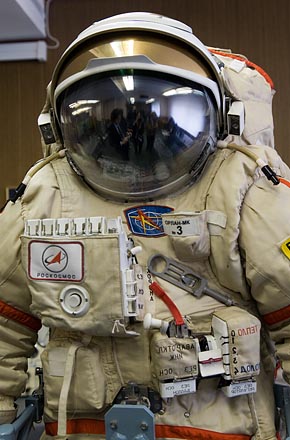
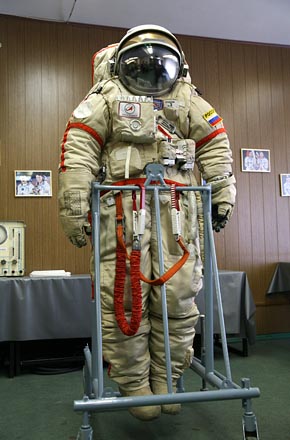
The Progress is carrying the first of the new Orlan-MK spacesuits, numbered 4; this is fitted with a digital computer in its life support backpack to process and transmit systems information, rather than the previous BRTA, БРТА radio-telemetry equipment. It will also indicate malfunctions and display the necessary recommendations to deal with these on a new special liquid crystal display (LCD) screen on the front chest part of the spacesuit. The Orlan-MK will be able to work in two modes: with the digital computer (as the MK) or without (as the previous M version).

Interesting tidbit: if a spacesuit’s serial number has a last even digit (2, 4, 6, etc.), then the spacesuit has blue stripes, if a last odd digit (1, 3, 5, etc.), then red stripes – a tradition of NPP Zvezda. (Via Anik) Thus Orlan-MK №4 has red stripes.

Some photo links of the spacesuits used for testing:

“Florida lawmaker opposes giving NASA permission to buy Russian spacecraft”, The Write Stuff, 12/9. If NASA loses its Russian/Soyuz access to space, the blame can be laid squarely upon cranky U.S. politicians! “Russia invaded Georgia” is somewhat more accurately phrased as “Russia responded to Georgia’s invasion of South Ossetia”.

Former astronaut LeRoy Chiao has a reasonably balanced blog post on the topic: “U.S.-Russian relations”, 31/8.

Prime Minister Putin signed a directive allocating 45 billion rubles ($1.8 bln) in additional funding for Russia’s space program. Funds will go firstly toward the construction of the new Russian spaceport, Vostochnii, in the Amur Region. Secondly will be ensured compliance with all the manned programs, which Russia exercises in the framework of international cooperation, taking into account all their commitments to the ISS. The third aspect is spacecraft, designed to enhance the effectiveness of Russia’s economy, such as meteorology, weather forecasting and scientific research.

Tuesday, 12 August 2008

He started it!

Georgia’s pea-brained hothead of a president decided to provoke Russia by invading South Ossetia, this while the Olympics are on too. Naturally the Western media are siding with Saakashvilli, who has them well and truly conned (“Saakashvili as a propaganda phenomenon”, RIA Novosti). This thread at NASASpaceflight.com speculates whether the hostilites will affect the ISS partnership, seeing as the USA has sided with Georgia (whose military has been trained by U.S. forces). Though as one notes, the U.S. invasion of Iraq didn’t affect the partnership.

Some blog commentaries: Da Russophile (beginning from this entry); Saakashvilli’s War at Sean’s Russia Blog. The Western media is generally useless for anything approaching impartial reporting when regards to Russia (some exceptions: “Russo-Georgian conflict is not all Russia’s fault”, Christian Science Monitor; “Plucky little Georgia? No, the cold war reading won’t wash”, Guardian).

Saakashvilli - epic FAIL

Sunday, 24 June 2007

Energiya vs. Roskosmos

Energiya and Roskosmos are bickering again, with the Federal Space Agency moving to fire Energiya President Nikolai Sevast’yanov (temporarily replacing him with Vice-President Aleksandr Strekalov).

Energiya’s management (including Sergei Krikalyov) signed a statement in support of Mr. Sevast’yanov (currently in Russian [Gone]; no English translation yet). This seems somewhat ironic, as his election was initially opposed in 2005, and the management of then signed a statement in support of the-then President, Yurii Semyonov! (The original collective letter. [Gone]) He must have made a good impression since then. At least he had a Vision for the future. Some interviews with him are on Energiya’s Publications page.

These sort of political machinations are wasteful and are hardly likely to inspire younger people to join the Russian space program (of whom it is in desperate need of).