Showing posts with label Progress. Show all posts

Thursday, 3 November 2011

Progress success

Progress M-13M/45 launched on 30/10 and docked to the Pirs module of the ISS on 2/11 with no anomalies, a great relief to everyone! The crew will get some iPads (lucky them!). (NASASpaceflight.com: “Progress successfully docks to ISS; stage set for return of manned Soyuz flight”.) The next crew to launch in November will be ISS-29/30.

The Mars-500 experiment ends this week, 4 November! The crew seem to have survived with their sanity intact :-).

China’s launch of the Tiangong 1 space station module on 29/9 was successful. On 31/10 Shenzhou 8 was launched, an unmanned version of the capsule, and remotely docked to Tiangong on 2/11.

The Phobos-Grunt probe is set to launch next week, 8 or 9 November, if there are no delays – the launch window is from 5-25 November, otherwise there are another 2 years or so until the next Mars launch opportunity. It has what appears to be an official website.

I decided not to buy the Spaceflight issues mentioned last entry as they were speculative only, and the magazine too expensive.

Wednesday, 21 September 2011

Heavenly bodies

The cause of the Soyuz rocket crash last month was given as being due to a clogged fuel line leading to a gas generator, thought to be human error rather than a design flaw. (NASASpaceflight.com articles: 31/8, 15/9.) Crew launches on the Soyuz rocket have been delayed a little, and the next Progress launch (Progress M-13M/45P) is set for 30 October. Crew launches are on the Soyuz-FG, which has a modifed fuel injection system on the engines of the first and second stages, but it and the Soyuz-U have the same 11S510-PVB Blok-I third stage.

China is to launch the first module of its planned space station next week on a Long-March Ⅱ-F carrier rocket (MSNBC/Spacedaily articles). The module is called Tiangong 1, or “Heavenly Palace”. The module is to be used to practice rendezvous and docking, initially with the unmanned Shenzhou-8 that will be subsequently launched. If it is successful, it will be followed by Tiangong 2 and 3 space labs in a few years.

New Scientist magazine had an article about the support operations for the Mars-500 mission in its 17 September issue. (Text online here.)

The July and August issues of BIS Spaceflight magazine have a 2-part article on death in space. I am debating whether to buy the issues as the magazine is now quite expensive in Australia ($17) and hard to find. On browsing through the July issue in a newsagent, the first part was more speculation about various medical issues that might occur during a long spaceflight. A bit disappointing as I was hoping for an actual list of procedures from NASA, or whoever! The somewhat morbid topic has interested me for years, but there are no actual documents online, only occasional speculations on forums. I actually wrote out my own version of such a document in the style of other online ISS documents as part of a somewhat irreverent short story I did some years ago (“Houston, we have a corpse”) that included a space autopsy (“2001: a space autopsy” – I had some fun making up those headings :-):

Thursday, 25 August 2011

Progress launch failure

For the first time after 135 launches, a Progress cargo ship failed to reach orbit on the 136th launch (since January 1978). Progress M-12M (44P) launched on 24/8, but the third/Blok 1 rocket stage of its Soyuz-U rocket failed 5m 25s into flight, achieving only a sub-orbital trajectory, and both crashed in the Choysk district of ​​the Altai Republic (South Siberia).

This comes the week after the telecommunications satellite “Express-AM4” failed to reach orbit on 17/8 after the Briz-M upper stage of the Proton-M rocket lost power after its fourth burn (NASASpaceflight.com report). Both are manufactured by Khrunichev. The damage for this, including launch costs, exceeds 20 billion rubles.

Khrunichev also manufacture the RD-0110 (11D55) liquid-propellant rocket engine used on the 3rd stage of the Soyuz rockets

The loss of the cargo is a setback but is not yet critical for the ISS crew, who have enough supplies to last until the next Progress launch on 28/10 (STS-135 also brought up a lot of supplies). However the next crew launch in September will be delayed until the cause for the malfunction is found, as they go up on a Soyuz-FG. The ISS also needs Progress ships for its periodic reboostings.

Thursday, 12 August 2010

Mars and magic curtains

Energiya has a brief report at its site (also at Roskosmos) on the cause of the Progress M-06M docking abort last month: due to interference over a communication channel, a cosmonaut accidentally pressed one of the buttons on the control panel.

Difficult rebirth for Russian space science”, BBC News, 29/6/2010. Article by Anatoly Zak on the difficult task facing Russian engineers trying to relaunch their country’s long-dormant unmanned space exploration program.

Russia to kick off construction of a new spaceport”, BBC News, 20/7/2010. Восточный, Vostochnyi (“Eastern”) cosmodrome, an alternative to Baikonur, is to be constructed in Russia’s Far East, intended to be finished by 2015.

Magic Anti-Radiation Curtain to be Installed in the ISS”, RK, 6/7/2010. An anti-radiation curtain developed by IMBP was delivered on M-06M:

Progress M-06M cargo supply vehicle has delivered a so-called “magic curtain” to the International Space Station. Flight engineer Fyodor Yurchikhin will install the curtain in the starboard’s cabin of the Zvezda module. The curtain designed by IBMP has special pockets for special wet hygienic towels used by cosmonauts onboard the station. The towels are saturated with hydrogen, carbon, nitrogen, which mitigate space radiation effects. The curtain is equipped with the radiation doze meters. Additional anti-radiation crew protection may be provided by three-layer wet towels on the walls of the cabins, thus mitigating radiation effects for cosmonauts, scientists believe.

Result of Matreshka experiment carried out in the station since 2004 show that the radiation is about two times weaker in the center of the station then near the walls. Phantom Matreshka-R is to monitor anti-radiation effectiveness of the wet towels. Experiment Matreshka is to study and to analyze radiation dose distribution in cosmonaut's body during long-term mission aboard the International space station (ISS). Dose from ionizing space radiation was determined with the help of thermoluminescent dosimeters mounted in conditional depths of critical organs in human body modeled in a dosimetric device, i.e. a ball-like tissue-equivalent phantom designed and manufactured in Russia for international space experiment Matreshka-R.

Roscosmos Head Anatoly Perminov: Mission to Mars is to Take Place after 2035”, RK, 7/7/2010. More disappointing confirmation that there won’t be a Russian Martian attempt for some decades. I hope circumstances alter this! (Perhaps discovery of an alien artifact somewhere in the Solar System…)

Roscosmos Head Anatoly Perminov stated that the mission to Mars is planned after 2035, answering the questions of the students at the opening ceremony of International Students Science School “Space Exploration: Theory and Practice” in Russian Federal Space Agency. “Russia, Europe, the USA are interested in Martian missions today. India and China also have similar projects. There are more talks about human space missions to Mars. Russian Government have approved Federal Space Program which clearly defines sequence of automated space missions, as well as future human missions. The basic strategy implies Martian program to be implemented after 2035,” Perminov stated.

He also explained that there are no engines and propulsions systems capable to deliver humans to Mars in 2-3 months. “This is feasible only with nuclear propulsion. Many countries are trying to develop engines of new type, which can make mission time 20 times less- to reduce it from 1.5 years to 2 months,” Roscosmos Head said.

He added that there is another issue – human protection against solar radiation and radiation of the nuclear propulsion (if it is used). “This leads us to increasing mass of the launcher. No country is able of reaching Mars or other planets quickly. We are facing the energy problem. That’s why 2035 is defined in our plans,” Perminov said. “There is another option proposed by Russia and negotiated with heads of other space agencies. Interplanetary vehicles could be assembled in LEO. This approach can help us making the interplanetary missions sooner. Young generation will work with it, develop a new propulsion with a brand new operation principle,” Roscosmos Head concluded.

The Mars-500 crew are now over 2 months into their mission. They are no longer in real-time contact with TsUP:

25/07/2010: Today is important crucial point in the life and work of the crew because voice communication sessions will be completely ceased since the 26th of July. We change over to batch communication with gradual (stepwise) increment of the delays of communication. Batch communication means video-voice messages to the crew and similar answers. It can be used for the implementation of difficult experiments, for regular medical control and for psychological support. In addition to this the communication with the crew via electronic messages will be kept.

Blogger/Google have at last instigated comment spam filtering, so perhaps I can block my persistent Chinese spammer!

Saturday, 3 July 2010

Progress gone astray

Progress M-06M launched successfully on 30 June, but its attempted docking on 2 July was aborted when 20 minutes/3 km from the Station:

Progress Docking Abort: Docking of Progress M-06M/38P was aborted about 20 minutes before its scheduled linkup with ISS at 12:58 p.m. EDT due to loss of radio lock between KURS-P on the SM (Service Module) and KURS-A on Progress. The cargo drone passed by ISS at a safe distance and continues to be in its safe fly-by mode, circling Earth along with ISS every 92 minutes. Docking will not be re-attempted today. ISS systems are being reconfigured back to nominal stage operations configuration. Evaluations are underway for subsequent docking attempts.

– ISS OOR 2/7/2010

The backup manual docking system (ТОРУ, TORU), controlled by crew on the ISS, was also unsuccessful when activated. The next docking attempt will be on Sunday 4 July. (Relevant NASASpaceflight.com thread)

[Update: Progress M-06M successfully docked on 4 July at 16:17:26 to Zvezda SM.]

Yest kasaniye! At 12:17 p.m. EDT, Progress M-06M (38P) docked successfully to the SM (Service Module) aft port under KURS autopilot control, followed by a final DPO post-contact thrusting burn, docking probe retraction and hook closure (“sborka”) after motion damp-out while the ISS was in free drift for ~20 min (12:17 p.m.-12:37 p.m.). At “hooks closed” signal, the SM returned to active attitude control, maneuvering the ISS to LVLH TEA (local vertical/local horizontal Torque Equilibrium Attitude) at ~12:37 p.m. Control authority returns to US Momentum Management at ~2:10 p.m. Russian thrusters will be disabled temporarily during clamps install and leak check (2:10 p.m.-4:10 p.m.). [This was the second docking attempt after yesterday’s aborted linkup, now traced to an interruption of the TORU radio signal by the SM’s Klest/Simvol television system. The dropout of the TORU teleoperated rendezvous & docking system then generated the command “cancel dynamic operations” which aborted KURS automatic rendezvous mode and switched Progress to a safe, passive flightpath, as designed. For today’s docking, TORU, which is usually in “hot standby” mode during Kurs-controlled dockings, was not activated.]

Monday, 13 July 2009

Moon melancholy

The 40th anniversary of the first Apollo Moon landing is coming up, so there is a lot of blather and angst in the media and on various forums. No Russian cosmonaut has yet been out of low Earth orbit – one wonders if they ever will. The anniversary has inevitably brought out the Paranoid Patriots, as evidenced in these quotes:

Now potential rivals such as China seek to challenge US dominance in space, and some see the new space race as once again a battle between ideologies.

“From the point of view of the future of the western world and its Asian allies it’s imperative that the US, Europe, Japan, Australia, Canada and other like-minded countries be competitive in deep space,” Moonwalker and geologist Harrison Schmitt told AFP.

Schmitt said he believed that “non-democratic nations of the world, China, Russia and maybe others, fully intend to be dominant in space…[and] gain that kind of prestige, that kind of advantage in technology and education and other fields that come with being the dominant space power.

“With the Apollo program we taught them how,” said Schmitt, who was the last astronaut to step out of a lunar craft and onto the moon surface in 1972.

– “Space, man’s greatest challenge, 40 years after Moon walk”, Space Daily, 12/7/2009

STS-127 Atlantis is still trying to launch; it has had 4 scrubs so far! Originally to have launched on 13 June, the first delay was due to a hydrogen gas vent leak; the second because of a work light knob embedded between the pressure pane on Atlantis’ pilot window and the dashboard panel, and the last two because of thunderstorms. The next attempt is in a few hours. A very frustrating process for all involved, as the orange External Tank has to be drained and refueled each time, and the Shuttle crew has to prepare themselves, only to be disappointed. (Maybe they should try sacrificing a goat.) The Soyuz manned rocket launches are, in contrast, rarely delayed (I don’t know if any have been).

Posters at the Novosti Kosmonavtiki forum are not too impressed with the proposed names (6/7/2009 entry) for the next 3 Russian ISS modules, describing them as “utilitarian”, lacking in romanticism, difficult to pronounce (i.e. too long) and imitating NASA’s pointedly symbolic names. Some proposed are: «Спектр», Spektr (Spectrum), «Природа» Priroda (Nature), «Радуга», Raduga (Rainbow), «Горизонт», Gorizont (Horizon). The names are “recycled” (used on previous projects, such as the Mir space station) but are nicer than the officially-proposed ones.

Progress M-02M successfully performed a re-rendezvous test today to verify the new passive KURS-P system antennas and TORU target installation accuracy at the SM PkhO (Service Module Transfer Compartment) zenith port. There was some nervousness about this as a similar 1997 Progress (M-34) rendezvous with Mir bumped into the space station.

Thursday, 2 July 2009

Phobos-Grunt on schedule

According to Anatoly Zak who was at the Paris Air and Space Show on 15 June, and who spoke to the head of NPO Lavochkin Georgii Poleshyuk, the components of the Phobos-Grunt, «Фобос-Грунт» probe were being integrated, beginning 20 June. The probe’s main propulsion unit is the most complex and critical element. Everything will be transported to Baikonur Cosmodrome in September of this year.

Progress M-02M undocked from the ISS (Pirs docking module) on 30/6 for autonomous flight tests of its systems; it will redock on 2/7.

From NK №789:

19/06/2009 / 08:46 – The economic crisis could derail the creation of a new Russian cosmodrome

The economic crisis could prevent modernisation of the Russian space-rocket industry, and also disrupt the establishment of our own “window” in space – the Vostochnyi, Восточный cosmodrome, Vitalii Davidov declared on Thursday.

According to him, last year’s re-financing of the industry has dramatically increased.

“Before it was one per cent, and in order to re-branch had about 70 years, starting this year, especially for the next year we have planned investments in retooling the industry, which should have been raised by 15% -20% of the overall funding level,” said the official, speaking at a meeting of the working group on innovative legislation in the Presidential Administration of the Russian Federation.

He noted that the same magnitude of re-financing was needed during the implementation of programs for the Soviet space shuttle Buran in the late 1980s.

But Davydov fears that the crisis could disrupt plans for re-equipment: “What happened at the end of last year, this crisis, we thought it would not affect our plans, but today we realize it is not possible. This is a significant impact on our plans, especially in terms of security, including independent access to space, the development of the new cosmodrome on the territory of Russia,” said the Roscosmos Deputy.

Sergei Krikalyov’s photo has at last appeared on the Gagarin Cosmonauts’ Training Center website (the Russian version so far), so he must now have officially assumed command. According to Anik, he left the Cosmonauts’ Group of RSC Energiya on 27 March 2009.

Thursday, 7 May 2009

MIM-2 update

Expedition 20 is to launch at the end of this month on Soyuz TMA-15; they will join Expedition 19 to make the first 6-person crew. Keeping track of comings and goings will be much more complicated from this year!

There is a NASA preflight interview with cosmonaut Roman Romanenko, who will be making his first flight. He, like Sergei Volkov (Expedition 17) is a second-generation cosmonaut (son of Yurii Romanenko). He gave some details about the next Russian module to be launched this year, MIM-2, МИМ-2:

Q: According to the plan currently, shortly after your arrival there is a pair of spacewalks planned for Gennady and Mike to make. Tell me about what they’ll be doing outside the station, and what you will be doing inside to support that work.

A: Yes, during our increment there will be a lot of EVA activities; in other words, spacewalks. In addition to two Russian scheduled EVAs, there will be seven or eight EVAs by the shuttle crew members. They will need to perform a lot of tasks. However, the main objective for all EVAs is to outfit the ISS with all those elements and modules and hardware units that will ensure successful operation of a six-person crew on board the ISS. EVAs that will be performed by Gennady and Mike Barratt, those EVAs will also address the tasks of outfitting the Russian segment with the new Mini Research Module #2, delivery of which is scheduled for this year. We’re hoping that we will receive this module during our mission; it is scheduled for delivery at the end of summer, beginning of the fall. It will dock to the Russian segment and Gennady, during his EVA with his U.S. colleague, will have to route cables in order to ensure docking of this module.

[…]

Q: Another new component for the Russian segment of the space station is due to arrive before the end of the year. It’s called the Mini Research Module 2. Can you describe what that is for us and what that will add to Russian segment operations?

A: I think that this new module will be slightly larger than the Docking Compartment. However, it will provide additional vole for various experiments on the Russian segment. It may also be used as the additional airlock for EVAs, or a connecting module for subsequent addition of a larger, another larger module to the Russian segment. The reason why the name of this new module is Mini Research Module is due to the fact that this new addition to the station will house a number of scientific experiments that will be performed under the Russian space agency science program.

Progress M-66 undocked yesterday at 15:18 UTC, and will deorbit on 18/5 after performing the Plazma-Progress geophysical experiment this week.

Wednesday, 6 May 2009

Phobos-Grunt: launching or not?

Contrary to the article mentioned in my 12/4/2009 entry, more media reports have surfaced that the Phobos-Grunt («Фобос-Грунт», Photos-Soil) probe to the Martian moon will launch later this year after all, as noted in this month’s FP Space posts, but it is hard to know what to believe! The article below is from a post at NASASpaceflight.com:

Preparations For Launch Of Phobos-Grunt Probe Proceed As Planned

Moscow ITAR-TASS in English 1307 GMT 05 May 09

Moscow, May 5 (Itar-Tass) – All preparations for launching the Phobos-Grunt space probe, expected to deliver to the Earth samples of Martian soil, proceed strictly as planned, the general director and general designer of the Lavochkin research and production association (the probe’s manufacturer), Georgy Polishchuk, told Itar-Tass on Tuesday.

“The work schedule is tight, but everything is on time and the question of shifting the launch from 2009 to 2001 has not been discussed anywhere,” Polishchuk told Itar-Tass in the wake of media rumors the probe’s launch had to be delayed due to a shortage of personnel.

Polishchuk said the Phobos-Grunt probe, which is on the list of the federal space program extending till 2015, is a number one priority for the Lavochkin Association.

“At the launch site and at the head office work is in full swing. Cooperation with the Chinese partners proceeds well,” he said.

The Lavochkin Association has already integrated a test sample of the Chinese micro-satellite with the Russian probe, and the flight sample will be delivered to Russia on June 17.

The probe’s Wikipedia page has more information.

“Focused On Phobos”, Space Daily/Astrobiology Magazine, 4/5. Describes planned missions to the Martian moon.

From Novosti Kosmonavtiki №779:

05/05/2009/11:45 – The waiting period for cosmonaut flight in Russia will be reduced by half

Russian cosmonauts, who are now waiting for their turn to fly more than a decade, will no longer have to wait so long. Starting this year, the ISS will be expanded to a crew of six people.

“This year we will send four Soyuz ships to the ISS, and the queue will move much faster,” said Yuri Gidzenko, the first deputy head of cosmonauts.

In turn, the first hereditary cosmonaut Sergei Volkov, the acting commander of the cosmonaut detachment at TsPK (Star City), said that in his opinion, the younger cosmonauts will “sit on the bench” only half as long as his generation. “If there will be four launches a year, they will have to wait five years for a flight, not eleven as we did,” he said.

Progress M-02M is to launch from Baikonur on 8/5, carrying the third Orlan-MK #6 (#1080006) with blue stripes. Progress M-66 is to undock from the ISS (Pirs DC) today at 15:15 UTC.

Saturday, 18 April 2009

Cosmonaut recruiting changes

US Astronauts will Learn Russian. Talent for Science will Take High Priority in Russian Cosmonaut Selection”, Roskosmos, 15/4. NASA astronauts will be required to learn Russian and study the Soyuz spacecraft as this will be their only means of transport to the ISS after the Space Shuttle is retired (and there is much controversy over that!). Also, when recruiting future cosmonauts, those who are researchers will be more emphasized:

Selection process of the future cosmonauts is intended to be based on their abilities to implement scientific and research programs. The Commission also discussed additional recruitment of test cosmonauts and research cosmonauts in 2009 for the ISS program (until 2015). The meeting was led by Roscosmos Head Anatoly Perminov, chairman of the Inter-Agency Commission.

A.N. Perminov proposed to introduce some changes into the Commission Protocol. He stated that “not only pilots, but researchers from the universities shall be hired to become cosmonauts”. The main emphasis should be made on the talented young people, who study prospective scientific topics. These people would continue their work during the space mission, and after it.

Baikonur: Progress M-02M Prelaunch Operations”, Roskosmos, 16/4. This features some photos of the Orlan-MK spacesuit (№6) being tested at Baikonur; it is to be launched on the next Progress cargo ship.

Sunday, 30 November 2008

Charred cosmonaut

A thread at the CollectSPACE.com forum links to an online photo of what are purportedly the remains of cosmonaut Vladimir Komarov, who died on impact in the Soyuz-1 landing after its parachutes malfunctioned. Being the ghoulish and morbidly curious type, I have to post the photo below (in case it disappears):

Remains of Vladimir Komarov

From one post:

I think these paragraphs in the Kamanin Diaries 1967-68 (General Kamanin is on the right adjusting his tie) give the context of when the picture was taken:

Kamanin returned to the place of the accident and ordered a group of doctors to remove Komarov’s body from the ship’s wreckage…at 21.45 (Moscow time) Komarov’s remains were placed aboard the II-18 airplane. Ten minutess before departure an An-12 arrived from the cosmodrome with General Kuznetsov and the Soyuz-2 prime and back-up cosmonauts, who would accompany their perished colleague to Moscow… Komarov’s remains were transferred to the morgue of the Burdenko hospital in Moscow, allowing doctors to write an official report on the cause of death. Subsequently the remains were cremated and an urn with the ashes was placed in the central House of the Soviet Army later that day were endless line of people came to pay their respects. The following day Komarov’s ashes were interred in the Kremlin Wall.

My initial impression on looking at that was “lump of charcoal” – not much left of him! He died immediately on impact, then the capsule burst into flame.

From Challenge to Apollo, page 587:

Finding the body had been a difficult job. One of the rescuers recalled:

The group’s physicians set to work – they shoveled away the top layer of dirt from the top of the mound from the hatch cover. After the dirt and certain parts of instruments and equipment were removed, the cosmonaut’s body was found lying in the center chair. The physicians cleaned the dirt and the remnants of the burned helmet phone from the head. They pronounced the death to be from multiple injuries to the cranium, spinal cord and bones.

[…]

In a grisly aside to his death, not all of Komarov’s remains were found during the initial search, and a group of Young Pioneers, the equivalent of Boy Scouts in the Soviet Union, discovered additional remains that were later buried at the crash site itself. Reportedly, Party officials took great pains to hide this from the general public.

I wonder how they could determine so much detail from those remains, if they are him.

Progress M-01M/№401, the first of the new Progresses with new onboard computer, TsVM-101, a digital telemetry system, launched on 26/11.

Saturday, 13 September 2008

Hurricane havoc

Progress M-65 (30P) launched on 10/9 at 19:50:02 and was due to dock on 12/9, but this has been delayed until 17/9 due to Hurricane Ike forcing the evacuation of Houston Mission Control (and the rest of the city) – “Hurricane Ike disrupts traffic in space”, MSNBC.com, 12/9.

NASA has set up backup Mission Control teams for the space station near Austin, Texas, and in Huntsville, Ala. Yembrick said that the main Mission Control room in Houston is preferred to feather the space station’s U.S. solar arrays into an edge-on position to incoming spacecraft to avoid damage from thruster firings.

From orbit the hurricane looks deceptively calm and serene (ISS photos ISS017-E-015751 and ISS017-E-015752); like swirled cotton wool or whipped cream. NASA has a Hurricane Resource Page with updates, and the NASASpaceflight.com forum has a dedicated thread. The hurricane is a Category 2 and is very wide (nearly 1000 km across). The low-lying Texas coast means the storm surge will flood the region.

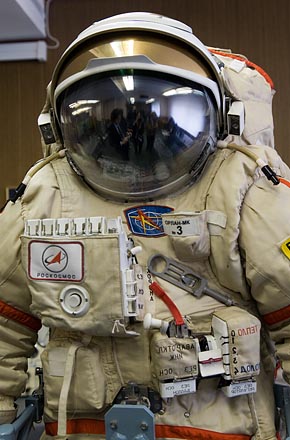
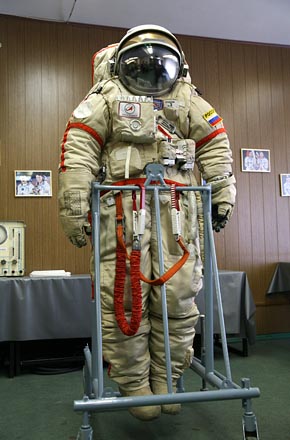
The Progress is carrying the first of the new Orlan-MK spacesuits, numbered 4; this is fitted with a digital computer in its life support backpack to process and transmit systems information, rather than the previous BRTA, БРТА radio-telemetry equipment. It will also indicate malfunctions and display the necessary recommendations to deal with these on a new special liquid crystal display (LCD) screen on the front chest part of the spacesuit. The Orlan-MK will be able to work in two modes: with the digital computer (as the MK) or without (as the previous M version).

Interesting tidbit: if a spacesuit’s serial number has a last even digit (2, 4, 6, etc.), then the spacesuit has blue stripes, if a last odd digit (1, 3, 5, etc.), then red stripes – a tradition of NPP Zvezda. (Via Anik) Thus Orlan-MK №4 has red stripes.

Some photo links of the spacesuits used for testing:

Florida lawmaker opposes giving NASA permission to buy Russian spacecraft”, The Write Stuff, 12/9. If NASA loses its Russian/Soyuz access to space, the blame can be laid squarely upon cranky U.S. politicians! “Russia invaded Georgia” is somewhat more accurately phrased as “Russia responded to Georgia’s invasion of South Ossetia”.

Former astronaut LeRoy Chiao has a reasonably balanced blog post on the topic: “U.S.-Russian relations”, 31/8.

Prime Minister Putin signed a directive allocating 45 billion rubles ($1.8 bln) in additional funding for Russia’s space program. Funds will go firstly toward the construction of the new Russian spaceport, Vostochnii, in the Amur Region. Secondly will be ensured compliance with all the manned programs, which Russia exercises in the framework of international cooperation, taking into account all their commitments to the ISS. The third aspect is spacecraft, designed to enhance the effectiveness of Russia’s economy, such as meteorology, weather forecasting and scientific research.

Thursday, 15 May 2008

Recruitment difficulties

Internal NASA Documents Give Clues to Scary Soyuz Return Flight”, James Oberg, IEEE Spectrum, May 2008. James Oberg gives a measured account of the events of the off-nominal Soyuz TMA-11 landing; what is known to date. There are also some diagrams from a NASA document. Novosti Kosmonavtiki news №702 also mentioned the article, saying that it is interesting material with a calmer tone in contrast to reports in the Russian media. “Oberg writes that the events on 19 April were very unpleasant, but they again demonstrated the reliability of the Soyuz spacecraft, which has accumulated nearly 100 manned missions. A flattering estimation, but it reflects reality.” Comments at the relevant thread at NASASpaceflight.com. There are some at the NK forum (in Russian, try Babelfish to translate), though they seem a little more dismissive (as much as I can make out from the translator).

Perilous Landings by Soyuz Worry NASA”, Washington Post, 12/5.

Progress M-64 launched on 14 May at 20:22:56.216 UTC. One item it carries is a new Sokol pressure suit for ISS Commander Sergei Volkov as his has a damaged zipper (4 teeth misaligned).

From Novosti Kosmonavtiki news №703, concerns with difficulties in recruiting cosmonauts:

4/05/2008/00:18 – Manpower is a serious problem for NPO Energomash, and for RKK Energiya’s cosmonaut group

Manpower is a serious problem for the famous creator of rocket engines NPO Energomash, and the RSC Energia cosmonaut group. This was stated by the CEO of NPO, Nikolai Pirogov, and the Deputy Leader Flight Space Center RSC Energiya pilot-cosmonaut Pavel Vinogradov at a recent meeting with the cosmonauts at Energomash.

“The problem of manpower and the problem of technical reequipping are the main challenges before us,” Nikolai Pirogov said in reply to a question. “With regard to personnel,” he elaborated, “this is an extremely acute problem. For three years we have managed to reduce the average age of staff for 4 years and now it is 49 years old, but it is still an advanced age.” As pointed out by the Director General, “a good, qualified fitter takes 5-6 years to train.”

As for his side, said Pavel Vinogradov, “the staffing problem, the problem of recruiting youth into the cosmonaut group is serious.” “We would like to recruit 5-7-8 people a year,” he said “but, unfortunately, today we select only one or two.”

“The problem is not serious because few are willing to apply,” added the pilot-cosmonaut, “many do apply, but we have a very strict selection system. According to our statistics, from thousands of military pilots, who are understandable, initially are healthy people, we initially draw 20 people. Then, when they start to take our commission, we select the healthiest two or three. We are reaping the fruits of what happened in the country 15-20 years ago, and healthwise, from a medical point of view, it is very difficult to select people.”

“In Energiya the requirements are considerably more stringent, ” noted Vinogradov. “Besides being healthy, an applicant must have professional knowledge, must be very good engineer, be very diversified, multitalented, with good preparation from a good university. And such people there are generally only one, if not less.”

According to him, “the financial side is also a problem.” “Today the highest salary among pilots, cosmonauts, who have classes already flew at 15 940 rubles,” he said. “We once tried to solve this problem, in particular, by paying the remainder to us from the corporation. But it is abnormal when a cosmonaut receives less than a subway train driver. I can not say that we do not pay attention,” stressed Vinogradov, “unfortunately, there are many unresolved legal and legislative problems that have remained since the Soviet Union and deal with them is very difficult. But we are working toward a solution.”

Friday, 11 April 2008

ISS RS delays

Russian ISS segment construction delayed for 5 years”, RIA Novosti, 10/4. Insufficient funding means the completion of the ISS RS might be pushed back from 2010 to 2015, requiring Russia to request of the other partners that the ISS lifetime be extended to 2020.

Sergei Krikalyov news:

  • Energiya photo-report, 7/4: “Baikonur launch site, branch office of S.P.Korolev RSC Energia A meeting of the State commission was held. Director of Gagarin Cosmonaut Training Center V.V. Tsibliev reported about the crew readiness for the planned spaceflight. RSC Energia President and General Designer V.A. Lopota reported about readiness of the Soyuz FG/Soyuz TMA-12 rocket-space complex for further prelaunch processing. The State commission approved the prime and backup crews for the Soyuz TMA-12 spacecraft and the ISS-17 and also a decision was adopted to continue preparation of the Soyuz-FG/Soyuz TMA-12 rocket-space complex for fueling and launch at the set time on April 8, 2008, namely at 15 hr. 16 min Moscow time.” Sergei appears in photos 7, 8, 11.
  • «Космонавты могут снимать более качественно, чем спутники – Крикалев», RIA Novosti, 10/4.

Cosmonauts can photograph better than satellites, says Krikalyov

A skilled cosmonaut onboard the International Space Station can make a photo of the surface of the Earth, of a quality comparable to the pictures received from satellites that cost hundred millions of dollars; besides he, unlike the automatic device, can analyze a situation and make pictures at the appropriate angles, Russian cosmonaut Sergei Krikalyov considers.

Krikalyov, the record-holder for the total duration of flights on the Mir space station and the ISS, presented on Thursday an exhibition of photos from space, as part of the Institute of Space Research (IKI) exhibition “Science on the ISS Russian segment”.

“NASA experts expected that from a camera in a manual mode with a telephoto lens from board the ISS, the pictures would turn out with a resolution worse than 15 meters. However the photos taken through windows have shown, after a careful studying of the ground, that separate pictures are obtained with a resolution of 10 meters, and with using the nadir (a point opposite to zenith) – about 5 meters,” said Krikalyov, answering a question from RIA News.

He explained that automatic satellites cannot replace a person as some Earth sites are often overcast above, and only a person can – having analyzed real-time conditions – take pictures at the correct angle.

“Even NASA experts say that they are reconsidering their attitude to the photos taken in a manual mode by cosmonauts. Earlier they relied only on photos from satellites,” the cosmonaut said. He also said that with the advent of new digital technology on board the ISS may enable things previously inaccessible. “For example, Polar Lights [aurora] from space appeared recently, and I am confident that no one else has done such imagery,” said the cosmonaut.

Six-flight veteran Krikalyov said that he took both art photography, and images on behalf of the Roscosmos and NASA. He used film at first, then Nikon digital cameras with a 400-millimetre telephoto lens and an extender.

From Novosti Kosmonavtiki news №696:

11/04/2008/00:09 – A mini-satellite will be released from a Progress cargo ship for studying lightning

In 2009 in orbit a unique experiment will be carried out for the first time: after undocking from the ISS, the Progress space cargo ship will release a mini- satellite, «Чибис», “Chibis” (“Lapwing”), intended for studying lightning, reported Leo Zelenyi, the head of the Institute of Space Research (IKI) RAN (Russian Academy of Science). The Chibis “mini- satellite”, intended for studying lightning discharges, is planned to first be delivered to the ISS with the flight of the Progress cargo ship, after which the following Station crew will install a container with the small automatic spacecraft inside the Progress, which is usually deorbited. This ship, which depleted its resources as part of the ISS, not will be deorbited immediately, but instead raised in orbit by height about 500 kilometers, where the automated mini-satellite will be separated from the cargo ship, a scientist explained.

“The ship itself after this will be brought down from orbit and deorbited in the calculated unnavigable region of the Pacific Ocean,” added Zelenyi.

Cosmonaut Sergei Krikalyov added, from his side, that in RKK Energiya at present begins the fundamental decision of conducting of this unique experiment. “We must study the question of ballistics, make a decision about servicing the Progress before launch with an additional volume of fuel so that it would be sufficient to raise the cargo ship to an altitude of 500 kilometers,” said the cosmonaut. The mass of the Chibis satellite is 40 kilograms, scientific instruments weigh 12.5 kilograms, and additional equipment is 18.2 additional kilograms. The satellite is developed by the specialists of the Institute of Space Research.

Wednesday, 30 January 2008

Soyuz TMA-10 ballistic landing cause determined

Via José (and also reported at MSNBC.com):

The reason for the rough landing of Soyuz TMA-10 has been determined

29/1/2008, Lenta.ru

The reason for the ballistic descent of the descent vehicle Soyuz TMA-10 with the ISS crew members onboard during 21 October 2007, was caused by damage to a cable in the spacecraft’s control panel, said RKK Energiya leader Vitalii Lopota.

“The Commission of Inquiry for the reasons for the contingency situation finished its work and established that the reason for ballistic descent was the cable fault, which connected the control panel with the Soyuz descent equipment,” said Lopota. According to him, RKK Energiya will take all measures to avoid a repetition of this situation.

On 21 October 2007 the descending ship capsule Soyuz TMA-10, on which was being returned the members of the 15th ISS Expedition – Russians Fyodor Yurchikhin and Oleg Kotov (more half a year in orbit) and the first cosmonaut of Malaysia, Sheik Muzafar Shukor (11 days in orbit) – passed from the controlled regime to ballistic. The capsule landed 70 kilometers from the planned landing place and the cosmonauts endured overloads up to nine gravities/units.

According to the chief ballastician of Mission Control Center (TSUP), Nikolai Ivanov, the overload was short-term and did not threaten the health and life of the cosmonauts. “The ballistic descent – into the regime of which the day before, the descent vehicle with the cosmonauts of the 15th Expedition and the first cosmonaut of Malaysia, the control system transferred in the section of descent into the Earth’s atmosphere – is not a nonstandard regime, and the overload to nine units, tested by the crew and which was being continued of approximately ten seconds, did not threaten their life and health,” said Ivanov. “There was a failure, but the Soyuz control system not only did not refuse, but, that – of principal importance – successfully transferred the descent vehicle into the more reliable regime of descent into the Earth’s atmosphere. If this happened, God forbid, with the American shuttle, in which a regime of ballistic descent is not provided, then it would be necessary to go with a funeral procession to meet the astronauts inside it.”

The difference between the ballistic and controlled descent is that the controlled automation constantly orients the descent vehicle by its flat lower part to the Earth, which ensures lift due to the incidental airflow, and it ensures minimum overloads for the crew up to four gravities/units, Ivanov explained. “The descent along the ballistic trajectory without the participation of lift is comparable with a falling stone, but if we permitted it to fall like a stone, then the overload would reach a limit incompatible with human life. Therefore we constantly rotated the descent vehicle around its axis, it achieved approximately one revolution after half a minute, what contributed (to transfer) the life-threatening ‘foot-head’ overload into the more acceptable ‘chest-spin’ overload due to the centrifugal force,” said the ballistics chief.

According to the 15th Expedition commander Fyodor Yurchikhin, “The rotation of the descent vehicle was sharp, rigid, with strong vestibular irritation, which I could feel from the left seat of the capsule in which I sat. The overload increased gradually, up to a tolerable 8.56 units. After overload at seven units we ceased to report to Earth about our health in order to concentrate on maintaining our respiration. But the crew members did not experience loss of sight and consciousness, and we understood that we just had to endure the ordeal.”

Russia may build new shuttle spacecraft by 2015”, RIA Novosti, 29/1. Energiya’s spacecraft proposal (it has 6 projects, 2 of which it will submit to the Russian Space Agency in the near future) would likely have a lifting-body design and carry a crew of 6. More via Novosti Kosmonavtiki news №682: Sergei Krikalyov, Energiya’s deputy design project leader, is convinced that several different spacecraft designs will be required to realize Russia’s space projects. “It is not possible to create a ship which would equally be suitable for flights the Moon, Mars, and for the flights to near-Earth orbit. Therefore I do not exclude that not one manned ship will be built, but several,” emphasized the cosmonaut. He said the new ship will be constructed at the new spaceport.

Energiya chief Valerii Lopota said at the 31st Academic Readings in Cosmonautics conference that the Soyuz and Progress ships would be transferred over to digital technologies in the 2008-2009 period which would increase their reliability.

Friday, 25 January 2008

30 years of Progress

Energiya press release: 20 January 2008 marked 30 years since the launch of the first Progress cargo ship. The Progress ships have served the Russian space program reliably (and mostly been ignored in the media). ESA’s Automated Transfer Vehicle cargo ship uses Russian propellant and tanks in its design, and the first launch is currently set for 22 February. It will dock to the aft of the Zvezda Service Module.

(Tass newspaper frontpage via Novosti Kosmonavtiki)

From Novosti Kosmonavtiki news №679:

20/01/2008/08:35 – Russian scientists will conduct a series of experiments to investigate the Moon, including the use of Japanese instruments

The project “Luna-Glob” (Luna-Globe) is planned to solve complex research tasks for the Study of Earth satellite, said Lev Zelenyi, the director of the Institute for Space Research at the Russian Academy of Sciences. The project “was broadened. It includes several phases, including the dumping on the surface of the Moon of so-called penetrators to study our satellite,” said Lev Zelenyi.

He explained that penetratory (impact penetrating probes) are planned to be fired from the automatic spacecraft, which will be placed in the Moon’s orbit. The probes under the action of lunar gravity will drive away also at a high speed and enter into the soil of the Moon at the depth of several meters. The on-board sensors, which operate from autonomous power supplies, can transmit information about the composition and the properties of lunar soil, and the seismic characteristics of Earth’s natural satellite. “It was decided to use penetrators of Japanese production, since the Russian technologies in this region can be considered lost,” reported L. Zelenyi.

Besides the use of impact probes, the “Luna -Glob” project provides for the launch of lunar orbital apparatuses, and over the long term and the creation of a rover landing station, which will travel across the lunar surface.

The equipment installed on the orbital devices, in the words of L. Zelenyi, in particular, will have to investigate the exosphere of the Moon, the space around it, and also magnetic and gravity anomalies whose nature is not yet clear.

Furthermore, on the orbital lunar apparatus will be established the instrument “LORD”, designed to study ultra-high-energy cosmic rays. The device would capture elementary particles with enormous speed and energy. Under normal circumstances, such a particle can not be caught by any devices, since they can easily pass through layers of any substance. The “LORD” instrument will recover those particles of superhigh energies, which “after piercing” the Moon, will be slowed down, said L. Zelenyi.

The China gambit”, The Space Review, 21/1. Article by Dwayne Day on how the USA could involve China in its space program (mainly the ISS) and use such involvement as leverage against Russia should the latter country become hostile and deny astronauts access to space via Soyuz flights once the Shuttle program is shut down. A pragmatic plan I guess, though it comes across as somewhat patronizing; of the dominant country “managing” others. Equally, Russia and China could team up to “manage” the USA! So it’s a 3-way game.

Manber’s proposal is clever and thought-provoking. He has not simply proposed cooperation with China for its own sake, or even for the benefit of improving relations with China, but to use such cooperation as a lever against the Russians. This is not the first time that someone has proposed that encouraging China in space could have strategic benefits for the United States—four years ago I wrote about the benefits of a cooperative/competitive space race with China (see “The benefits of a new space race”, The Space Review, April 26, 2004), suggesting that we encourage them to spend money on human spacecraft instead of missiles. But Manber is apparently the first to suggest that we use China to moderate the Russians, something that Nixon gained as a side benefit of his China rapprochement nearly four decades ago.

“Russia To Raise Space Funding, Build New Space Center”, 22/1, RIAN/Space Daily. Space funding is to be raised by 13% (doesn’t say the actual amount).

Russian space center to launch boosters”, Space Daily, 23/1. The new Vostochnii space center will be built near Uglegorsk in the Amur region of eastern Russia. Manned flights are expected to begin by 2018.

Ivanov Says Russia Must Not Turn Into Space Cabman”, Space Daily, 24/1. Russia shouldn’t rely on revenue from launches of foreign satellites for most of its space funding, and should focus on creating the new space center, Vostochnii, to ensure the country’s access to space (rather than risk being blackmailed by Kazakhstan, which leases out Baikonur to Russia).

Sunday, 23 December 2007

Russia-bashing

NASAWatch notes the excessive “Russia-bashing” contained in this Bill being put forward by a Congressman Weldon to prolong the operations of the Space Shuttle to 2015 (rather than the current end date of 2010). “RUSSIA IS NOT A RELIABLE PARTNER”, etc… (There is a long discussion thread at NASASpaceflight.com.) What a Paranoid Patriot Weldon is (a Republican, not surprisingly)! The thought of someone like him becoming U.S. President is dismaying!

Progress M-61 undocked from the ISS yesterday (22/12) at 3:57 UTC. It will remain in autonomous orbit for about a month, performing a series of technical experiments. Progress M-62 launched today at 7:12:35 from Baikonur.

12 December: Cosmonaut candidates visit the Khrunichev Center

Today, for the purpose of acquaintance with the activities of one of the most important enterprises of the rocket-space industry, the cosmonaut candidates and the instructors of the Yu. A. Gagarin Cosmonaut Training Center visited GKNPTs Khrunichev.

The state space scientific and industrial center named after M.V. Khrunichev was selected on purpose. The old enterprise has almost a half-century length of employment in the field of creation and operation of rocket-space technology.

The Center has a special role in the implementation of the manned programs of the USSR and Russia. Here was created the “Salyut” orbital manned stations and the TKS transport supply ships, the large-dimension modules for the Mir orbital complex, and the FGB Zarya and SM Zvezda modules for the International Space Station. At present, according to the ISS program, work is conducted here on the creation of the third module, the Multifunctional Laboratory Module.

The manager of the rocket-space plant, Victor Latyshev, described all this to his guests. The instructors of TSPK – V. Kolyasnikov, A. Radchenya and A. Larin – and also the cosmonaut candidates O. Novitskii, A. Ovchinin, S. Ryzhikov, A. Misurkin, M. Ponomarev, E. Serova and N. Tikhonov visited the assembly shops of the space center, and with their eyes they saw the process of assembling the “Proton-M” heavy carrier rocket, and boarded the full-scale copy of the legendary complex Mir.

Taking into account that the encounter in GKNPTs Khrunichev passed on the threshold of the New Year, the center management presented memorable gifts to the cosmonaut candidates.

«Кандидаты в космонавты посетили Центр имени Хруничева», Khrunichev.

Monday, 6 August 2007

Progress M-61 launches

Progress M-61 launched on 2/8 at 17:33:48 and docked with the Pirs module on 5/8 at 18:40:25 UTC.

The Progress M-59 cargo ship undocked on 1/8 at 14:07 UTC, deorbited at 18:42 and the remains entered the ocean near Christmas Island at 19:27.

Russia’s space effort: one step forward, two steps backward”, RIA Novosti opinion piece, 2/8. (Same article at SpaceDaily)

“By 2014, Russia may drop behind the United States, China and the European Union in manned flights unless it continues developing a new spacecraft. By 2014, the U.S. is planning to complete a new ship, the Orion, which will put up stiff competition against our Soyuz craft on the international market. We may seriously fall behind in technologies by that time,” a worried Sevastyanov said.

[…]

Of course, one can take it easy and continue taking pride in the number of annual launches and link research plans with the number of tourists wishing to have a ride on the ISS. But then it is not clear whether the Russian space effort has any future prospects worth pursuing.

Soviet Space Art,” Metafilter, 2/8. Links to an article at GlobalSecurity.org, “Pop Culture Materials Highlight Soviet Commitment to Manned Lunar Flight, Provide Hints of Actual Plans” with lots of illustrations of propaganda cards, postage stamps, and so on.

There was a post about a miniseries called Race to Mars at the Uplink forum. Synopsis:

In the year 2030, the race to be the first to reach the Red Planet is on – and China is leading the way. China has stunned the world by leapfrogging over America’s long-term plans and has landed a series of advanced rovers and robotic landers in their quest to make the most important discovery in history – extraterrestrial life on Mars. Once again, America and its partners, including Canada, are thrust into a winner-take-all space race – but the stakes are higher than the race to the Moon nearly seven decades earlier.

The international team accelerates its plans – when China prepares to send its final wave of rovers, this consortium will surge ahead and at last launch a human crew. Six extraordinary individuals from Canada, the United States, Russia, France and Japan are selected for this gruelling two-year mission. These four men and two women must work together as a team, rise above their secret fears and struggle with the sacrifice of leaving friends and family behind. Training and determination will get them only so far, and when this crew sets out on humanity’s first expedition to another world, nothing can prepare them for the unexpected danger and staggering wonder of what they will experience.

Note how Russia has been reduced to a “bit player” (though at least they don’t seem to be the bad guys), but China is now where Russia used to be in the public consciousness. (I would like to see Russia “stun the world” by putting the first humans on Mars, but realistically that doesn’t seem likely to happen. Would like to be proven wrong, though!)

Wednesday, 1 August 2007

New Energiya president

A new president of Energiya was elected, Vitali Aleksandrovich Lopota. The company also seems to be in financial trouble. [According to this post at FP Space, the “bankruptcy” statement was a slight mistranslation.] The Klipper spaceship won’t be displayed at the upcoming MAKS 2007 airshow. The deputy head of Roskosmos, Vitali Davidov, informed journalists on Tuesday that in the Federal space program of Russia, no flights of Russian cosmonauts to the Moon are planned until at least 2012.

Other news tidbits:

  • Oxygen Generating System activated onboard ISS”, NASASpaceflight.com, 12/7. The OGS in the Destiny module has been turned on, so it will be interesting to see how this performs over time! The cantankerous Elektron seems to have been behaving itself the last few months (at least, there have been no reports of any trouble).
  • The 1st Russian Space Tourist?”: NASASpaceflight.com forum thread about a rumor that a Russian tourist will be going up in spring 2008 (autumn in the Northern Hemisphere). Hope they are not an obnoxious oligarch or the equally obnoxious Sergei Polonskii.
  • Clayton Anderson (EV1, EMU No.3008) and Fyodor Yurchikhin (EV2, EMU No. 3006) successfully completed their spacewalk on 23 July, taking 7h 41m (10:24-18:05 UTC). Some photos start from this page at the ISS-15 Gallery.
  • An article by Asif Siddiqi: “Russia’s Long Love Affair with Space”, August 2007.

From Novosti Kosmonavtiki news №640:

20/07/2007/10:42 – Scientists will contact the ISS from the bottom of the ocean at the North Pole

The participants of the expedition of the Russian “Mir” deep-water manned devices – who, for the first time in history, will make a dive at a point of the North Pole – plan to communicate from the bottom of the Arctic ocean via TsUP (Moscow Mission Control) with the crew of the International Space Station. The special representative of the president of the Russian Federation – State Duma Vice-President Artur Tchilingarov – announced this in connection with the third International Polar Year.

According to Tchilingarov – who will head this expedition – the beginning of the immersing of the devices Mir-1 and Mir-2 in an area of the North Pole is planned for 29 July of this year.

The “Mir” submersibles appeared in the 1997 Titanic movie. A test dive was made on the 29th.

Progress M-61 is to launch on 2 August.

Wednesday, 16 May 2007

Progress M-60 launches

Progress M-60, the 25th Progress flight to the ISS, launched on 12 May 2007 at 03:25:38 UTC and docked to Zvezda at 15 May 2007 at 05:10 with no problems.

Alexei Krasnov, the head of the Russian Space Agency’s department for manned flights, said that ISS crews will be increased to six people by 2009 on 11 May.

A tale of two rockets...with a happy ending”, James Oberg, MSNBC.com, 14/5. 15 May is the 50th anniversary of the R7 rocket, and the 20th anniversary of the first launch of the Energiya booster rocket. Both were originally intended for military purposes, but the R7 became a successful launch rocket for civilian missions, and the Energiya was intended to covertly launch weapons but was cancelled after the USSR collapsed.

From Novosti Kosmonavtiki news №627. Nikolai Sevast’yanov told journalists at Baikonur Cosmodrome on 15 May that Energiya would present the Kliper project to Roskosmos at year’s end. Energiya’s primary goal is the development of a new space transport system of a new qualitative level.

Energiya has begun the construction of the 6 piloted Soyuz and 3 Progress cargo spaceships ordered by NASA under contract for nearly U.S.$1 billion. The ships will be completed between 2009-2011. As the construction takes 2-3 years, Energiya has begun “bookmarking” the ships, though the method of financing is not certain yet; the company is beginning the work with its own resources.