Saturday, 12 April 2008

Happy Cosmonautics Day!

Energiya said it would need $5 billion to complete the ISS Russian segment.

Will Russia give space industry a boost?”, MSNBC.com, 11/4. Some items discussed at a conference dedicated to Cosmonautics Day:

  • Space tourist flights will end after 2010 with the increase of the ISS crew to 6 (which will include 3 Russian cosmonauts).
  • All Russian manned space programs would be transferred to the new cosmodrome in Russia’s Far East region of Amur, Vostochny, Восточны, by 2020.
  • The Angara heavy booster rockets should continue to be developed.

The Buran test-analog OK-GLI arrived in Germany, transported by barge to the Speyer museum (description on their site). It is still described in some news articles as the orbiter that flew in space! It was an atmospheric model only, with two jet engines attached. Some photos of the journey along the river are at NASASpaceflight.com.

I was very enthusiastic about the Buran orbiter for a while, up to the hangar collapse in May 2002. After that I became disheartened and lost much interest (the Buran-Energiya program was unlikely to be resurrected again).

Friday, 11 April 2008

ISS RS delays

Russian ISS segment construction delayed for 5 years”, RIA Novosti, 10/4. Insufficient funding means the completion of the ISS RS might be pushed back from 2010 to 2015, requiring Russia to request of the other partners that the ISS lifetime be extended to 2020.

Sergei Krikalyov news:

  • Energiya photo-report, 7/4: “Baikonur launch site, branch office of S.P.Korolev RSC Energia A meeting of the State commission was held. Director of Gagarin Cosmonaut Training Center V.V. Tsibliev reported about the crew readiness for the planned spaceflight. RSC Energia President and General Designer V.A. Lopota reported about readiness of the Soyuz FG/Soyuz TMA-12 rocket-space complex for further prelaunch processing. The State commission approved the prime and backup crews for the Soyuz TMA-12 spacecraft and the ISS-17 and also a decision was adopted to continue preparation of the Soyuz-FG/Soyuz TMA-12 rocket-space complex for fueling and launch at the set time on April 8, 2008, namely at 15 hr. 16 min Moscow time.” Sergei appears in photos 7, 8, 11.
  • «Космонавты могут снимать более качественно, чем спутники – Крикалев», RIA Novosti, 10/4.

Cosmonauts can photograph better than satellites, says Krikalyov

A skilled cosmonaut onboard the International Space Station can make a photo of the surface of the Earth, of a quality comparable to the pictures received from satellites that cost hundred millions of dollars; besides he, unlike the automatic device, can analyze a situation and make pictures at the appropriate angles, Russian cosmonaut Sergei Krikalyov considers.

Krikalyov, the record-holder for the total duration of flights on the Mir space station and the ISS, presented on Thursday an exhibition of photos from space, as part of the Institute of Space Research (IKI) exhibition “Science on the ISS Russian segment”.

“NASA experts expected that from a camera in a manual mode with a telephoto lens from board the ISS, the pictures would turn out with a resolution worse than 15 meters. However the photos taken through windows have shown, after a careful studying of the ground, that separate pictures are obtained with a resolution of 10 meters, and with using the nadir (a point opposite to zenith) – about 5 meters,” said Krikalyov, answering a question from RIA News.

He explained that automatic satellites cannot replace a person as some Earth sites are often overcast above, and only a person can – having analyzed real-time conditions – take pictures at the correct angle.

“Even NASA experts say that they are reconsidering their attitude to the photos taken in a manual mode by cosmonauts. Earlier they relied only on photos from satellites,” the cosmonaut said. He also said that with the advent of new digital technology on board the ISS may enable things previously inaccessible. “For example, Polar Lights [aurora] from space appeared recently, and I am confident that no one else has done such imagery,” said the cosmonaut.

Six-flight veteran Krikalyov said that he took both art photography, and images on behalf of the Roscosmos and NASA. He used film at first, then Nikon digital cameras with a 400-millimetre telephoto lens and an extender.

From Novosti Kosmonavtiki news №696:

11/04/2008/00:09 – A mini-satellite will be released from a Progress cargo ship for studying lightning

In 2009 in orbit a unique experiment will be carried out for the first time: after undocking from the ISS, the Progress space cargo ship will release a mini- satellite, «Чибис», “Chibis” (“Lapwing”), intended for studying lightning, reported Leo Zelenyi, the head of the Institute of Space Research (IKI) RAN (Russian Academy of Science). The Chibis “mini- satellite”, intended for studying lightning discharges, is planned to first be delivered to the ISS with the flight of the Progress cargo ship, after which the following Station crew will install a container with the small automatic spacecraft inside the Progress, which is usually deorbited. This ship, which depleted its resources as part of the ISS, not will be deorbited immediately, but instead raised in orbit by height about 500 kilometers, where the automated mini-satellite will be separated from the cargo ship, a scientist explained.

“The ship itself after this will be brought down from orbit and deorbited in the calculated unnavigable region of the Pacific Ocean,” added Zelenyi.

Cosmonaut Sergei Krikalyov added, from his side, that in RKK Energiya at present begins the fundamental decision of conducting of this unique experiment. “We must study the question of ballistics, make a decision about servicing the Progress before launch with an additional volume of fuel so that it would be sufficient to raise the cargo ship to an altitude of 500 kilometers,” said the cosmonaut. The mass of the Chibis satellite is 40 kilograms, scientific instruments weigh 12.5 kilograms, and additional equipment is 18.2 additional kilograms. The satellite is developed by the specialists of the Institute of Space Research.

Wednesday, 9 April 2008

Soyuz TMA-12 into orbit

Soyuz TMA-12 launched yesterday at 11:16:39 UTC with Expedition 17 and Visiting Crew-14 (South Korean astronaut Yi So-yeon). Somewhat surprisingly there are Koreans living in Baikonur and Kazakhstan (courtesy of Joseph Stalin).

Yi So-yeon (I think Yi is her surname, if last names are presented first in Chinese fashion) has the usual intimidating array of qualifications (a biosystems engineer) and is a tae-kwon-do expert. She seems very enthusiastic.

Sergei Volkov is the son of a cosmonaut, Aleksandr Volkov, and is the first second-generation cosmonaut to go into space.

Three Rocketeers For Shenzhou”, Space Daily, 9/4. Three Chinese astronauts are to go into space and one will make China’s first spacewalk later this year (at the time of the Olympics), but there is annoyingly little information about them or the mission!

TsUP (Moscow Mission Control) has redesigned its website, so it looks a bit better, but the same annoying Javascript menu is required to navigate – if you don’t have Javascript enabled, or are using a text browser, the site is inaccessible.

Saturday, 5 April 2008

ATV docked

The ATV successfully docked to the ISS on 4/4. The NASA Human Spaceflight Gallery has some nice photos from its earlier test run for the docking on 31/3.

Response to a reporter of a Russian periodical: Upper stages Block DM built by S.P.Korolev RSC Energia are of highest reliability” on the Energiya site; apparently even some Russian reporters can’t get the facts accurate on their own country’s space program! The name of the publication isn’t given.

Sergei Krikalyov sightings in photos (he is looking ever-greyer :-( – he’ll be 50 this year!):

The io9 blog mentioned a computer game based on a trilogy of novels by Russian author Alexander Zorich (actually two authors writing under the pseudonym); they write science fiction and fantasy novels, only available in Russia though (and not translated into English). The game is an alternative history where Russia has expanded into outer space and has contact (and conflict) with 4 alien races. I don’t know if I would like the novels or not if I were able to read them, but I would be curious to see how they would compare with the usual (and predictable) U.S./British sci-fi that dominates the novels available in Australia. (The sci-fi I like is of the “aliens and spaceships” sort.)

Tuesday, 11 March 2008

Disqualified

In a somewhat surprising announcement, the South Korean astronaut Ko San was dropped from the upcoming Soyuz TMA-12 mission because he apparently removed some training manuals from Star City without authorization. The manuals are Soyuz flight manuals – not exactly state secret material – so they seem to have been making more of a statement about his doing things he wasn’t supposed to do:

“The Russian space agency has stressed that a minor mistake and disobedience can cause serious consequences,” Lee told reporters. Lee said he believed the materials in question were not classified.

It seems a bit harsh, though. His backup is a woman, Yi So-yeon, so she will get to go up instead. (James Oberg comments at FP Space.)

There were several comments at FP Space regarding the article “NASA wary of relying on Russia”, starting with Kirill Simon and replies following.

As reported at the Buran-Energiya site, the experimental space shuttle Buran OK-GLI will be shipped to the Sinsheim Auto & Technik Museum in Germany from Bahrain where it has been languishing for over 4 years during a dispute over its ownership. The model was exhibited in Sydney in 2000 but the organization that owned it then went bankrupt. It will at last be properly looked-after, though it’s a pity it could not be returned to Russia and exhibited. (CollectSPACE thread: Buran found, sold to German museum.)

The ATV Jules Verne ran into a technical problem after its successful launch: one of the four “electronics chains” controlling its propulsion system detected an anamoly and shut down. It is only a glitch so far; it’s unclear if the fault is with the electronics or the propulsion system.

Saturday, 8 March 2008

A busy launch week

The European Space Agency’s unmanned ATV cargo spacecraft, Jules Verne, is due to launch tomorrow! At 04:03 UTC (3:03 p.m. in Melbourne). It will be the first new spacecraft (for the human space program) to enter orbit since China’s Shenzhou launch in 2003. The Space Shuttle, STS-123 Endeavour, is also to launch on 11 March at 6:28 UTC; the main components to be installed are the Japanese Experiment Module (Kibo), and the Canadian Special Purpose Dexterous Manipulator (SPDM) Dextre robotics system. A busy week in orbit, assuming both launch on time! (Russia is getting overshadowed a bit; it has not launched a module since Pirs in 2001 – though the ATV has some Russian components and will dock to the end of Zvezda – “Our Russian colleagues look at the ATV as though it were also their own vehicle”.)

NASA wary of relying on Russia”, MSNBC, 7/3. With the imminent retirement of the Space Shuttle, Russian Soyuz spaceships will be the only way for NASA to get its astronauts into space until the Orion spaceship is developed.

I spent most of the afternoon doing 2 pages for my “RuSpace” site about Russian space toilets! (For the ISS and Soyuz.)

I didn’t make any posts last month (February); there wasn’t much that interested me!

The new Russian President was elected on 2 March: Dmitrii Medvedev (Дмитрий Анатольевич Медведев) – to no-one’s surprise! I wonder if he will take any interest in his country’s space program. (Vladimir Putin looks set to become Prime Minister.)

Some previous collected news tidbits:

Russia has the corner on guns in space”, James Oberg, MSNBC, 12/2. An overview of the gun carried on board the Soyuz spaceship that the relevant authorities don’t want to acknowledge!

Perhaps a year or so ago, nobody would have raised an eyebrow over “trained spacefarers” being able to grab a gun at will, for whatever reason they felt like. But in the wake of the past year’s tragic violence involving professional astronauts and space center veterans, and in light of stories now surfacing over psychological crises on past missions (including one threatened suicide that the mission commander took very seriously), the open access to such lethal hardware needs reappraisal.

At the very least, the survival kit needs to be locked, with the key (or combination) in the possession of the capsule commander. The very presence of the gun probably also needs to be reviewed again, to determine if it is a critical piece of safety gear or a space disaster just waiting to go off.

I can just imagine the headline: “Psychotic astronaut slaughters crewmates on Space Station!”

An interview with Richard Garriott”, The Space Review, 18/2. He is also updating his journal more regularly. He seems to be missing the greater variety of foods back home!

The United Nations flag is to be taken onboard the next Soyuz flight in April with Korean guest cosmonaut Ko San.

A tidbit of information about Sergei Krikalyov from his page at Space Encyclopedia ASTROnote is that “in December 2007 he was a candidate for the Deputies of the State Duma 5th convocation on the list of the All Russia political party ‘United Russia’, the regional group № 81 (St. Petersburg). Despite the fact that the party overcame the 5% barrier, being the 16th in the list of regional groups in the allocation of seats, in the number of deputies has not shown up.” Is he getting involved in politics?

From Novosti Kosmonavtiki news №687:

In Star City (Звездном городке, Zvezdni Gorodok) an exhibition was opened of the photographic works of airman-cosmonaut, Hero of the Soviet Union and Hero of Russia Sergei Krikalyov with the symbolic name “Paintings of the Creator”. Our planet Earth is presented in an unusual perspective – from space. All photographs were taken from onboard the International Space Station.

Wednesday, 30 January 2008

Soyuz TMA-10 ballistic landing cause determined

Via José (and also reported at MSNBC.com):

The reason for the rough landing of Soyuz TMA-10 has been determined

29/1/2008, Lenta.ru

The reason for the ballistic descent of the descent vehicle Soyuz TMA-10 with the ISS crew members onboard during 21 October 2007, was caused by damage to a cable in the spacecraft’s control panel, said RKK Energiya leader Vitalii Lopota.

“The Commission of Inquiry for the reasons for the contingency situation finished its work and established that the reason for ballistic descent was the cable fault, which connected the control panel with the Soyuz descent equipment,” said Lopota. According to him, RKK Energiya will take all measures to avoid a repetition of this situation.

On 21 October 2007 the descending ship capsule Soyuz TMA-10, on which was being returned the members of the 15th ISS Expedition – Russians Fyodor Yurchikhin and Oleg Kotov (more half a year in orbit) and the first cosmonaut of Malaysia, Sheik Muzafar Shukor (11 days in orbit) – passed from the controlled regime to ballistic. The capsule landed 70 kilometers from the planned landing place and the cosmonauts endured overloads up to nine gravities/units.

According to the chief ballastician of Mission Control Center (TSUP), Nikolai Ivanov, the overload was short-term and did not threaten the health and life of the cosmonauts. “The ballistic descent – into the regime of which the day before, the descent vehicle with the cosmonauts of the 15th Expedition and the first cosmonaut of Malaysia, the control system transferred in the section of descent into the Earth’s atmosphere – is not a nonstandard regime, and the overload to nine units, tested by the crew and which was being continued of approximately ten seconds, did not threaten their life and health,” said Ivanov. “There was a failure, but the Soyuz control system not only did not refuse, but, that – of principal importance – successfully transferred the descent vehicle into the more reliable regime of descent into the Earth’s atmosphere. If this happened, God forbid, with the American shuttle, in which a regime of ballistic descent is not provided, then it would be necessary to go with a funeral procession to meet the astronauts inside it.”

The difference between the ballistic and controlled descent is that the controlled automation constantly orients the descent vehicle by its flat lower part to the Earth, which ensures lift due to the incidental airflow, and it ensures minimum overloads for the crew up to four gravities/units, Ivanov explained. “The descent along the ballistic trajectory without the participation of lift is comparable with a falling stone, but if we permitted it to fall like a stone, then the overload would reach a limit incompatible with human life. Therefore we constantly rotated the descent vehicle around its axis, it achieved approximately one revolution after half a minute, what contributed (to transfer) the life-threatening ‘foot-head’ overload into the more acceptable ‘chest-spin’ overload due to the centrifugal force,” said the ballistics chief.

According to the 15th Expedition commander Fyodor Yurchikhin, “The rotation of the descent vehicle was sharp, rigid, with strong vestibular irritation, which I could feel from the left seat of the capsule in which I sat. The overload increased gradually, up to a tolerable 8.56 units. After overload at seven units we ceased to report to Earth about our health in order to concentrate on maintaining our respiration. But the crew members did not experience loss of sight and consciousness, and we understood that we just had to endure the ordeal.”

Russia may build new shuttle spacecraft by 2015”, RIA Novosti, 29/1. Energiya’s spacecraft proposal (it has 6 projects, 2 of which it will submit to the Russian Space Agency in the near future) would likely have a lifting-body design and carry a crew of 6. More via Novosti Kosmonavtiki news №682: Sergei Krikalyov, Energiya’s deputy design project leader, is convinced that several different spacecraft designs will be required to realize Russia’s space projects. “It is not possible to create a ship which would equally be suitable for flights the Moon, Mars, and for the flights to near-Earth orbit. Therefore I do not exclude that not one manned ship will be built, but several,” emphasized the cosmonaut. He said the new ship will be constructed at the new spaceport.

Energiya chief Valerii Lopota said at the 31st Academic Readings in Cosmonautics conference that the Soyuz and Progress ships would be transferred over to digital technologies in the 2008-2009 period which would increase their reliability.

Friday, 25 January 2008

30 years of Progress

Energiya press release: 20 January 2008 marked 30 years since the launch of the first Progress cargo ship. The Progress ships have served the Russian space program reliably (and mostly been ignored in the media). ESA’s Automated Transfer Vehicle cargo ship uses Russian propellant and tanks in its design, and the first launch is currently set for 22 February. It will dock to the aft of the Zvezda Service Module.

(Tass newspaper frontpage via Novosti Kosmonavtiki)

From Novosti Kosmonavtiki news №679:

20/01/2008/08:35 – Russian scientists will conduct a series of experiments to investigate the Moon, including the use of Japanese instruments

The project “Luna-Glob” (Luna-Globe) is planned to solve complex research tasks for the Study of Earth satellite, said Lev Zelenyi, the director of the Institute for Space Research at the Russian Academy of Sciences. The project “was broadened. It includes several phases, including the dumping on the surface of the Moon of so-called penetrators to study our satellite,” said Lev Zelenyi.

He explained that penetratory (impact penetrating probes) are planned to be fired from the automatic spacecraft, which will be placed in the Moon’s orbit. The probes under the action of lunar gravity will drive away also at a high speed and enter into the soil of the Moon at the depth of several meters. The on-board sensors, which operate from autonomous power supplies, can transmit information about the composition and the properties of lunar soil, and the seismic characteristics of Earth’s natural satellite. “It was decided to use penetrators of Japanese production, since the Russian technologies in this region can be considered lost,” reported L. Zelenyi.

Besides the use of impact probes, the “Luna -Glob” project provides for the launch of lunar orbital apparatuses, and over the long term and the creation of a rover landing station, which will travel across the lunar surface.

The equipment installed on the orbital devices, in the words of L. Zelenyi, in particular, will have to investigate the exosphere of the Moon, the space around it, and also magnetic and gravity anomalies whose nature is not yet clear.

Furthermore, on the orbital lunar apparatus will be established the instrument “LORD”, designed to study ultra-high-energy cosmic rays. The device would capture elementary particles with enormous speed and energy. Under normal circumstances, such a particle can not be caught by any devices, since they can easily pass through layers of any substance. The “LORD” instrument will recover those particles of superhigh energies, which “after piercing” the Moon, will be slowed down, said L. Zelenyi.

The China gambit”, The Space Review, 21/1. Article by Dwayne Day on how the USA could involve China in its space program (mainly the ISS) and use such involvement as leverage against Russia should the latter country become hostile and deny astronauts access to space via Soyuz flights once the Shuttle program is shut down. A pragmatic plan I guess, though it comes across as somewhat patronizing; of the dominant country “managing” others. Equally, Russia and China could team up to “manage” the USA! So it’s a 3-way game.

Manber’s proposal is clever and thought-provoking. He has not simply proposed cooperation with China for its own sake, or even for the benefit of improving relations with China, but to use such cooperation as a lever against the Russians. This is not the first time that someone has proposed that encouraging China in space could have strategic benefits for the United States—four years ago I wrote about the benefits of a cooperative/competitive space race with China (see “The benefits of a new space race”, The Space Review, April 26, 2004), suggesting that we encourage them to spend money on human spacecraft instead of missiles. But Manber is apparently the first to suggest that we use China to moderate the Russians, something that Nixon gained as a side benefit of his China rapprochement nearly four decades ago.

“Russia To Raise Space Funding, Build New Space Center”, 22/1, RIAN/Space Daily. Space funding is to be raised by 13% (doesn’t say the actual amount).

Russian space center to launch boosters”, Space Daily, 23/1. The new Vostochnii space center will be built near Uglegorsk in the Amur region of eastern Russia. Manned flights are expected to begin by 2018.

Ivanov Says Russia Must Not Turn Into Space Cabman”, Space Daily, 24/1. Russia shouldn’t rely on revenue from launches of foreign satellites for most of its space funding, and should focus on creating the new space center, Vostochnii, to ensure the country’s access to space (rather than risk being blackmailed by Kazakhstan, which leases out Baikonur to Russia).

Thursday, 17 January 2008

Mars over Moscow

In this nicely symbolic photo by Seiji Yoshimoto at the NPO Intercos site, the red planet Mars is visible over the red star of the Kremlin! (Full photo page of Moscow scenes here – there are a lot of high-resolution photos on the one page.) Let’s hope that is a good omen! (As in landing there one day.)

From Novosti Kosmonavtiki news №677:

10/01/2008/00:02 – The cost of the Mars flight simulation experiment will exceed 15 million dollars

The total cost of the Russian project on the “Mars-500” flight simulation to the Red Planet, which will take place at the site of the Institute of Biomedical Problems (IMBP, Moscow), will exceed 15 million dollars, reported the project leader, the first deputy director of IMBP Victor Baranov. “If some additional expenditures appear, then general expenditures will be increased,” he added.

Among the first unplanned expenditures V. Baranov named was the elimination of some deficiencies and observations, that were revealed in the activities of the experimental complex during the daily technical experiment carried out during November. He also reported that the material reward of volunteers for the participation in the “Mars-500” experiment will compose 50 thousand Euros. This number was announced by the European space agency, which participates in the experiment. “We have an understanding with ESA that the payment for the Russian and European participants must not differ,” said V. Baranov.

He also did not exclude that the basic material reward of the highly professional participants will be above average. According to V. Baranov, there was also discussed the question of encouragement by rewarding those participants who carry out the experiment more honestly. “But this question will be linked with the personal contracts with each of the testers,” the Russian scientist specified.

The Mars flight simulation experiment will be prolonged more than 520 days – precisely this many days will be required in order to fly so far to the planet, to spend 30 days on its surface and then to return. All this time the six testers will be located in the isolated modules, fulfilling the functional duties of participants in the Martian expedition. Two participants in the experiment will be selected from ESA, which signed with the Institute of Biomedical Problems (IMBP) of RAN (Russian Academy of Science) an agreement on participating in the project. Four more will be selected by the IMBP specialists.

Russia set to develop new launch vehicle despite problems”, RIAN, 11/1. The Angara rocket is supposed to launch from the «Восточный», Eastern space center, but the rocket has yet to be developed.

Monday, 7 January 2008

Mars-500 updates

Mars-500 Simulated Space Mission”, 24/12: image gallery at RIA Novosti. The latest issue of Novosti Kosmonavtiki magazine, №1 2008, has an article about the recent Mars-500 experiment on its site: «В ИМБП стартовал проект «Марс-500»», “IMBP began the Mars-500 project”, including an interview with cosmonaut Sergei Ryazanskii (use Babelfish for a rough translation – the article is very long and I do not have the energy to struggle to correct the translator’s convoluted attempts!).

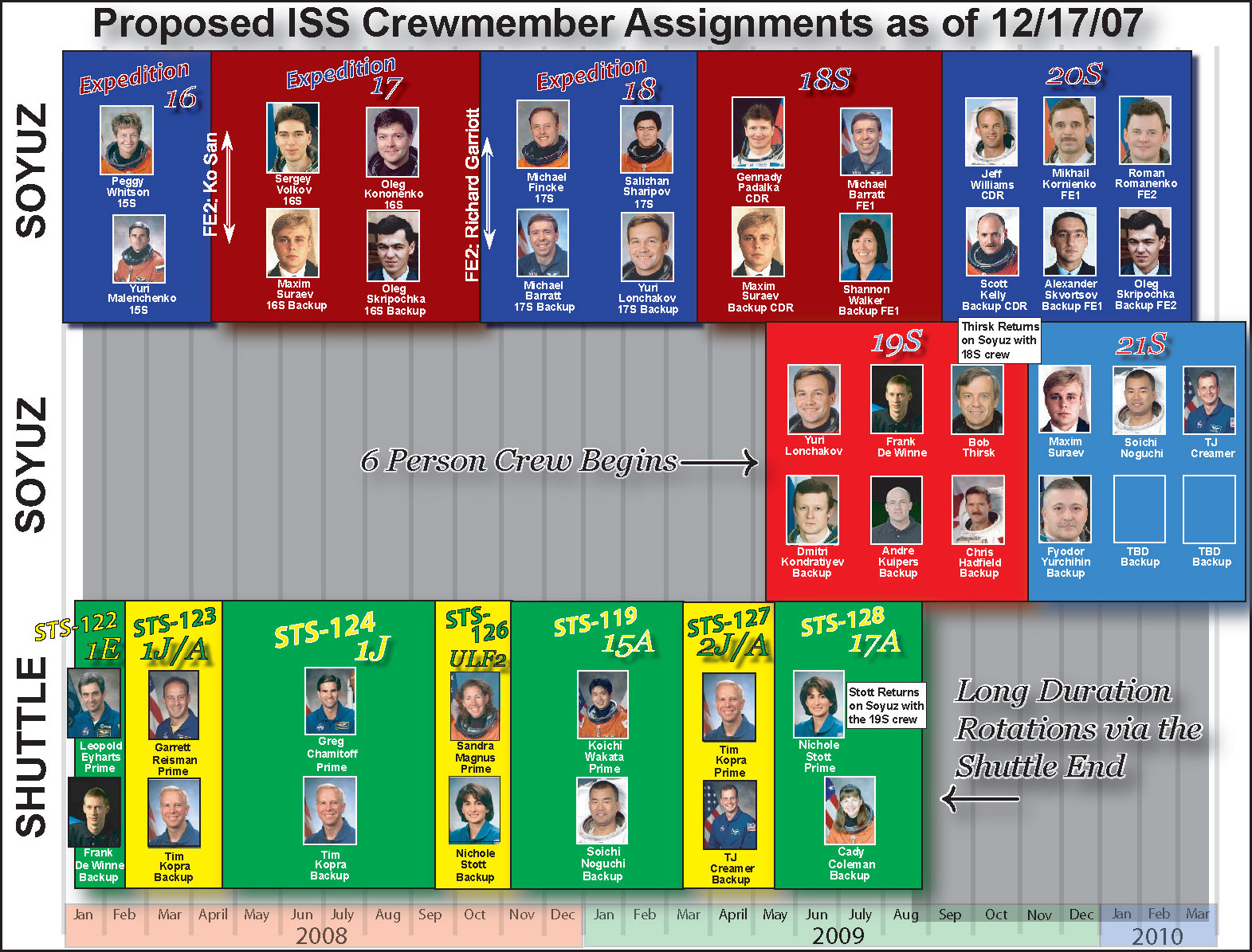
Sergei Krikalyov seems to have been dropped from the Soyuz TMA-14/ISS-19 crew as commander; he is no longer in the latest ISS flight crew roster up to ISS-21, though the roster is not yet finalized. (Via Olaf and this thread at the Novosti Kosmonavtiki forum, posted in August.) So perhaps he was moved to a later mission? Or will he be in management for a few years, though he is still an active cosmonaut?

ISS cosmonaut roster, December 2007
Expedition Prime crew Backup crew
ISS-17 Sergei Volkov, Oleg Kononenko Maksim Sura’ev, Oleg Skripochka
ISS-18 Salizhan Sharipov Yurii Lonchakov
ISS-18S (6-person crew begins) Gennadii Padalka Maksim Sura’ev
ISS-19S Yurii Lonchakov Dimitri Kondrat’ev
ISS-20S Mikhail Kornienko, Roman Romanenko Aleksandr Skvortsov, Oleg Skripochka
ISS-21S Maksim Sura’ev Fyodor Yurchikhin

Anatoly Zak has a new article on his website: “Russian space program: a decade review (2000-2010)”, 3/1. After the near-catastrophic social turmoil in the 1990s, Russia’s space program is slowly being reinvigorated, but it is dangerously dependent upon continued high oil prices for most of its funding.