Friday, 25 January 2008

30 years of Progress

Energiya press release: 20 January 2008 marked 30 years since the launch of the first Progress cargo ship. The Progress ships have served the Russian space program reliably (and mostly been ignored in the media). ESA’s Automated Transfer Vehicle cargo ship uses Russian propellant and tanks in its design, and the first launch is currently set for 22 February. It will dock to the aft of the Zvezda Service Module.

(Tass newspaper frontpage via Novosti Kosmonavtiki)

From Novosti Kosmonavtiki news №679:

20/01/2008/08:35 – Russian scientists will conduct a series of experiments to investigate the Moon, including the use of Japanese instruments

The project “Luna-Glob” (Luna-Globe) is planned to solve complex research tasks for the Study of Earth satellite, said Lev Zelenyi, the director of the Institute for Space Research at the Russian Academy of Sciences. The project “was broadened. It includes several phases, including the dumping on the surface of the Moon of so-called penetrators to study our satellite,” said Lev Zelenyi.

He explained that penetratory (impact penetrating probes) are planned to be fired from the automatic spacecraft, which will be placed in the Moon’s orbit. The probes under the action of lunar gravity will drive away also at a high speed and enter into the soil of the Moon at the depth of several meters. The on-board sensors, which operate from autonomous power supplies, can transmit information about the composition and the properties of lunar soil, and the seismic characteristics of Earth’s natural satellite. “It was decided to use penetrators of Japanese production, since the Russian technologies in this region can be considered lost,” reported L. Zelenyi.

Besides the use of impact probes, the “Luna -Glob” project provides for the launch of lunar orbital apparatuses, and over the long term and the creation of a rover landing station, which will travel across the lunar surface.

The equipment installed on the orbital devices, in the words of L. Zelenyi, in particular, will have to investigate the exosphere of the Moon, the space around it, and also magnetic and gravity anomalies whose nature is not yet clear.

Furthermore, on the orbital lunar apparatus will be established the instrument “LORD”, designed to study ultra-high-energy cosmic rays. The device would capture elementary particles with enormous speed and energy. Under normal circumstances, such a particle can not be caught by any devices, since they can easily pass through layers of any substance. The “LORD” instrument will recover those particles of superhigh energies, which “after piercing” the Moon, will be slowed down, said L. Zelenyi.

The China gambit”, The Space Review, 21/1. Article by Dwayne Day on how the USA could involve China in its space program (mainly the ISS) and use such involvement as leverage against Russia should the latter country become hostile and deny astronauts access to space via Soyuz flights once the Shuttle program is shut down. A pragmatic plan I guess, though it comes across as somewhat patronizing; of the dominant country “managing” others. Equally, Russia and China could team up to “manage” the USA! So it’s a 3-way game.

Manber’s proposal is clever and thought-provoking. He has not simply proposed cooperation with China for its own sake, or even for the benefit of improving relations with China, but to use such cooperation as a lever against the Russians. This is not the first time that someone has proposed that encouraging China in space could have strategic benefits for the United States—four years ago I wrote about the benefits of a cooperative/competitive space race with China (see “The benefits of a new space race”, The Space Review, April 26, 2004), suggesting that we encourage them to spend money on human spacecraft instead of missiles. But Manber is apparently the first to suggest that we use China to moderate the Russians, something that Nixon gained as a side benefit of his China rapprochement nearly four decades ago.

“Russia To Raise Space Funding, Build New Space Center”, 22/1, RIAN/Space Daily. Space funding is to be raised by 13% (doesn’t say the actual amount).

Russian space center to launch boosters”, Space Daily, 23/1. The new Vostochnii space center will be built near Uglegorsk in the Amur region of eastern Russia. Manned flights are expected to begin by 2018.

Ivanov Says Russia Must Not Turn Into Space Cabman”, Space Daily, 24/1. Russia shouldn’t rely on revenue from launches of foreign satellites for most of its space funding, and should focus on creating the new space center, Vostochnii, to ensure the country’s access to space (rather than risk being blackmailed by Kazakhstan, which leases out Baikonur to Russia).

Thursday, 17 January 2008

Mars over Moscow

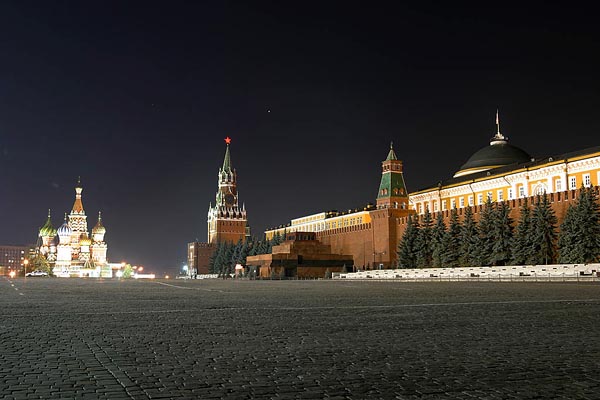
In this nicely symbolic photo by Seiji Yoshimoto at the NPO Intercos site, the red planet Mars is visible over the red star of the Kremlin! (Full photo page of Moscow scenes here – there are a lot of high-resolution photos on the one page.) Let’s hope that is a good omen! (As in landing there one day.)

From Novosti Kosmonavtiki news №677:

10/01/2008/00:02 – The cost of the Mars flight simulation experiment will exceed 15 million dollars

The total cost of the Russian project on the “Mars-500” flight simulation to the Red Planet, which will take place at the site of the Institute of Biomedical Problems (IMBP, Moscow), will exceed 15 million dollars, reported the project leader, the first deputy director of IMBP Victor Baranov. “If some additional expenditures appear, then general expenditures will be increased,” he added.

Among the first unplanned expenditures V. Baranov named was the elimination of some deficiencies and observations, that were revealed in the activities of the experimental complex during the daily technical experiment carried out during November. He also reported that the material reward of volunteers for the participation in the “Mars-500” experiment will compose 50 thousand Euros. This number was announced by the European space agency, which participates in the experiment. “We have an understanding with ESA that the payment for the Russian and European participants must not differ,” said V. Baranov.

He also did not exclude that the basic material reward of the highly professional participants will be above average. According to V. Baranov, there was also discussed the question of encouragement by rewarding those participants who carry out the experiment more honestly. “But this question will be linked with the personal contracts with each of the testers,” the Russian scientist specified.

The Mars flight simulation experiment will be prolonged more than 520 days – precisely this many days will be required in order to fly so far to the planet, to spend 30 days on its surface and then to return. All this time the six testers will be located in the isolated modules, fulfilling the functional duties of participants in the Martian expedition. Two participants in the experiment will be selected from ESA, which signed with the Institute of Biomedical Problems (IMBP) of RAN (Russian Academy of Science) an agreement on participating in the project. Four more will be selected by the IMBP specialists.

Russia set to develop new launch vehicle despite problems”, RIAN, 11/1. The Angara rocket is supposed to launch from the «Восточный», Eastern space center, but the rocket has yet to be developed.

Monday, 7 January 2008

Mars-500 updates

Mars-500 Simulated Space Mission”, 24/12: image gallery at RIA Novosti. The latest issue of Novosti Kosmonavtiki magazine, №1 2008, has an article about the recent Mars-500 experiment on its site: «В ИМБП стартовал проект «Марс-500»», “IMBP began the Mars-500 project”, including an interview with cosmonaut Sergei Ryazanskii (use Babelfish for a rough translation – the article is very long and I do not have the energy to struggle to correct the translator’s convoluted attempts!).

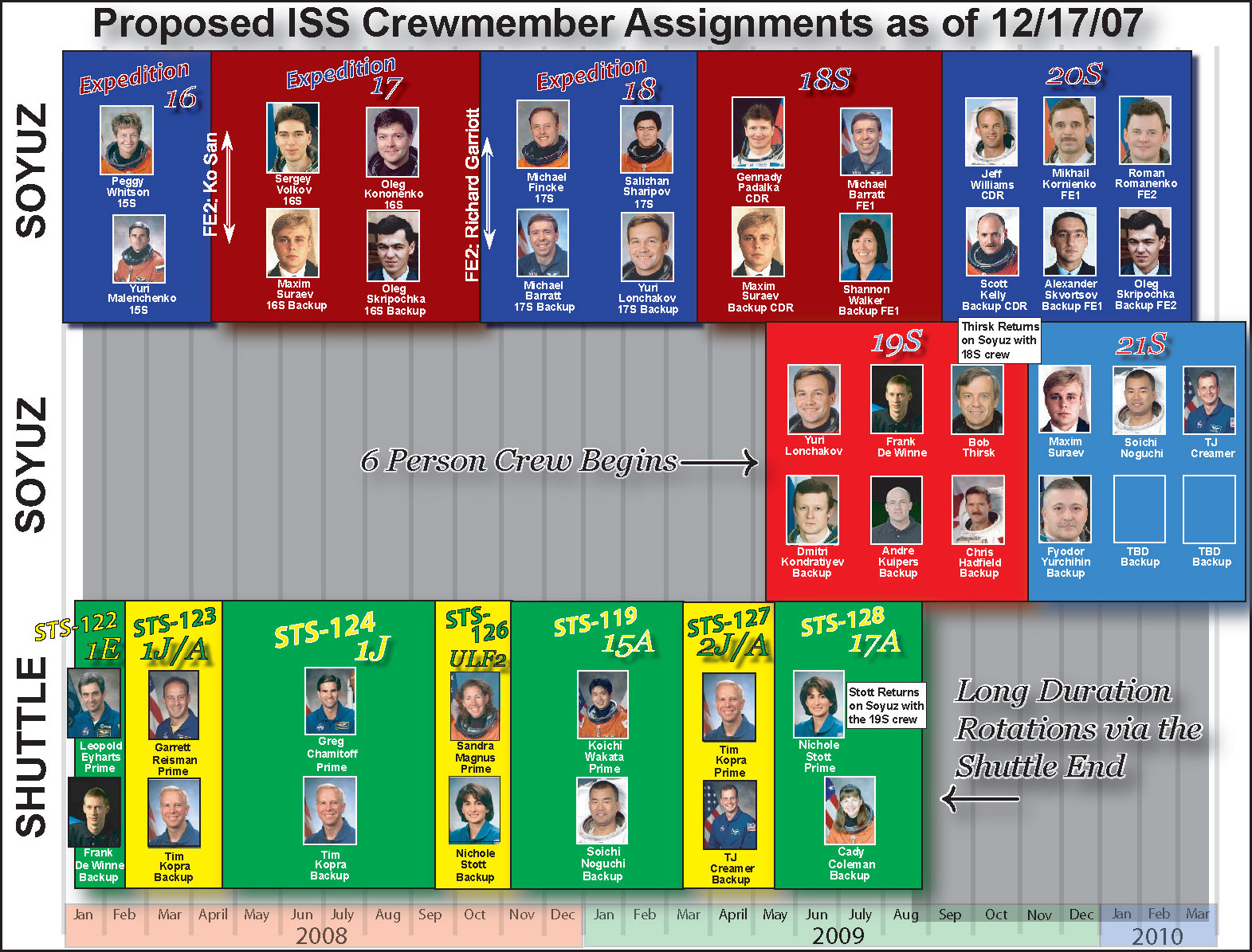
Sergei Krikalyov seems to have been dropped from the Soyuz TMA-14/ISS-19 crew as commander; he is no longer in the latest ISS flight crew roster up to ISS-21, though the roster is not yet finalized. (Via Olaf and this thread at the Novosti Kosmonavtiki forum, posted in August.) So perhaps he was moved to a later mission? Or will he be in management for a few years, though he is still an active cosmonaut?

ISS cosmonaut roster, December 2007
Expedition Prime crew Backup crew
ISS-17 Sergei Volkov, Oleg Kononenko Maksim Sura’ev, Oleg Skripochka
ISS-18 Salizhan Sharipov Yurii Lonchakov
ISS-18S (6-person crew begins) Gennadii Padalka Maksim Sura’ev
ISS-19S Yurii Lonchakov Dimitri Kondrat’ev
ISS-20S Mikhail Kornienko, Roman Romanenko Aleksandr Skvortsov, Oleg Skripochka
ISS-21S Maksim Sura’ev Fyodor Yurchikhin

Anatoly Zak has a new article on his website: “Russian space program: a decade review (2000-2010)”, 3/1. After the near-catastrophic social turmoil in the 1990s, Russia’s space program is slowly being reinvigorated, but it is dangerously dependent upon continued high oil prices for most of its funding.

Sunday, 23 December 2007

Russia-bashing

NASAWatch notes the excessive “Russia-bashing” contained in this Bill being put forward by a Congressman Weldon to prolong the operations of the Space Shuttle to 2015 (rather than the current end date of 2010). “RUSSIA IS NOT A RELIABLE PARTNER”, etc… (There is a long discussion thread at NASASpaceflight.com.) What a Paranoid Patriot Weldon is (a Republican, not surprisingly)! The thought of someone like him becoming U.S. President is dismaying!

Progress M-61 undocked from the ISS yesterday (22/12) at 3:57 UTC. It will remain in autonomous orbit for about a month, performing a series of technical experiments. Progress M-62 launched today at 7:12:35 from Baikonur.

12 December: Cosmonaut candidates visit the Khrunichev Center

Today, for the purpose of acquaintance with the activities of one of the most important enterprises of the rocket-space industry, the cosmonaut candidates and the instructors of the Yu. A. Gagarin Cosmonaut Training Center visited GKNPTs Khrunichev.

The state space scientific and industrial center named after M.V. Khrunichev was selected on purpose. The old enterprise has almost a half-century length of employment in the field of creation and operation of rocket-space technology.

The Center has a special role in the implementation of the manned programs of the USSR and Russia. Here was created the “Salyut” orbital manned stations and the TKS transport supply ships, the large-dimension modules for the Mir orbital complex, and the FGB Zarya and SM Zvezda modules for the International Space Station. At present, according to the ISS program, work is conducted here on the creation of the third module, the Multifunctional Laboratory Module.

The manager of the rocket-space plant, Victor Latyshev, described all this to his guests. The instructors of TSPK – V. Kolyasnikov, A. Radchenya and A. Larin – and also the cosmonaut candidates O. Novitskii, A. Ovchinin, S. Ryzhikov, A. Misurkin, M. Ponomarev, E. Serova and N. Tikhonov visited the assembly shops of the space center, and with their eyes they saw the process of assembling the “Proton-M” heavy carrier rocket, and boarded the full-scale copy of the legendary complex Mir.

Taking into account that the encounter in GKNPTs Khrunichev passed on the threshold of the New Year, the center management presented memorable gifts to the cosmonaut candidates.

«Кандидаты в космонавты посетили Центр имени Хруничева», Khrunichev.

Tuesday, 4 December 2007

Redesigning space sites

NASA’s website launched a newer, more modern design on 30 November - it looks much nicer and the clunky HTML table layout has been dumped at last! (The site does, however, require Javascript to display properly, and takes nearly a minute to load on broadband because of the huge amount of JS files loaded.)

Now if only the Russian space websites would redesign and upgrade! Some quick observations:

  • Energiya: site appearance is neat and somewhat conservative, but the HTML layout consists of old-fashioned tables and is a bit messy.
  • Federal Space Agency: tables layout and navigation requires Javascript to function, so it is not very accessible.
  • TsUP: design looks outdated (color scheme is not very attractive) and the site menu is Javascript-based, so without this enabled the site can’t be accessed
  • IMBP: ugh! Uses frames and an image map. Very outdated and totally inaccessible.

News tidbits:

Mark Wade has abandoned his Pausanius blog. He sounds as disillusioned as I do, though for different reasons.

AstroMom and Basstronaut, revisited”, The Space Review, 19/11. What happened to the space-tourists-who-weren’t, Lori Garver and Lance Bass. To me it was another example of how dismally avaricious the Russian space program has become – the word that come to mind is “prostitution”.

Russia To Launch Manned Spacecraft From New Site In 2018”, Space Daily, 22/11. The new site is to be called Восточный, Vostochnyi (“Eastern”), so you can guess in what direction it is located. Baikonur will continue to be used until at least 2020.

Ivanov confirmed that Russia would continue to use the Baikonur launch site until at least 2020, and would also build new facilities at the Kazakh center under the joint Baiterek project to support launches of the future Angara family of launch vehicles.

At the same time, the first deputy premier called for urgent measures to develop the country as a leading space power rather than to turn it into a provider of launch services for other countries. “I would like to stress that Russia should not turn into a country providing only launching services – a kind of space hauler, although this alarming trend has been taking shape lately,” Ivanov said. “This trend may become a reality, unless proper measures are taken urgently to develop all aspects of space activities,” he said.

On 15 November, Space Adventures offered anyone who could come up with the $3 million fee a chance to train as space tourist Richard Garriott’s backup. The contender was announced in the 26/11 Herald-Sun: a 38-year-old Australian businessman, Nik Halik. (Note that the article might disappear.) I have not seen this mentioned anywhere else yet.

“Russia Conducts First Experiment In Preparation For Mars-500”, RIA Novosti/Space Daily, 30/11. A short test of the modules was conducted by a Russian crew (5 men, 1 woman) from 15-29 November. There is disappointingly little information on the Mars-500 site, though.

Novosti Kosmonavtiki news №669 has a more detailed report on the recent completion of the first Mars-500 short test run, including short biographies of the participants, who all have intimidatingly impressive qualifications. (Yes, I am envious of them.)

30/11/2007/00:03 – Flight to Mars from the Khoroshevskogo highway of the capital city

Within the framework of the “Mars-500” project – an international crew flight simulation to the Red Planet – the Institute of Medical and Biological Problems of the Russian Academy of Science held a two-week experiment involving six testers.

The purpose of the two week experiment, which was conducted in IMPB RAN with the active assistance of the Federal Space Agency, was checking the conformity of the technical and operating characteristics of the modules and their systems to the requirements of the developed technical and operational documentation under the conditions maximally approximating real operation. The experiment was conducted in two modules of the medical-technical complex: EU-150/ЭУ-150 (habitable module with a volume of 150 m³) and EU-100/ЭУ-100 (medical module with a volume of 100 m³). In the course of the experiment, the crew lived and worked in these completely isolated modules. During the experiment was tested newly-developed life-support systems, monitoring and control, information management and the local tele-medical network.

The experiment began on 15 November at 11:00 and was completed on 29 November at 14:00.

The crew successfully managed the tasks entrusted to it. During 14 days there was performed the estimation of modules and their systems in terms of their suitability to conducting of the more prolonged experiments, which are part of the Mars-500 program.

The deputy chief of the Federal Space Agency, V.A. Davydov, and the chief for the administration of the manned programs Roskosmos, A.B. Krasnov, became acquainted with the progress of the experiment and the work of the support systems during a visit to IMBP on 22 November.

The experiment was attended by major developers: ФГУП ЦЭНКИ/FGUP TsENKI, ЗАО МИУС/EAO MIUS, ОАО ВНИСИ/OAO VNISI, ОАО НИИХИММАШ/OAO NIIKhIMMASH, ФГУП ЦНИИМАШ ЦУП-МФ/FGUP TsNIIMASH TsUP-MF, ЗАО ЦВТ/EAO TsVT. During the experiment some elements of the crew uniforms were tried, designed and provided by ЗАО НПО «Динафорс»/EAO NPO “Dinafors” working within the framework of the partnership program for the project “Mars-500”.

The crew consisted of five men and one woman:

  • Artamonov, Anton Anatol’evich/Артамонов Антон Анатольевич (1982). Engineer physicist, and IMBP engineer-programmer. After graduating from the physical chemistry department of Moscow Institute of Steel and Alloys, he specialized in the department of theoretical physics in the region of the superconductivity of nanomaterial. His research interests are the properties and the functioning of muscular apparatus, and the application of laws governing physics of materials in biomechanics. At present he works on his thesis.
  • Artem’ev, Oleg Germanovich/Артемьев Олег Германович (1970). Mechanical engineer, he graduated as RKK Energiya engineer and finished at N.E. Bauman MGTU. His specialization is technology and low-temperature physics. After the successful completion of general space training, he obtained qualified as a cosmonaut-researcher and was enrolled as a cosmonaut-tester in the RKK Energiya group, specializing in extravehicular activity. Has a number of publications in this region.
  • Kovalev, Aleksandr Sergeevich/Ковалев Александр Сергеевич (1982). Engineer, works in the telemedicine laboratory at IMBP. He graduated from the MAI in the specialty “Engineering in the biomedical practice”. He participated in the experiments on the study of the influence of the simulated effects of microgravity on the human organism. His scientific interests are the influence of the extreme conditions of living environment on the cardiorespiratory system of the body.
  • Perfilov, Dmitrii Vladimirovich/Перфилов Дмитрий Владимирович (1975). Doctor, works in the IMBP telemedicine laboratory. Graduated from Moscow Medico-stomatological University, specializing in therapeutic matter. Upon completion of his clinical internship, he qualified as a therapeutist and has additional qualification as a anesthesiologist-resuscitator. Scientific interests: pain sensitivity by changing the factors of space flight, which assumes the possible correction of the existing scheme of the treatment of cosmonauts.
  • Ryazanskii, Sergei Nikolaevich/Рязанский Сергей Николаевич (born 1974), expedition commander. Graduated from the Faculty of Biology of Moscow State University named after M.V. Lomonosov in the specialty of biochemistry. In 2005, after completing training he received general space training and cosmonaut-researcher qualifications. He is a member of the Bioethical Commission SRC RF IMBP-RAS. According to the results of studies performed, he has published 19 works, and made 12 reports, eight of them in international conferences. In 2006, he defended his candidate’s thesis on the specialty “physiology” and “aviation and space medicine”.
  • Tugusheva, Marina Petrovna/Тугушева Марина Петровна (1983). Biologist, Researcher IMBP. She graduated with honors from the biological department of the Tverskii State University in the department “Anatomies and physiologies of man and animals”. After completion of university she was invited to undertake full-time post-graduate study at GNTS RF of the RAN Institute of Biomedical Problems in the specialty “Aviation, space and sea medicine”. She is at present a graduate student in her 3rd year of learning and a scientific worker in the division of Barophysiology and Diving Medicine. She participated in the conferences of young scientists in the years 2006-2007, in the 8th International Congress for Adaptive Medicine in 2006, and also in 2007 in the I.P. Pavlov Congress of the Physiologists and the “Cosmos and Medicine” conference . She has repeatedly participated in experiments.

(A blog gripe: I hate having to think up a title for each blog entry; I find it hard to come up with anything, sometimes!)

Sunday, 18 November 2007

7th International Scientific Conference reports

The Russian FKA site has a page of children’s space paintings, which are colorful and imaginative!

Some Novosti Kosmonavtiki news №666 items for 16/11; reports from the 7th International Scientific Conference “Manned Flights into Space”.

16/11/2007/00:03 – ISS operations are considerably less effective than those on Mir, says the chief of the Cosmonaut Training Center

In six years of ISS operation the volume of scientific works at the station grew threefold, reports ITAR-TASS. Such data was announced on 15 November by the chief of the Cosmonaut Training Center, Vasilii Tsibliyev, at the opening of the 7th International Scientific Conference “Manned Flights into Space”.

“Since 2001, 240 different experiments were carried out on the ISS, the main themes of the NPI applied-scientific studies being biomedical, biotechnological, geophysical and physics of the sun,” he said.

Tsibliev, however, recognized that by volume the NPI ISS operation is considerably less effective than that of the Mir orbital complex, where each crew perfomred up to 250 experiments during the flight. In his opinion, “When the construction of the Station is finished, the science portion will grow.”

The TSPK chief focused attention on the problems which decrease effectiveness of NPI on the ISS. One of the basic problems: “searching for the necessary scientific gear aboard,” because of which “sometimes an experiment is not carried out by the crew for which it was prepared, but a following crew […] There has even appeared a joke: an engineer is not one who knows, but who knows where to find things,” noted Tsibliyev. In his opinion, for increasing the return of scientific work “it is necessary to develop more efficient mechanisms for crew accountability, more actively to use incentive leverages, including material from both the cosmonauts and the specialists who prepare experiments, and to also prepare cosmonauts as specialist researchers.”

The chief of the flight-test center of the Energiya Rocket & Space corporation, ISS-14 commander Pavel Vinogradov, in turn emphasized that the colossal scientific potential in space is used very poorly, the returns from ISS crew activity is considerably lower than 10-15 years ago. “From the idea of experiment to obtaining the first concrete results there passes years, and even decades,” the cosmonaut complained. Furthermore, “There are only 1 or 2 new, bright experiments on the ISS; the rest are repeats of those performed on Mir.

One of the basic problems, in his opinion, is the absence on the ISS Russian segment of a normal communication channel with the Earth. “That that we have is the Stone Age in comparison,” said Vinogradov. To work and not to have any possibility transfering acceptable volumes of information is unacceptable.” Furthermore, the cosmonaut issued a call for the producers of the experiments to support closer contacts with the crews and to inform them about the results of the onboard studies carried out by the crews. In the opinion of Vinogradov, if scientists and cosmonauts exchanged information more often, the effectiveness of scientific studies would improve.

The cosmonaut also noted that at present, “scientific gear occupies only a small percentage of general goods traffic […] when half of the Progress cargo ship will be loaded with science, we will begin to obtain real results,” Vinogradov is convinced.


16/11/2007/00:03 – since 2001 the quantity of experiments conducted on the ISS has grown three times

In six years of ISS operation, the quantity of scientific experiments conducted by crews has grown threefold. The crew of the 16th ISS Expedition will conduct 48 scientific experiments in the course of their flight, while the first crew conducted only 15, reported the leader of the Cosmonaut Training Center, Vasilii Tsebliev, at the opening of the 7th International Scientific Conference “Manned Flights into Space”.

Meanwhile cosmonaut Pavel Vinogradov, coming forward after he critically answered about the experiments conducted on the Station, said: “We repeat the fact that most were done 5-10 years ago. The experiments – two or three are new but not more […] in this sense I do not agree with the opinion of our leaders that everything is good. When half of the Progress cargo ship is loaded scientific gear, then only then will I agree that everything is good,” said P. Vinogradov.

Today, he noted, in the total volume of cargo delivered to the ISS, only a small percentage is allotted to scientific equipment. Furthermore, P. Vinogradov came out with criticism of the communications system of the ISS Russian segment with the ground. Thus, because of the absence of the specialized relay satellites, video images and data for Russian Mission Control Center TsUP during the presence of the ISS beyond the zones of radio visibility not controlled by Russia are downlinked via the American satellites (TDRSS).

Cosmonaut Pavel Vinogradov had a lot of criticisms about aspects of the Russian program in an NK interview last year (see my 14/1/2007 entry) – at least someone involved is trying to draw attention to this!

A report on preparations for the “Mars-500” experiment:

16/11/2007/00:03 – crew of volunteers begins checking the systems of the “Martian ship”

At the Institute of Biomedical Problems IMBP/RAN (Russian Academy of Science), on 15 November there began the first 14-day stage of the experiment on the preparation of the manned space flight to Mars. The IMBP deputy director, Boris Morukov, announced this at the 7th International Scientific Conference “Manned Flights into Space”.

Previously the IMBP director, the RAN Academician Anatolii Grigor’ev stated that prior to the beginning of the “manned space flight to Mars”, which was planned for the end of 2008, at IMBP two preliminary experiments will be carried out: a 14-day and a 105-day. “During the 14 days we will verify technical equipment, and then in the 105-day experiment we will conduct the selection of the Russian and European scientific proposals, which then will be realized in the ‘Mars-500’ program,” he explained. According to him, the international crew of the 105-daily experiment will be formed prior to the end of this year, which will begin in the beginning of 2008.

In parallel continues the intensive selection of basic crew for the “Martian flight”, that will comprise 4 Russians and 2 Europeans. The main requirement for the candidates are possession of Russian and English languages, outstanding physical fitness and professional qualifications in several specialties is desirable.

Grigor’ev noted that among the aspirants, whom they already passed dispensary inspection, there is one woman. However, the gender composition of crew will be determined not earlier than the end of 2008, when it is planned to promulgate the list of the happy fellows, who during 520 days will completely isolated from the external world aboard the created “Martian” ship in IMBP with a volume of 550 m³ and communicate with the external world only through electronic mail. All the life-support systems of the “ship” are designed to be completely independent.

Requirements for the international crew are most serious. Preferred professions are doctors, engineers, biologists, specialists in computer technology. Moreover it is desirable that the candidates would combine several specialties. Furthermore, they must provide proof to the selection commission of the absence of serious diseases, harmful habits and problems with the law.

Future projects at Khrunichev:

16/11/2007/00:03 – the Khrunichev space center is developing rockets for manned space flights and habitable complexes for the lunar and Martian expeditions

In the State Space Scientific Production Center GKNPTS Khrunichev, work is continuing on the creation of rockets for manned space flights and habitable complexes for lunar expeditions. The division head of KB Salyut GKNPTS, Sergei Pugachenko, reported this on 14 November at the 7th International Scientific Conference “Manned Flights into Space”.

The discussion, first of all, deals with the modification of the future rocket of the RN carrier of the Angar-5 heavy class. The Angar-5P “can be used for the launch of manned ships, including the following generation.” For the delivery of cargo to Low Earth Orbit it is intended to also use the superheavy Angar-7 with a load capacity of 41 tonnes.

But to deliver a crew in orbit is only half the battle; it is necessary to create standard conditions to support human life. In GKNPTS, where the first ISS module was built – the Functional Cargo Block Zarya, and also the airtight housing of the official module Zvezda – already they are working on a new, more contemporary inhabited module. “Over the long term the creation and installing on the RN Angara “of a housing of a larger volume, which will improve the conditions of crew stay aboard,” explained Pugachenko.

Furthermore, the specialists at GKNPTS are developing their versions of a lunar orbital station and manned lunar base, which is intended to be delivered into Earth orbit with the aid of a superheavy RN with a load capacity of 100 tonnes. The lunar orbital station will be intended for the transfer and the storage of cargo and fuel, temporary crew stay, and also studies of the Moon, explained Pugachenko. But the manned lunar complex will serve as a home for the cosmonaut-trailblazers. An analogous complex is also being developed for Mars. “In GKNPTS there are all the basic technologies for the lunar missions,” said Pugachenko.

Monday, 12 November 2007

Russian Mars plans

“The appeal of Mars”, RIA Novosti: Parts 1, 2, 3. A series by Yuri Zaitsev concerning Russian plans for Mars missions.

Ex-Energiya president Nikolai Sevastyanov believes the Martian project could be realized after 2025 and would consist of three stages: a trial expedition around the Moon, a non-landing manned expedition to Mars and then a manned Mars landing. Anatoly Perminov, head of the Russian Space Agency (Roskosmos), said: “We are planning a Mars mission after 2035.” The ultimate decision is likely to be made at the top. Before the year is out the government must approve a program for the development of the space industry until 2040.

[…]

Technically speaking, a manned mission to Mars would be no more difficult than a flight to the Moon. Experts believe that the hardware required for reaching the Red Planet is largely already available. But it is the human element that is both the most important, and the most vulnerable, part of the mission. Before sending astronauts to Mars, scientists will have to solve the numerous medical and biological problems associated with deep space flight.

[…]

U.S. experts estimate the cost of a manned mission to Mars at $500 billion. Russia believes it can place cosmonauts on the planet’s surface in the next 12 years for just $14 billion, a sum roughly equivalent to 10 national space programs. However, this would entail a doubling of federal space spending and the launch of several unmanned reconnaissance probes to explore Mars in greater detail. Nikolai Anfimov, a member of the Russian Academy of Sciences and Director General of the Central Research Institute of Machine Building (TsNIIMash), believes the total cost of the manned Mars mission would run to over $100 billion.

2025 or later is much too far away! How about…2015? I reckon a simple mission could be done for…under $10 billion? A test mission around Mars (but not landing on it) could be done for maybe $3 billion or so:

  • A crew of two (possibly suicidal!) cosmonauts who don’t mind the possibility of long-term damage to their health, or dying – the tradeoff is they would be forever remembered in history (first humans to leave the Earth-Moon system!).
  • Mission profile based on the one at Energiya (12 months to Mars, 1 month around/on Mars, 11 months back).
  • Spaceship based on the Russian ISS modules with a nuclear reactor (of the Topaz-2 type) that provides power for the engines (rather than the huge solar array in the Energiya plan). There would be no means of artificial gravity (designing this would incur extra expense).
  • Progress launches to bring up supplies (don’t know how many would be needed).
  • Soyuz spaceship used to fly crew up to the interplanetary spacecraft, and later back to Earth (need to have a 2-year lifespan).
  • A small automated probe could be used to retrieve Mars surface samples.
  • Developing a Mars lander would add extra time to the mission preparations.
  • Upcoming Mars launch windows (low-energy type): December 2009, February 2012.

My bargain-basement Mars mission! So, build a spaceship and go! Enough with the fussing around – after 40 years or so of spaceflight we know the effects of weightlessness on mental and physical health, so how many more studies do they need? Accept that there will be risk to the crew, and just go. (Yes, I am impatient.)

More articles of interest:

“Protecting Earth Against Asteroids”, Part 1 & 2, Space Daily. Russian ideas for trying to deflect threatening asteroids.

Does Russia Have A Nuclear Engine Advantage?”, Space Daily, 5/11.

Wednesday, 31 October 2007

A year old

It is just over a year since my first entry (20/10/2006). The blog is not exactly hugely popular, either because I am too boring or no one is interested. Or both. Oh, well.

A news roundup:

China launched its first lunar orbiter, Chang’e 1, on 4 October. If China can do this, why can’t Russia?

Russians blast off without space pistol”, Guardian, 15/10. “Russia is sending a cosmonaut into space without a fearsome triple-barrelled ‘space pistol’ for the first time in 20 years, due to a shortage of ammunition.” Yurii Malenchenko is instead taking a normal pistol/handgun.

Giant leap looming for womankind”, MSNBC.com, 20/10. “It will be the first time in the 50-year history of spaceflight that two women are in charge of two spacecraft at the same time.” I grumbled about Russia’s dismal failing in this area in my previous 16/10 entry.

Soyuz TMA-10 landed at 10:36 UTC on 21 October after undocking from Zvezda at 07:14. There was a glitch when the computers for some as-yet undetermined reason switched to the backup, automatically controlled ballistic descent mode, which imposes higher g-forces on the crew.

Back in the Space Race: Russian Revival Raises New Questions”, Moscow News, 18/10. NASA’s dependence on Russia for manned space access after the Shuttle retires could become a problem if Russia’s plans change or U.S.-Russian relations become tense. Security at the Baikonur launch site is also an issue (as well as the future of the complex itself) – James Oberg wrote an article about it at The Space Review last year: “Earthly threats for a spaceport”, 26/6/2006.

“China eyes the Moon”, RIAN/Space Daily, 25/10.

On October 4, with Russia and the U.S. apparently unable to do more than talk about flights to the Moon, China, strictly on schedule, launched a Long March 3A rocket carrying the satellite Chang-e 1 on a mission to map the Moon’s surface.

Two women spacecraft commanders: the meaning of the meeting”, James Oberg, The Space Review, 29/10. Mentions the issues on Russia’s attitude towards women in space grumbled about in my previous entry.

Tuesday, 16 October 2007

Soyuz TMA-11 launched, and a rant

Soyuz TMA-11 launched on 10 October at 13:22:39 UTC/11:22:39 p.m. Melbourne time with Expedition 16 and the Malaysian guest cosmonaut on board. It docked on 12/10 at 14:50:05 UTC.

Depressing thread at CollectSpace on why there are currently no women cosmonauts (aside from the one currently in training, who might never make it into space). Quite a lot of men in the Russian space program deserve a punch in the nose – their attitude towards women just sucks. The Americans have now had female Shuttle commanders, and Peggy Whitson will be the first female ISS commander, and there is no questioning their competence. So why do Russian men have this archaic attitude that women are weak and inferior (“Does Mars need women? Russians say no”)? This attitude pisses me off in the extreme and is one reason I am disillusioned with their program (the other being the focus on space tourism at the expense of exploration – though they don’t seem to have a problem with flying paying foreign female space tourists).

(On the Wikipedia “History of Women in the Military” page is a mention of military women in Russia. Women fought well in combat in World War 2. But I was disgusted to read: “Today, the Russian army runs the Miss Russian Army beauty contest for attractive female Russian soldiers. Colonel Gennady Dzyuba, of the Defense Ministry, said of the 2005 contest that ‘Those who have served, especially in hot spots, know the importance of women in the armed forces.’ ” Beauty contest?! WTF is with that bullsh*t?? No wonder women aren’t regarded seriously!)

Space Station: Internal NASA Reports Explain Origins of June Computer Crisis”, James Oberg, IEEE Spectrum October 2007.

Thursday, 4 October 2007

Anniversaries

Today is 50 years since the launch of Sputnik.

In that BBC article it is noted that the Russian space program “have been given $12bn (£6bn) to spend over the next decade – a small amount compared with NASA’s budget but enough for the Russians to have ambitious plans.” NASA’s budget for one year is about $16 billion.

More articles from the past couple of weeks:

“Russia aims for new far east space launch pad by 2020”, The Raw Story, 21/9; RIAN 26/9.

From Novosti Kosmonavtiki news №655:

25/09/2007/00:01: The head of Roskosmos is convinced that it is necessary to more actively involve young cosmonauts from the Russian force

The leader of the Roskosmos Federal Space Agency, Anatolii Perminov, is convinced of the necessity of more actively involving young cosmonauts from the Russian force. About this he stated on Thursday during the traditional tea drinking with the prime and duplicating crews of the 16th Expedition to the ISS, reports ITAR- TASS.

After noting that the “Cosmonaut Training Center and Rocket & Space Corporation Energiya insure themselves by sending experienced cosmonauts into orbit,” Perminov added: “but I always support those who have yet to fly, since I have no doubts that the young will manage.”

In the Russian group about two dozen astronauts have sat “on the replacement bench” for 10 years or more. They are habitually refered to as “young”, but most of these guys are over 30 years old.

But this 16th expedition, which starts on 10 October, will be very difficult; therefore it is good that an experienced crew flies, Perminov believes.

The next paying space tourist to go up will be Richard Garriott, in October 2008. He has a rather formidable CV, and is the son of former NASA astronaut Owen Garriott. Though as pointed out by a NASA Watch reader, he will be the second 2nd-generation astronaut to launch – Sergei Volkov (son of Aleksandr) will launch in April 2008 – not the first as reported by Space Adventures. He is also the creator of a rather nice-looking MMORPG called Tabula Rasa (I have been admiring the graphics on the site and wishing I could design things like that).

Game guru going into space”, Cosmic Log entry, 28/9.

50 years after Sputnik, Russia revives space ambitions”, Space Daily, 30/9.

As Russia commemorates the 50th anniversary on Thursday of the launch of Sputnik 1 and the start of the Space Race, there is a sense of cautious optimism among its space scientists, says Igor Lysov, an expert with monthly magazine Space Industry News. Next year, state spending on space is projected to equal about 1.5 billion dollars (one billion euros). As Lysov observes: “That’s 11 times less than the financing for NASA but 10 times better than the financing for the Russian space programme a decade ago.”

[…]

Nonetheless, uncertainty remains due to funding problems and Russia’s difficulties countering a brain drain of its most talented scientists, says the head of spacecraft designer RKK Energia, Leonid Gorshkov. “Even if commercial projects help us survive, the development of the space programme is impossible without state support,” said Gorshkov.

The discovered space”, RIA Novosti, 3/10.

2007 sees four space related anniversaries: 150 years since the birth of Konstantin Tsiolkovsky, the theoretician of cosmonautics, who translated the bold dream of space flight into maths; 110 years since the birth of Alexander Chizhevsky, the founder of geliobiology, a new field of research into the influence of solar and geomagnetic activity on living beings; 100 years since the birth of Sergei Korolyov, who put cosmonautics on a practical plane, and 50 years since the start of the space era, ushered in by the launch of the Earth’s first artificial satellite.

Russian science to ride on NASA probes”, MSNBC.com, 3/10. Plans for Russian science instruments to be installed on NASA probes to the Moon and Mars. The Russian unmanned exploration program seems to only exist in this form now – hitching rides on others’ spacecraft.

Found an article, “What’s Wrong With Libertarianism”, while wandering around the Hard Science Fiction site. There seem to be many people in the space community who proscribe these views (the ones who optimistically believe the private space industry will take over from governments in exploring space). I find Libertarianism a detestable philosophy – my view is that corporations and business cannot be trusted to ensure the public good – that is why we have governments.

An example of the space Libertarians is the Space Liberates Us! site (found via NASA Watch, who posted about a contributor who died). There is a place for private space exploration (mainly near-Earth space tourism), but I don’t believe it will ever replace government-funded programs.